“Lock your shit on chain u deepfake mf.”
This was one of many colorful tweets on my feed as my crypto coin crossed a half million-dollar valuation in its first hour of trading.
I’d spent the last 18 months making my first feature film, Coin. In the movie, two friends misappropriate campaign funds to launch a cryptocurrency.
I’d decided to make the coin in real life. Guerrilla marketing. Very meta. Very Thompson. Great. But how would I actually do that?
“I’m not learning how to fucking code, man,” was the lingering thought brake-checking this idea for the past year.
Turns out, it’s not that complicated to launch a crypto coin in 2026. I’d learn that soon.
----//----
I began trading cryptocurrencies in 2016, while working in the strategic claims department of an insurance company, my first job out of school.
The legacy insurance cubicle is difficult at 22. I was bored as hell.
I first purchased Bitcoin at $710. I was so early to the party, I left before it started.
Alternative coins were almost entirely unknown. Trading them on foreign crypto exchanges was for gamblers.
I remember taking a selfie on my Samsung Galaxy S3 with my driver’s license and sending it to an obscure Chinese email address for verification and platform access. Totally legit.
If you showed up at my office then, you would have found me ducked in a cafeteria booth, trading alt coins on Binance. The insurance company didn’t give me enough to do.
At this time, I had never read a screenplay, let alone written one. But in the hours that I was in my cubicle, I wrote bits, jokes and plot lines into Microsoft Word – fragments of my first narratives.
----//----
I’d long been drawn to financial risk, a scholastic term which predominantly presented itself in the form of gambling.
I was introduced at a young age through garage poker games. Diverted evolutions of the character present at blackjack tables or six-screen financial desks. An attraction to the latter idea, paired with a misguided sense of the nobility of men in suits working long hours, led me to enroll as a master’s student in the financial risk program at the University of Connecticut.
I’d sketch parlay combos freehand, calculating odds on my TI-84 graphing calculator while professors lectured on Monte Carlo simulation or stochastic volatility models during night classes.
Studying risk is not exclusive to the risk averse.
----//----
In 2019, I moved to Los Angeles to work for a strategic affiliate of Apollo Global Management (Athene), one of the largest private equity firms in the world. I had another notion that in L.A. I could lean further into screenwriting, a hobby occupying more of my time.
I split work between our L.A. and Midtown Manhattan offices.
I was in New York the day Jeffrey Epstein committed suicide.
“He had close ties to Leon Black,” I learned via whisper.
The entire office seemed in structured agreement to not speak openly of the matter. “Our shares are down six percent,” was the lead talking point. Got it.
Weeks later, I sat at a boardroom table on the 42nd floor overlooking Central Park with the executives of both companies as we announced the collapsing of our shareholder structures into one and Apollo’s $1.6 billion injection into Athene.
Black headed the table. Josh Harris chatted next to him about Joel Embiid’s injury status and the contract extension they had recently finalized with Ben Simmons.
“Ben Simmons…?” I mutter to myself.
“Don’t say a word,” I’m told needlessly.
Beneath the billionaires was an industry of men who bartered soul for fiscal comfort, a plight of lower Manhattan (one I myself was flirting with), the best of which forged smiles, the lesser, cloudy eyes and narrow pupils.
Yet it was a valuable room in which to be of little value, surrounded by sovereigns of risk.
This past September, the House of Representatives voted to hold Leon Black in contempt of Congress for his refusal to comply with its ongoing investigation of Epstein.
----//----
Modern day, a few years since I’ve actively invested in or traded cryptocurrencies. The thought resurfaces: I wonder if I can make that coin?
I’m still under the impression that making a crypto coin requires the ability to code and some knowledge of the mythic crypto-mining process. I have neither.
But this is the age of A.I.
Claude: “How do you make a crypto coin?”
Use Pump.fun.
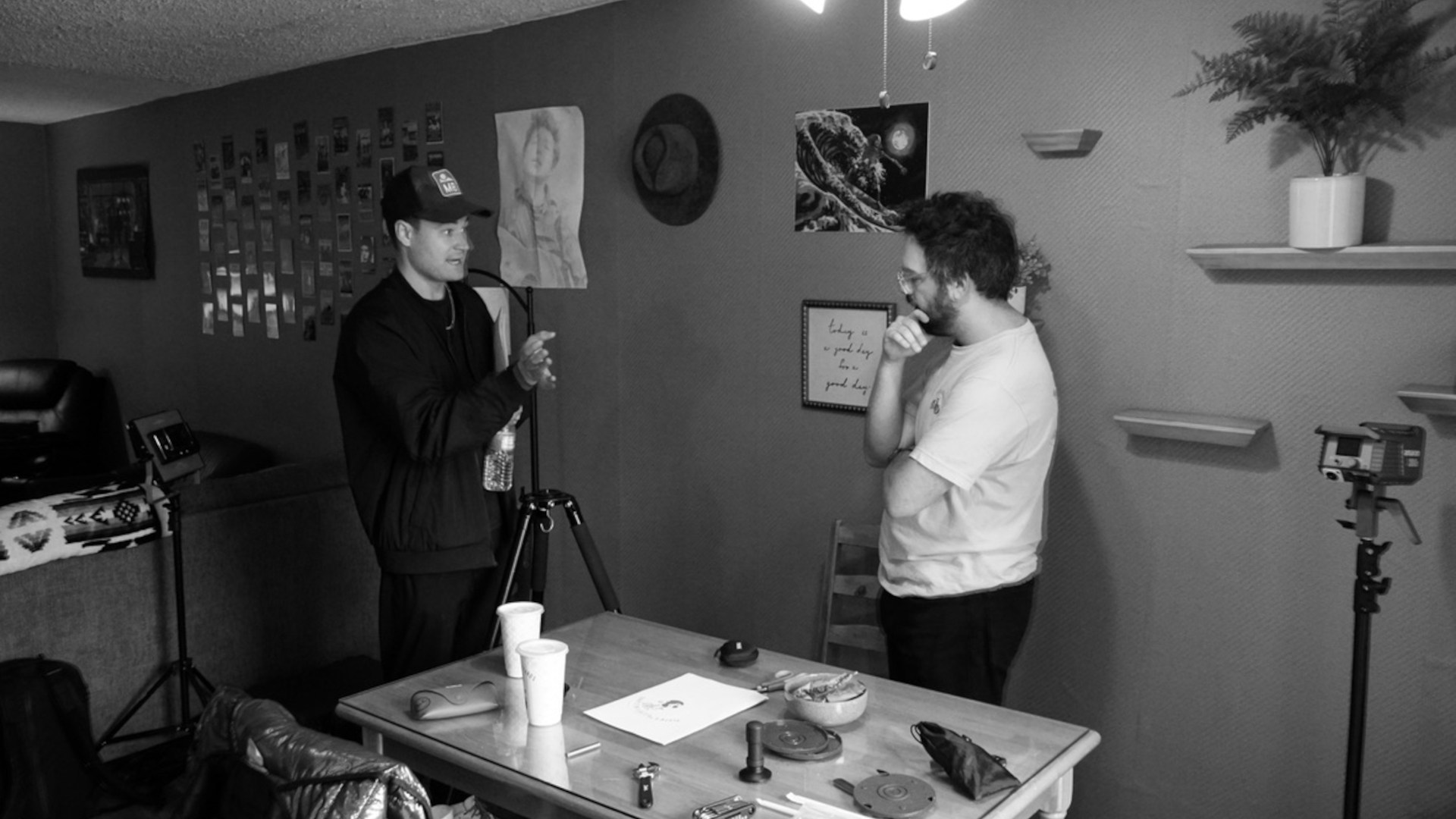
Behind the scenes of Coin: John Brownell (far right) with Roy Abramsohn, Blake Johnson, Julia Hess, Danny Breslin, Luis Manuel Peña and Tyler Picchi.
What now? A gamified meme coin-trading platform. Like Robinhood on crack. And look at that, a “Launch Coin” button, front and center.
Within minutes, my long-perceived difficulty at launching a crypto coin evaporates.
Three clicks … three clicks?!
That’s all it takes. Well, after you’ve exchanged U.S. dollars for Solana, and sent that via the blockchain into your pump.fun account.
It takes me about an hour to work through these steps. OK, done.
“Link to a Twitter page?” Pump.fun prompts. Twitter, X … ? It’s been a minute. I create a page.
What should I call this coin? Goondough, of course – the coin from the movie.
Ticker: $GOON
I queue up some tweets. The “launch coin” button looms.
Hold on, I should test this. GovCoin is the other cryptocurrency in the movie. Let’s do that one first.
Same steps. OK, launch.
A chart pops up and the coin is live.
Small price movement, light volume, bright colors and sound effects. I see the appeal – this is fun.
A few minutes pass – OK, let’s go for the real deal.
Goondough ($GOON): “The official coin of the movie Coin.”
Launch.
I tweet the trailer too. Rock and roll, we’re live.
----//----
Of the various forms of wagering, sports gambling is the biggest waste of time. When the pandemic hit, we had plenty to waste. Some of us, including me, bet big and frequently.
A couple years later, it’s 2023 and I need the Celtics to beat the Miami Heat straight up in Game 6 of the Eastern Conference finals. It’s the final leg of a six-team Hail Mary parlay (a desperate last-heave wager to erase a large loss). I place this bet at a dive bar in Hermosa Beach. The first five legs, MLB games, hit the night prior (a minor miracle in its own right).
It’s a Saturday night and our downstairs neighbors are having a party. It’s May in California. A gray fog blows up from the beach.
I watch the game with my cousin and two guys from Miami who we’ve just met, Heat fans.
The Celtics lead by nine points with three minutes left when the Heat stage an improbable comeback to take the lead on three Jimmy Butler free throws with three seconds left.
You gotta be fuckin’ kidding me.
The Celtics have one shot. The inbound goes to Marcus Smart (oh, come on), a fall-away long two (really?) and then … a miraculous buzzer-beating putback layup by Derrick White.
The parlay hits for five figures. I walk outside and am done sports gambling.
For a gambler, though, there’s always a new bet. A chip push on intuition. No more playing with scripts, let’s do the real thing.
----//----
The pandemic gave me time to focus on screenwriting.
I met a writer in a bar. She asked me to submit a work to a writing group she belonged to. These writers picked apart my scripts for a few years.
After Derrick White made his layup, I had much more time. I completed several screenplays, but understood spec scripts from unrepresented writers were unlikely to be read, let alone made. I skipped the process altogether.
Short films were the place to start. We made three of them over two years: my education.
By 2025, I wanted to make a feature. In indie filmmaking, you write what you know and can shoot.
I hadn’t seen any films about crypto. This world still fascinated me. The memories of those trades in an insurance cafeteria still thrilled me. The message boards I followed still made me laugh.
I wrote a script in 10 days. Coin, a crypto dramedy.
In May 2025, I put together a scrappy group of artists who’d helped me make my shorts and a small cast of talented, mostly up-and-coming actors.
John Brownell (left) on the set of Coin with lead actors Tyler Picchi and Danny Breslin.
We shot the film in L.A. over 27 days for $14,000 – self-financed. Calculated risk.
How do I promote this thing? With no marketing budget, the only option is creativity. What about making that coin…?
----//----
There are moments when you realize you’re deep in a thing you don’t understand.
This happened 30 minutes after I launched $GOON, when the coin passed a $100,000 market cap valuation and my Twitter notifications reached 100.
“Spammer!” “Fraud” “Grifter” “Don’t rug us!” “Deepfake mf!”
OK, I get it – here’s a community in constant peril of being scammed. They let you know it. But I don’t recognize some of these phrases. I tap back into Claude.
I purchased $400 of $GOON when it launched, a 12 percent stake (a volume trigger that spurs trade activity), similar to the characters in my movie. At a $100,000 valuation, that stake was now worth $12,000. All of this was visible on the trading platform.
A coin developer liquidating their stake once a coin rises in valuation is known as “rugging,” a.k.a. pulling the rug out from under the other investors.
The $GOON holders are actively watching my wallet to ensure I don’t divest my stake and crash the valuation of the coin. A “rug pull.”
Got it. I have no plan to do that.
“Lock the coins!” The chorus grows louder.
OK, but how? Claude guides me to a Google Chrome extension called Phantom, which holds my wallet keys, and links to a platform called Streamflow, which allows me to lock coins on the blockchain. A measure of good faith for the community. Let’s do it.
“Locking the coins,” I tell the coin’s growing followers on Twitter.
$GOON surpasses $300,000.
By the time I create a Phantom account and link my wallet address to it, $GOON is past half a million.
It’s hard not to watch the live trading. It’s intoxicating. But this isn’t about money, it’s about the movie.
----//----
Within minutes, we’re past a million. My 12 percent stake is now worth more than $100,000. If I’m honest, I have a moment of temptation – Lucifer. It’s brief and it passes quickly.
I’m not going to rug these people. This is my audience. These are my people. These laptop degenerates, adrenaline trading in hoodies around the world. I made Coin for them.
The volume chart of $GOON as it nears a $1.5 million market capitalization.
$GOON passes $2 million.
I’m still navigating Phantom and Streamflow at the direction of Claude. What a sentence.
Alright, I think I’m here. “Lock amount?” Streamflow prompts. “Max,” I select. “Are you sure you want to lock your full amount; this action cannot be undone?” Yes. $GOON passes $3 million. My stake is more than $300,000. A lightning ascension. Fuck it. Lock.
“Tokens are fully locked on chain,” I tweet.
“Going live on Twitter shortly.”
I’m in a cut off white T-shirt with “COIN-MOVIE.COM” written in blue marker. (This is another marketing idea, homemade Coin clothes as a counter movement to the elitist Marty Supreme jacket from the winter before, a reach I don’t expect many to get, but one I find hilarious.)
I go live. Five thousand people are watching, their fear of a rug eradicated, their interest in my film … to be determined.
I set out to bring attention to the movie and now have several thousand people in my direct audience listening to me tell them about it.
$GOON hits $4 million.
I talk about Coin on stream for 10 minutes.
Soon after my live stream ends, $GOON trades back down to earth, as most do. Attention moves fast in the meme coin world.
The sharp increase is followed by a similarly sharp decrease, first to a million, stabilizing at a few hundred thousand for several days, until slowly ticking further down to about $25,000.
I extend the original token lock until 2027 and purchase additional unlocked shares to support $GOON’s valuation for existing holders.
The fictional coin from a $14,000 film briefly reached a $4 million valuation.
I’ve spent more than a decade chasing risk down different avenues – investments, gambling, screenwriting, filmmaking. The mechanics changed, but the exercise was consistent, value committed for unrealized return. Many times, the payout was the risk itself.