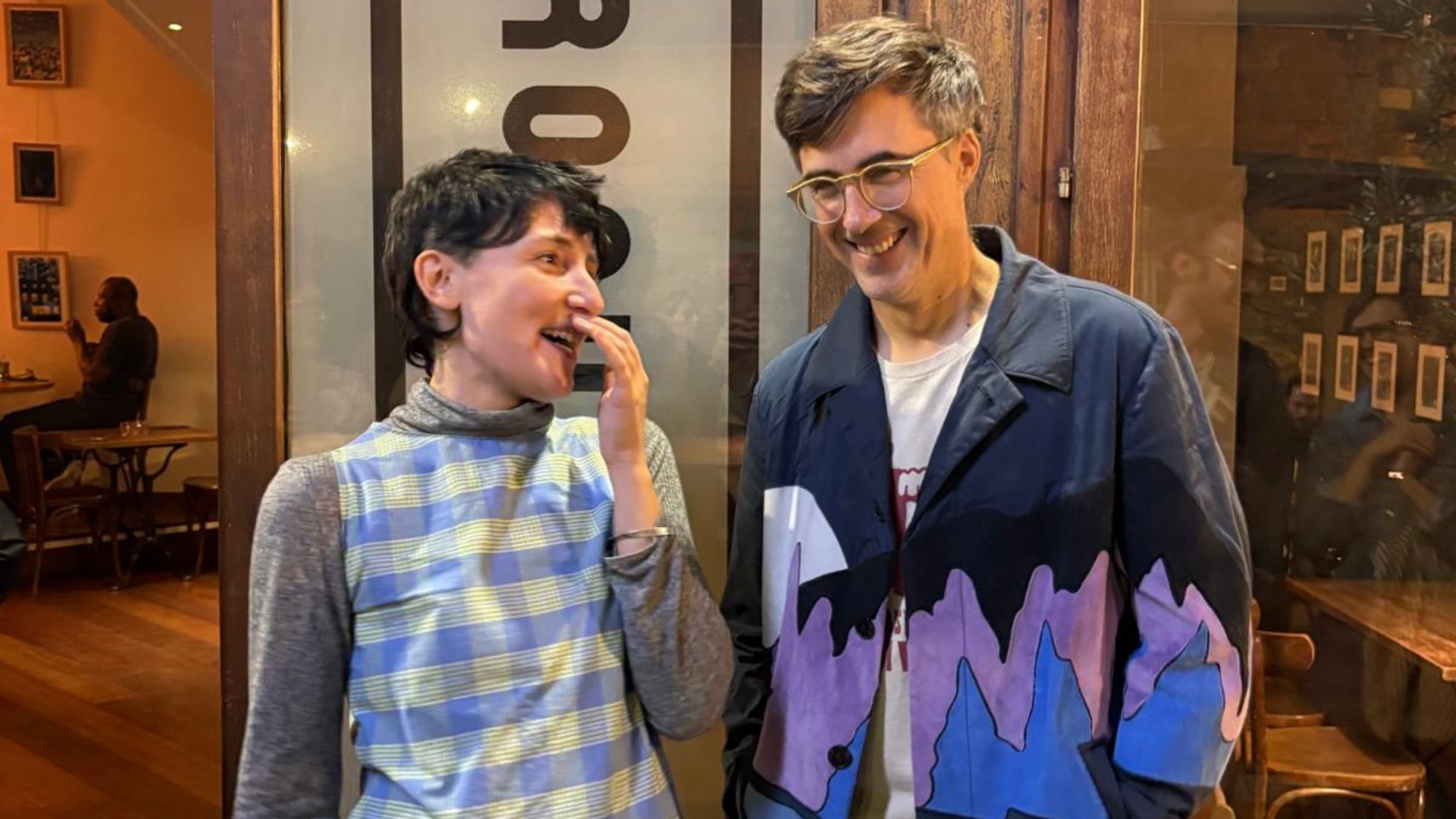
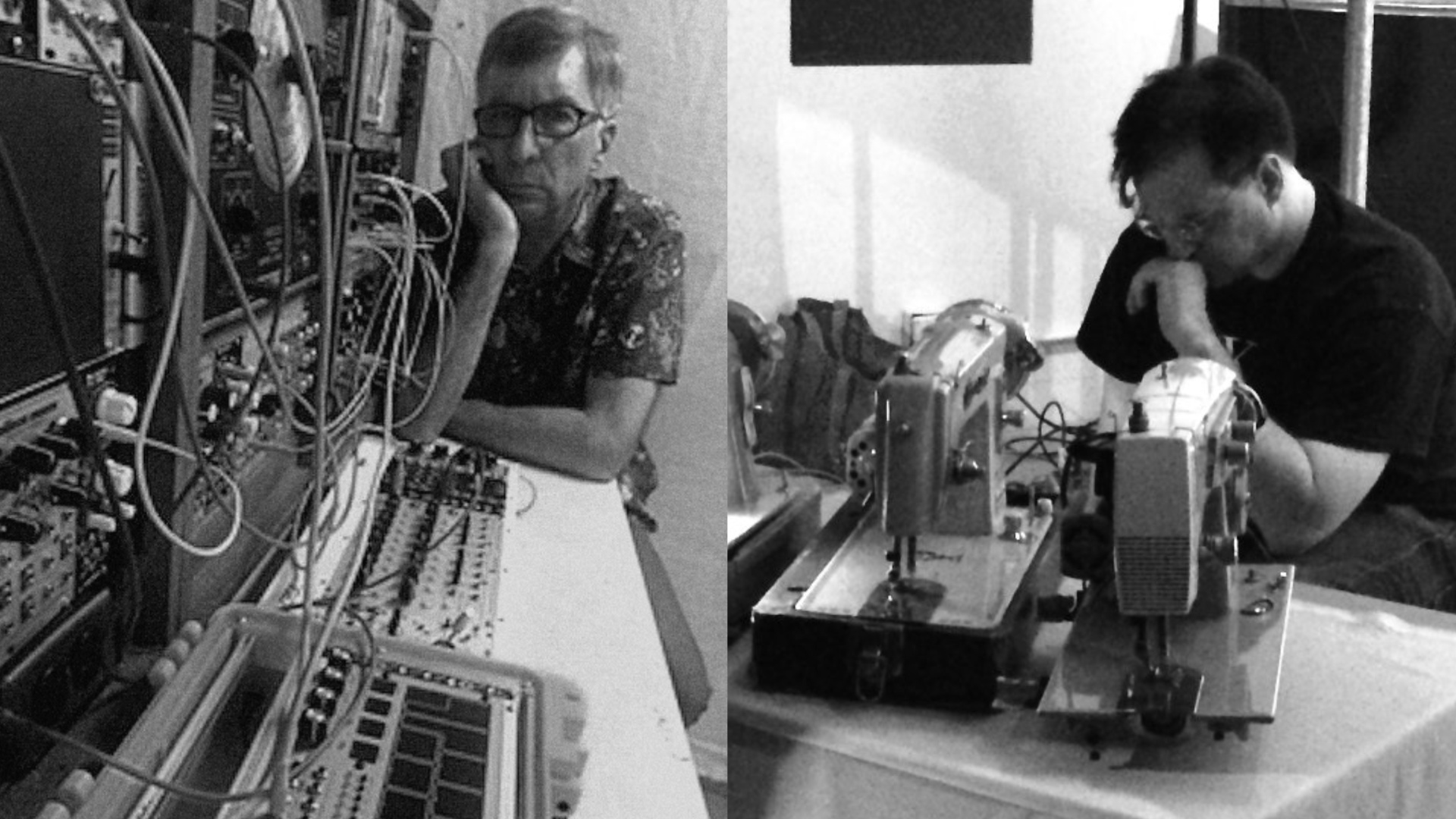
Karl J. Palouček is a composer and performer based in Chicago; Richard Franecki is a Milwaukee-based multi-instrumentalist, and the founder of projects like F/i, Vocokesh, The Purple Room, and more. Birdman Records just reissued F/i’s record Invisible Men, which Karl wrote the liner notes for. To celebrate the release, the two got on the phone to catch up about Richard’s early work, the global cassette-sharing network of the ‘80s, and much more.
— Annie Fell, Editor-in-chief, Talkhouse Music
Karl J. Palouček: I got the LP the other day, and the art looks great. I'm shocked that the liner notes ended up on the back cover. I have not put the vinyl on my turntable yet, but I know the album, obviously. I'm hoping it sounds as great as ever, and I'm sure it does.
Richard Franecki: Considering the original source, it's been mastered and done up very well.
Karl: I love talking about all of this stuff, because first of all, there's never enough talk about your work with F/i, Vocokesh, or any of your other projects. But specifically, I think that your old stuff gets a bit glazed over. It's understandable: It's early, no one has it — or very few do — you don't even have a lot of this stuff, from what I remember. I mean, there was the three LP box set on RRRecords, The Past Darkly / The Future Lightly. I know for me, that was a boon. It was the kind of thing that just made me want to hear more. What was it like in those early days? How did you get started doing your tape experiments and whatnot?
Richard: Well, it's hard to say. Music is something I've always been interested in. I guess I inherited it from my father, who was a passionate amateur musician. At a very, very young age, I was interested in music and rock & roll and all that. I remember the Ed Sullivan Show, the Beatles’ first appearance. So music has been a thread going through my entire life. But unlike the path that a lot of other people took, I seemed to develop an interest in things that were a little bit out there and non-mainstream. A real epiphany for me was back in 1969, being used to top 40 radio, but a local FM station — WZMF, to be exact — I heard “Dazed and Confused” by Led Zeppelin. You know, the whole middle part — everybody's heard that, but for a kid back in 1969, that was so out there it just freaked me out. And then I heard Pink Floyd, the live version of “Saucerful of Secrets,” and that blew me away. I was in eighth grade when all this happened. It was just so different that it got me on a path that I'm still on.
Karl: Now, we know about the Surfin’ Führers, the precursor to F/i with you and Greg Kurczewski — that was you and Greg with the drum machine. But how did the transition to F/i take place?
Richard: Basically, it started out when Greg and I were both in a punk band called The Drag. And then the Drag broke up and I was in another punk band, the Shemps. But that was something that was happening parallel while that was going on. Greg and I got together while we were still in the Drag and started doing this two-piece thing, the drum machine guitar and I had a little Moog prodigy, my first synthesizer. We were doing this very rhythmic drum machine, repetitious type stuff. And then Brian Wensing was a friend of Greg, and Brian started coming around, and the three of us eventually dispensed with the drum machine and were just doing really free form, atonal type stuff. But not completely — the drum machine still reared its head here and there. But we would just roll the tapes and see what would happen. That's how a lot of those early cassettes were done. Eventually, we got tired of the drum machine. You know, those ‘80s drum machines had such a distinctive sound; I could listen to things done by different people from back then and you could tell what make and model of drum machine they’re using…
But anyway, the other punk band I was in between the Drag and what became F/i was the Shemps, who made a little bit of a splash locally. Jan Schober was the drummer of the Shemps, so we just got him to play drums in some of the really early F/i stuff. He's on some of the early recordings. But I gotta say that Jan — rest his soul, he's no longer with us — was basically a punk drummer, and he just did it because he had nothing else to do. He just liked playing drums, getting together with the guys, and having a few beers. So we used him until he sort of phased himself out.
Karl: Did he kind of come and go?
Richard: You could say the same thing for several members. Greg came and went a couple of times. Greg was not really into improv music. I mean, improv is very hard to do, and if your brain's not wired for it — you know, “Well, what do you want me to do?” “I don't know, anything you want.” “What do you mean, anything you want?” Some people have a real hang up about that, and that's what caused a few people to come and go.
I should mention at this point, too, Steve Zimmerman, who we knew as a friend: We got him in the group because Steve was an amateur radio operator and he had a lot of shortwave equipment. I used to listen to some of the weird noises he would pull out of the airwaves in the atmosphere. So he sat there with his shortwave radio hooked up to an Echoplex, and there just would be a smile on his face making weird noises.
Karl: [Laughs.]
Richard: The lineup was very fluid. Some things were just me and Brian. Other things were just practically me doing solo stuff under the name F/i. Anything and everything went back in those days.
Karl: It's interesting because I know most of the early cassettes; I have a lot of them. And sometimes it's hard for me to keep them straight in my head. I know Invisible Men. I know the sound in Air as well. I'm very familiar with both of them. A couple of them, I know less well. And some are better than others. There's no other way to put it.
Richard: Well, as you alluded to in your liner notes, I find a lot of our early stuff cringeworthy. And you explained to me — which made sense — how that's not true to maybe a third party who wasn't in the band. But a lot of those early cassettes, plus some of the material on that box set, I find it actually painful to listen to. [Laughs.]
Karl: I get it. I read something recently where Neil Peart from Rush was talking about some of their old material. People were like, “Why don't you ever play Caress of Steel? Why don't you ever play anything off of this?” And he's like, “Well, once you've matured as an artist, you don't want to get out those drawings you did as a fourth grader that your mom stuck on the fridge.” You don't want to necessarily take those out and revisit them. I can see it being something like that if you're the person who did them, but there's a lot of merit to that old stuff. And one of the things that is always really interesting to me is that you guys were doing what you were doing in the early ‘80s, and this was a time when the avant garde, there was a lot of stuff coming out of Europe; Throbbing Gristle had been a thing since the ‘70s, things like Whitehouse were starting to make a splash, and power electronics was becoming a thing.
Richard: We should mention power electronics here, because those things were a bit of an influence. But the thing I really never got into, and kind of rejected about a lot of that industrial music, especially Whitehouse, is all the grotesque imagery.
Karl: Well, yeah.
Richard: I never got into that. To me, it's just experimenting with sound, and that's where it stopped and started. As far as putting some kind of a philosophical treatise on the back of the record or over-intellectualizing it or using really horrible imagery, that's a complete turn off for me.
Karl: For me, it's much like that as well. But I was totally taken with Whitehouse in my high school years. Not the imagery, really, but the sound, the brutality of it.
Richard: That can’t be denied.
Karl: That was very appealing at the time. I will say, over the years, I lost touch with what they were doing, but I ended up getting in touch with their material much later and some of their later stuff is really incredible, just from a sonic standpoint. It makes the old stuff look really tame.
Richard: They got better equipment.
Karl: That’s a lot of it. But getting back to the power electronics thing: that was the peak of the avant garde at that moment. But you guys were still doing something a little bit different, and I think Invisible Men is a really good example. You're not giving people the beat to hang on to. It's not a rocking thing.
Richard: It’s very ambient.
Karl: Yes. It has elements of what people would expect from power electronics, but it isn’t. It's very different. You can pull guitar sounds out of it.
Richard: Not listening to it in a long time and listening to it now, there's things in there — you can hear the radio here and there, and you can hear a little bit of guitar. But it almost reminds me — not exactly, but elements of it — of Zeit by Tangerine Dream. I wouldn't go too far with that, but there's elements. There's also elements in there of some of the stuff that Eno was doing in the ‘80s with his ambient series. In fact, my wife — she'd never heard it before — her observation was it would go great in a yoga studio. I never thought of that, but if you played it quietly, I guess it would work in a context like that.
Karl: [Laughs.] It could. Might be an interesting yoga session. People might end up with cramping…
Getting back to the cassettes in general: I still think there's a lot of really good work there. Zombie — I really strongly believe that's an important one for you guys.
Richard: Two of my personal favorites from that era are Zombie and Illuminati. I think Illuminati did some interesting things. Steve Zimmerman and I were driving around downtown Milwaukee with a microphone taped to a broom handle connected to a portable tape recorder, and we were driving through tunnels and honking the horn. You can hear that on there.
Karl: What kind of car were you driving?
Richard: I think my parents’ old 1973 LTD…. We did a lot of sound experiments of that nature, and it could be pretty interesting. Sometimes less is more. You don't have to have a Bell Labs, Columbia Tape Center room full of stuff to do interesting things.
Karl: No, it's true. I have a similar relationship to my early material that you do. Some of it I like, some of it I don't want to hear again. But it was interesting at that time because we just had what we had. The best we had for a long time was a four-track cassette recorder. Actually, there was a period where we were using a Vector Research boom box that you could plug in a microphone and it would give you, more or less, a stereo field. It was primitive to say the least. But the sound on it was quite good, for what it was.
Eno would talk about how the limitations of the equipment of the age in which you're working become the signature sound. The sound of where everything breaks apart, where you reach the limitation — that becomes the signature of the era that you're in. I think that was definitely true of your time, and it was true of mine.
Richard: You mentioned a four-track — for a while, we didn't even have a four-track cassette deck. Invisible Men was recorded just on my old Sansui stereo cassette deck. And you mentioned the Radio Shack mini mixer in the liner notes, and we just had microphones and stuff plugged directly into that tape deck, and that's how we did it.
Karl: In your living room.
Richard: Well, actually, Steve Zimmerman's living room. I was heavily into the tape networking back then, too, so I remember distinctly we would get together at Steve's house on Saturday afternoons, record a bunch of stuff, and by Monday or Tuesday I'd be sending tapes off to Germany already.
Karl: How did all of that get started, the sending of cassettes? Because I remember that as well, doing the cassette networking thing in the ‘80s. But you were on the tip of that.
Richard: I sent out hundreds and hundreds and hundreds of cassettes, and that's how this old stuff still has life in it. Basically, there was a magazine a lot of you might remember called Op Magazine. When they started, they were only going to do 26 issues, an issue for each letter of the alphabet. All the articles would be primarily with that letter of the alphabet. But they had a section they called “Castanets” — you know, a funny little play on words — with a review of cassettes that people sent in. They would review anything sent to them. And they also published addresses, so I would just send a cassette to every single person reviewed in that particular issue of the magazine and offer a swap, and that's how it all started. Ninety percent of the people would respond, and I accumulated a cassette collection of hundreds and hundreds of cassettes from everywhere — Europe, all over the United States, Canada.
Karl: And you don't have any of it anymore, I'll bet.
Richard: Well, I’ve got very little of it. That's a whole ‘nother story. I was living at my parents’ house and I had my cassettes, like an idiot, in boxes on the floor. During a storm, the electrical failed and the sump pump didn't go on and the basement flooded like a foot deep and submerged all the cassettes. That's how I lost a lot of this stuff.
But in any case, I had a lot of cassettes from everywhere. People would also trade and my stuff got around to places I never had contact with. I got letters from Cuba, of all places, asking about F/i cassettes. I got a letter from a guy in Soviet Central Asia, Siberia — he was a jazz aficionado, and F/i made it all the way out there somehow.
Karl: It's so weird how that happens. I got bootlegged in Russia years ago. I’m sure you guys have many times. I was completely puzzled by it…
So, this lineup with you and Brian and Steve all doing electronic stuff — what about a reunion? What about doing a show at some point in the future with this original lineup? You and Brian and Steve with the shortwaves and your ARP and the Korg… What do you think, Rick?
Richard: Well, funny you should mention that, because I met up with Brian just a couple of weeks ago. I gave him some copies of the record, and he's been suffering from some bad health in recent years — heart trouble. But he's doing really well now. He hadn't played guitar in a long time. F/i kind of broke up in 2018, and that's the last time the guys were in the room at the same time. But he missed doing things, so he went out and bought himself one of those reissues of an ARP Odyssey made by Behringer. So he has an ARP Odyssey clone, and he and I were thinking we're probably going to do something this summer, some recordings under the name Invisible Men.
Karl: Get out! Oh, this is kismet.
Richard: We're deciding the logistics of how we do it. I've got a lot of electronic equipment and we’d probably get together at my place. But, yeah, Invisible Men might be an entity that might release some recordings.
Karl: Well, if you're ever going to do something live, please let me know, because I would love to be there. For the purposes of this interview, I think we're finished, but we can touch base outside of this call.
Richard: Sure, I'll shoot you in email in the next couple days.
Karl: Cool. Thanks, Rick!