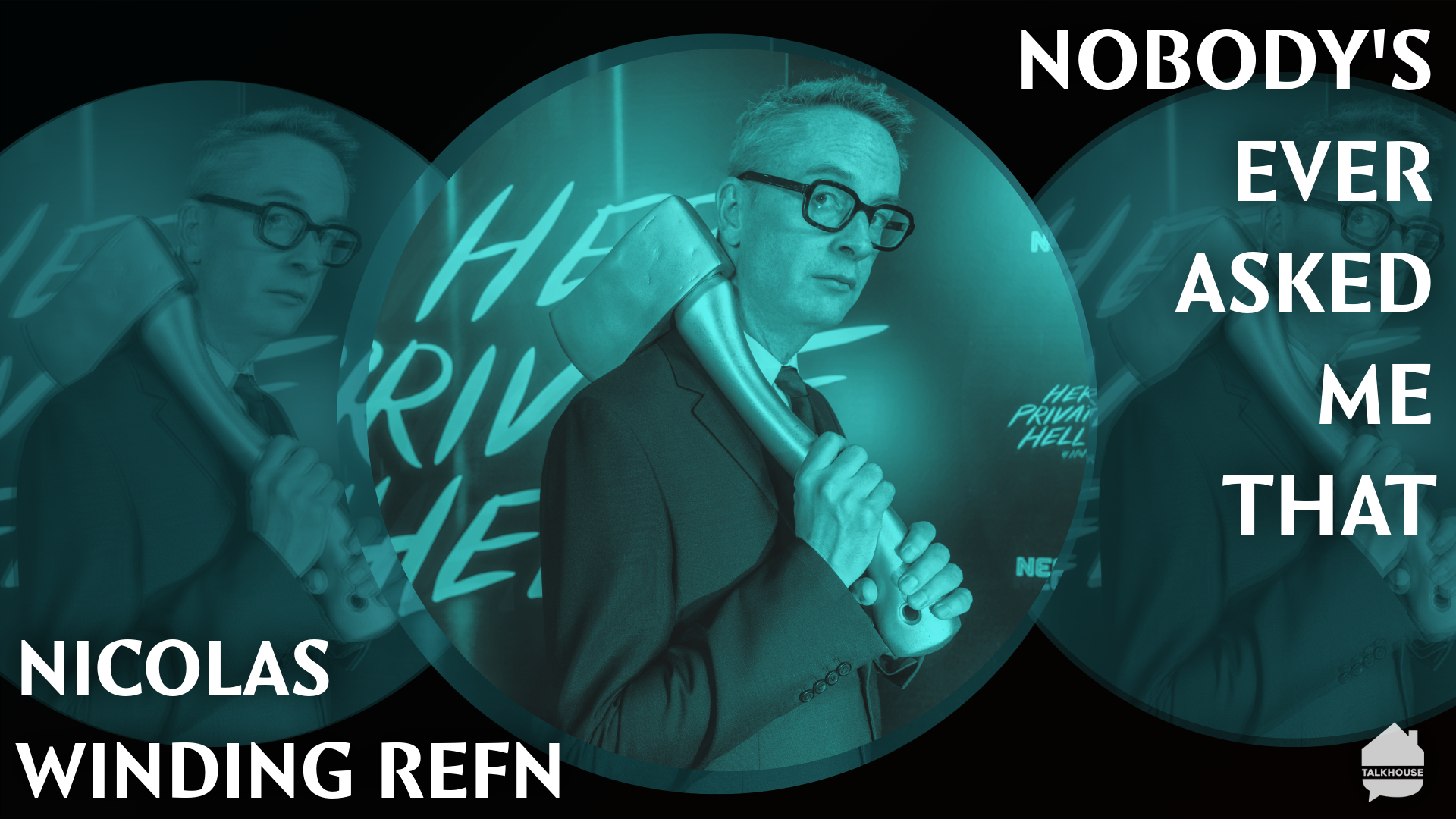
Today, my guest is cinematic iconoclast Nicolas Winding Refn …
Refn’s preoccupation has, for the most part, been telling stories of desperate men staring into the void. It’s a theme that was present from the very start of his career with Pusher, a contemporary Danish take on Mean Streets; Bleeder, a portrait of flailing modern masculinity; and Fear X, a beautifully sparse and haunting mystery about grief and loss starring John Turturro and written by Last Exit to Brooklyn novelist Hubert Selby Jr.
After Refn made Pusher II and III – a financial imperative after the failure of Fear X –he put his main thematic preoccupation to best use in a string of prominent movies: the brilliantly inventive prison biopic Bronson with Tom Hardy, the dialogue-sparse medieval-set Valhalla Rising, starring Mads Mikkelsen, and two collaborations with Ryan Gosling, the heist thriller Drive and the Thai-set psychodrama Only God Forgives.
Drive was a surprise commercial success and made Refn a big-name director, and he has smartly parlayed that into becoming a brand – literally. “By NWR” is now the stamp that’s on his recent work, and the bold neon-drenched look of his films of the past 15 years or so has become his trademark.
That savvy branding has actually allowed him to really push the boundaries of his work: The Neon Demon, the TV shows Too Old to Die Young and Copenhagen Cowboy were unapologetically art pieces, and his new film Her Private Hell is confounding and infuriating critics for its failure to deliver on their expectations.
When Her Private Hell premiered at Cannes, Refn broke down as he revealed that he had died for 30 minutes during a heart operation three years ago, and sees this film as a creative rebirth. In it, Refn seems infinitely more interested in image-making than in story, playing with influences from Kenneth Anger, camp, fashion, the Orpheus legend, and more. Like The Neon Demon and Copenhagen Cowboy, it’s an incredibly female-centric narrative, with a cast lead by Sophie Thatcher, Havana Rose Liu and Kristine Froseth.
My interview with Refn runs pretty much unedited here, as I wanted to retain the specificity of his speech. I’ve interviewed him a number of times over the years, and in press mode he’s part impresario and part zen master, sometimes speaking in koans, with long pauses between his thoughts. Those gaps may be for him to summon his next insight, or for the listener to absorb the previous one. Sometimes what he says seems totally sincere, sometimes it’s drily ironic … and sometimes you simply can’t tell.
In a fascinating and unique conversation, he touched on turning his dyslexia, color-blindness and other “untreated diagnoses” into creative advantages, his addiction to Legos, his fantasy of living in a world of only women, meeting Andy Warhol as a teenager, the importance of telling your kids that they’re geniuses, and much, much more.
Her Private Hell is now in theaters, and Nicolas Winding Refn’s very strong body of work is out there to stream. If you know him just as the guy who directed Drive or maybe The Neon Demon, there’s much, much more to explore and enjoy.
This episode was produced by Myron Kaplan and the theme music is by The Range.
Nobody’s Ever Asked Me That now has a Substack, so head there to check out all of our past episodes, plus subscribe to get access to exclusive audio and video content!
Next week on Nobody’s Ever Asked Me That, my guest is writer-director Avalon Fast …