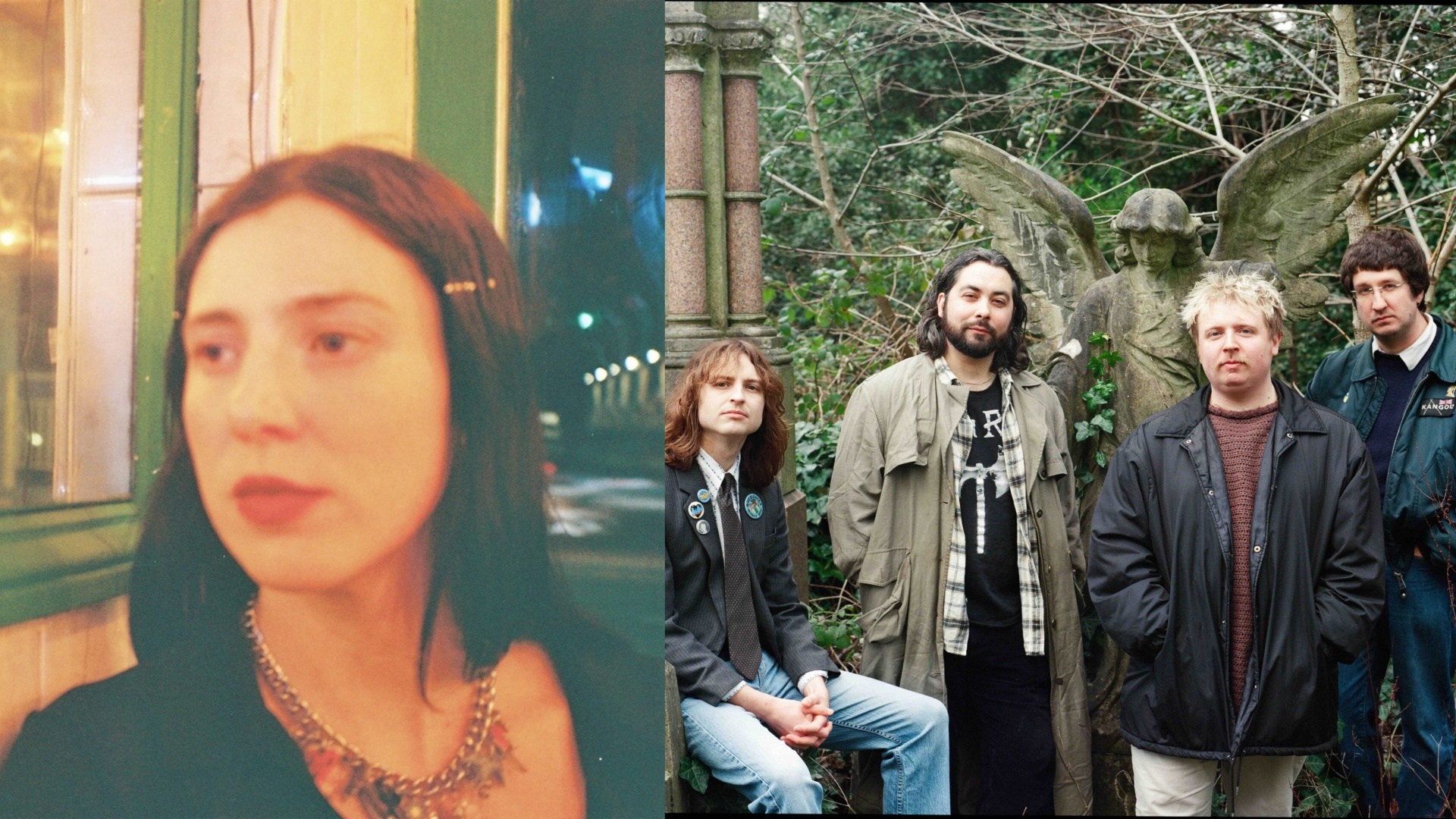

John McCauley and Ian O’Neil are half of the Providence, Rhode Island band Deer Tick. Their latest record, Coin-O-Matic, just came out this past Friday. To celebrate the release, John and Ian got together to catch up about the making of the record, and more.
— Annie Fell, Editor-in-chief, Talkhouse Music
John McCauley: OK, the time is 3:22. Thursday, April 30.
Ian O’Neil: Where are we located?
John: We're at What Cheer Tavern. We filmed a part of our latest music video in here.
Ian: That's right.
John: You may hear some background noise. Whoever's transcribing this, I apologize, but there's no way Ian and I were going to do this without going to a bar.
Ian: [Laughs.]
John: So,we're here to talk about our new album.
Ian: Coin-O-Matic.
John: I guess we consider it a very Providence, very Rhode Island record. Almost if an album could be a homecoming of sorts. We recorded it here in Rhode Island, produced it ourselves. And that leads me into one question I had for you: Would you ever want to self-produce a Deer Tick record again? And were any of us tyrants as producers?
Ian: [Laughs.] No, I don't think anybody was a tyrant as a producer at all. I think that we've been doing this long enough where we can hold each other to a high standard. I think there were times when we were doing it where it was difficult, but I feel like the result leads me to believe that I would do it again. How do you feel about that?
John: I like where we're all at with our friendship with each other, that you just tell each other, “hey, you're fucking up,” or, “why don't you try it this way?” Or, “hey, I got an idea.” It doesn't hurt my feelings for one of you guys to tell me that. And I hope it doesn't hurt any of your feelings.
Ian: No. And I think the funny part about that is, we've been through these situations already with producers where we've still had to tell one another when the other person wasn't doing something the way that they either saw fit for their song or that they’re wasting too much time trying to get a part right, or you're not spending enough time getting a part and really knuckling down. So I think we went through all the pitfalls before actually self-producing.
John: Yeah, it felt like the hardest part of doing it at home, which doesn't really have anything to do with producing it ourselves, was just the fact that we did it at home. It was the biggest challenge for me, our family lives and our lives in the recording studio crossing like that.
Ian: Yeah, totally. Usually when we get out of town and go to a remote location or work with somebody else, we don't have the distraction of small children. And as much as we can rely on our partners to pick up the slack when we're in the studio all day, it just doesn't feel fair sometimes.
John: Yeah. I mean, the studio is at my house, so every now and then, my daughter would come busting in. Or my dogs, who are both maniacs…
Ian: Alright, I got a question for you. The biggest shift in your writing for this one is a narrative approach to the lyrics. What motivated you to make that change? Did you already want to explore that method or did the stated theme of the record require you to shift in that direction?
John: I think it was the theme of the record. I had a feeling you might ask something like this, so I thought about what I wanted to say, and I forgot it all. But I felt like a narrative approach to songwriting for this was the only way that we'd really get the feel of Rhode Island through on it. I didn't think masking anything in lyrical poetry and gobbledygook or whatever would really do the mission any favors.
Ian: That makes sense. And it should be noted that you can write narratively in an autobiographical way. And I guess that's another question: How do you keep fictional stories feeling personal? Is it just instinctual? Or were there any times where you caught yourself making sure you had to keep it feeling personal?
John: I don't know. I guess once I got in the mode of writing and creating some of these characters for the songs… I felt like I got to know them maybe the way an actor gets into character. Not that I was method acting or something — method songwriting. But I guess I had the ideas for a lot of these songs kicking around for a long time, even if they were incomplete. I was able to think more of these characters’ motivations or whatever. And, I mean, I took a lot of information from just growing up here, family members that are no longer with us, or just people from the neighborhood where I grew up in Providence.
Ian: So do you think there's a lot of subtext that's not even mentioned in the lyrics about who these people are? For example, Matthew McConaughey, when he did True Detective, he as Rust Cohle wrote diaries as the character. Do you feel like you, even just in your own psyche, had subtext that helped you flesh out the characters?
John: Maybe. “ACI,” I really had to whittle down, and it's still a pretty long song. I had this guy's family tree all mapped out and shit. But I was like, What good is this information for this song? Maybe if I was writing a book, it'd be different.
Ian: Do some annotated bonus material for a Patreon or something.
John: What did you think of my initial assignment? How'd that grab you?
Ian: I think it's equal parts exciting and daunting when there's a specific task for somebody like myself who can have a somewhat aimless approach to making art in general, kind of feeling my way through a fog. I think especially when we started hearing some of your material that you were working on, it illuminated more what the project should be, and it got me excited about the project when it wasn't just an amoebous idea but it actually started to become a real thing.
John: And it stayed in that state for so long, just an idea, that it did start to worry me that it would never get done.
Ian: Yeah, it took a leap of faith to write the first songs.
John: I guess “ACI” was the first one that I finished for this record. And that felt like a good jumping off point. It's one of the more fleshed out stories on the record. Captures a little bit of the Providence criminal underbelly.
Ian: That leads me to another question I have. There's themes of family, there's themes of loss, there's themes of imprisonment, there's themes of migration on a song like “Candy Cigarettes.” How did you choose which situations to put your characters in?
John: I think just reflecting on my own experiences as a young kid growing up here… I mean, there's big immigrant communities here in Providence and little ethnic enclaves. I wanted to tap into that a bit. My family's mostly Irish and Italian and we can trace a lot of our families back to the old country. And I think some attitudes with immigration have really shifted lately, it seems, and that to me is stupid. That's what this country was built on. And maybe, at least with “Candy Cigarettes,” it’s just a gentle reminder to my fellow whites, “Hey, you're not really from here either.”
Ian: Yeah. I grew up in Western Mass, and being Irish in Western Mass is really, really important to the identity of this part of the country. I don't think it's that way across all parts of this country. But it seems like in the Northeast, because it was one of the first stops for people to come through, it's persisted here a lot more.
John: How do you see your contributions fitting onto the record with this theme?
Ian: I wrote this song called “Endless Loop.” I had the chorus and the opening lines of that kicking around in various [ways]. Actually, my wife found a bunch of initial lyrics to that song that were just stuffed in a drawer for a couple years, and it was really different. So when the theme revealed itself, I wanted to take that song and challenge myself to apply it to the theme. So instead of making it a completely personal song, I envisioned two characters, one out of jail and one in jail, writing to each other about unfortunate incidents in their lives and how that led them to where they were. And it can be a little more subtle and more esoteric. But I think that, almost like the subtext conversation we're talking about, I'm writing these two characters with it in mind who they are and setting it in Providence. Especially because when I was writing all the songs that ended up on the record, it was the last year I was living in Providence itself before I moved out of town to the burbs. So everything's just set here.
And I would say with “Everything Born,” it's more character-driven than I would have done previously. I'm writing about other people in my life and about a specific time and place in Providence. A little less selfish, you know?
John: I like how Dennis [Ryan], our drummer, talks about the record, how he says, “My songs are set in a very specific period of time with certain characters.” There's a through line with some of it. And that's one major tone of the record. The stuff that you and Dennis wrote for the record are kind of like little vignettes that pop in and out of the the story exploring other periods of time and other characters.
Ian: Yeah. It's almost like, where you homed in on really specific stories that are still remembered stories — even from “Dog Years” to “Candy Cigarettes,” it feels like characters are looking back — I feel like Dennis and I are kind of like little flashes of memory that give color throughout the record.
Do you feel like obstacles and parameters help your creativity?
John: This was kind of my first real crack at it, and I thought I was able to really wring the towel dry. I pushed myself further than I think I have in the past to complete songs and to assemble something with cohesion and tell more of a story. So it's definitely something I'm interested in trying again, maybe with different parameters, but I did enjoy this process quite a bit. I'd find myself kind of wandering out of the house at odd times in the middle of the day bringing my notebook or my laptop down to a bar and grabbing a beer and just writing away trying to finish a song. I've never done that. I've never scheduled time in my day to work on a song.
Ian: Yeah. That feeling when you're onto something with a song where there's a massive dopamine hit happening…
John: Yeah, these songs to me, I definitely felt a lot of satisfaction upon completion.
Ian: So the flip side of that question is, what was the most difficult process about making this record?
John: I think it was really finishing the lyrics. I got all of them about 80-90% there, and then just really hit a wall. How long did we spend on the record? We worked a couple days a week for two months or something. And I spent every day that we weren't in the studio, and some of the ones that we were where I didn't have anything to do, just trying to finish up the final 10-20% of the lyrics. So, yeah, lyrics were my biggest challenge on this record because I wanted to tell stories. But, you know, trying to paint a really big picture within three or four minutes…
Ian: Did you have the beginning and the end of the story in your mind before going through the details? Did you know where you wanted to get to?
John: Most of the time. I think my biggest challenge is with the endings were “Candy Cigarettes” and “Exit Door.” I didn't really know where I was going when I started those songs, I just had a vague direction, but I couldn't really see the ending. So it took a lot of taps of the delete button and a lot of rubs of the eraser.
Ian: And I don't know if you would have had that time had we not self-produced for this particular batch of songs.
John: That's true. I think if we had done a more traditional thing, where we'd gone to a studio for a week or two with a producer and just recorded some songs, I would have never finished these songs and it would have been completely different. It wouldn't have been this record at all. So I'm glad this idea didn't get pushed back further or abandoned.
Ian: The circumstances lent themselves to the type of songs that we ended up making.
John: I got a question: I've been singing this lyric of yours to harmonize with you on it from “Everything Born.” What is a “windowless chore”?
Ian: [Laughs.] I think the original lyric was, “some crime to commit or some windowless chore,” so I think the character in the story is begging for anything to do to put them in the headspace to understand what they were thinking. I was picturing a job in a prison or something like that. You know what I mean? But then the lyric changed while we were recording it. But I think a “windowless chore,” I'm pretty sure I made that up, but I thought I've heard that in literature as the worst, the most mundane thing…
John: I mean, that's what I'm imagining. But the lyric just sounds right and made sense to me without me really knowing what it meant.
Ian: That whole chorus was written immediately, basically, except for that one little change. I think I was trying to channel some Tom Petty directness and simpleness in that song as much as I could. I was thinking about it like, what are the most mundane aspects of the tasks in life that you could be assigned? I don't know about you, but when I'm doing a “windowless chore,” like the laundry in my basement, I end up pretty lost in thought and having some revelations.
John: So that's what it is, ladies and gentlemen: Ian doing laundry in the basement.
Ian: [Laughs.] Yeah, exactly. My own personal prison.
John: I have a final question for you.
Ian: I have a final question, too. You go ahead first.
John: At the end of the day, do you feel like we've met our goal of creating a very Providence and/or very Rhode Island album?
Ian: I think you can fit it into Providence, to be honest with you. I do think we have met our goal. I think we as a band are ostensibly as close to a democracy as you could get, and when you take multiple songwriters and ask them to fit their personality into this mission, I think we have. Do you think we have?
John: I think so. And I think it worked because it was a subject matter that just works for all of us. I mean, you're not a native Rhode Islander, but the majority of us are, and you've lived here for a very long time now.
Ian: Seventeen years.
John: And you're from nearby, Springfield, Mass.
Ian: Similar culture.
John: It felt like the right topic to try this experiment.
Ian: I feel like it’s the right topic at this time in each of our lives, because we're entering middle age and it seems like a good time to take stock.
John: Yeah, look back. We're all raising children now.
Ian: This segues perfectly into my question: what's something you miss about Providence that you remember as a child? John: Well, outside of Providence and Warwick, there was Rocky Point Amusement Park. I'll always miss that. I will miss the original Smith Hill New York System, when it was run by the Pappas family who opened it in the 1920s. They've closed and reopened and had different owners and stuff for the past 15 or 20 years or so, and it's still pretty good, but I miss those old days with all the old dudes behind the counters lining hot wieners — they’d line up the buns on their bare, hairy arms, cigarette dangling out of their mouth. I miss that shit. And I miss walking into a restaurant or a bar and you know there's something else going on there. Even if it's something illegal but kind of innocent, like there's somebody running a numbers game out of the place or something. That made everything very interesting to me. I like the hustle, you know?