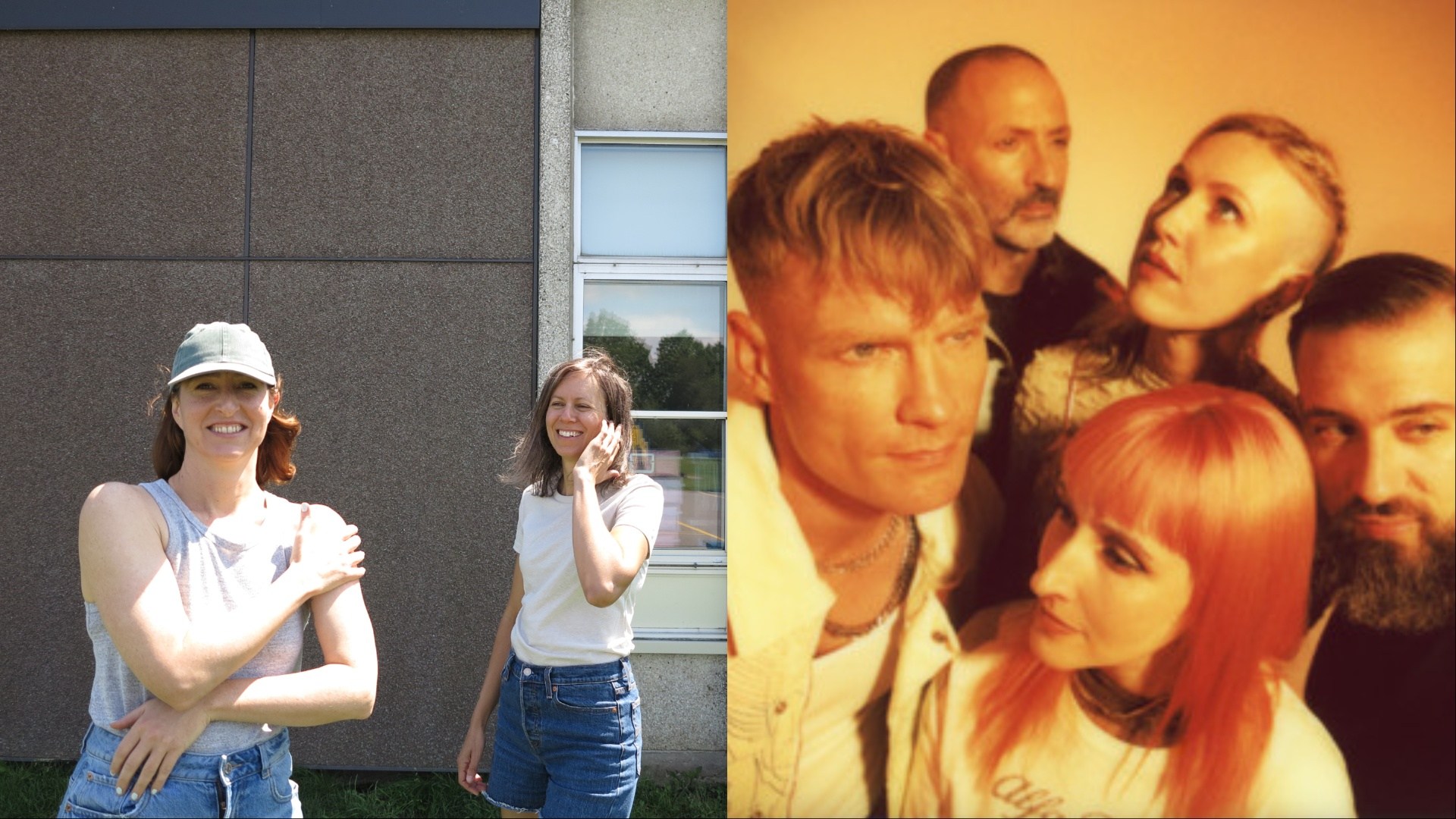

Beth B is an artist and filmmaker known for her films like Two Small Bodies and Lydia Lunch: The War Is Never Over; Jim Coleman is a composer and musician who’s played in the bands Cop Shoot Cop and Human Impact. Jim composed the music for Beth’s latest film, Glowing, and so to celebrate it, the collaborators (and life partners) sat down to talk about the making of it, their own origin story, and more.
— Annie Fell, Editor-in-chief, Talkhouse Music
Beth B: I think we're going to start with how we ended up coming together, working together as artists in different disciplines. So, you're going to get the inception story.
Jim Coleman: The origin story.
Beth: Yeah, that's a better term.
Jim: OK, so: I was a projectionist at the Whitney for years, and I used to show your films. So I knew of your work, but I didn't know of you.
Beth: I was such a fan of Jim's band Cop Shoot Cop. That was in the ‘90s. I used to see them play at different clubs in New York City, and it was raw, edgy, sexy and spoke to a lot of pain and ideas of what the world could be, what the world was. It connected with me on so many different levels.
Jim: There was a lot of reveling in pain.
Beth: [Laughs.] I feel like I still revel in pain. Sometimes it's more like reveling in other people's pain, and I can kind of have a different perspective on my own… but now I’m looking to transcend that pain.
Getting back to the origin story. We met each other in 1995.. I had just finished directing the feature filmTwo Small Bodies. I come from indie filmmaking, and I had really scraped and scrounged to find a way to continue making the movies that I wanted to make. But after Two Small Bodies, the funding totally fell out for films that were more challenging and thoughtful and had a deep sense of disturbance — which is what I'm attracted to. So in 1995, I went back to my roots in experimental filmmaking and doing things totally DIY. I started working on a film called Out of Sight, Out of Mind, and I was looking for a composer. Richard Kern was a close friend of mine and he said, “Jim Coleman.” And I was like, “Oh, my god, Cop Shoot Cop! I could never ask him!” But Richard and I went to CBGBs where Cop Shoot Cop was playing, and Richard introduced me to Jim. I remember being really nervous. Jim, I felt like you were so aloof, not interested, and I was like, Well, fuck him. Forget it. But what I didn't know was…
Jim: So, that introduction happened about five minutes before we were going onstage to play, which is always a hard time to pay attention to anything. So Beth thought I was just a dick. But regardless, you called me up after that to do the music. Which ended up being an installation, didn't it?
Beth: Yes, it was a film and an installation about our mental health system. It so often just locks people away and forgets about them… out of sight, out of mind. So who has the authority to define madness in the first place? And who has the right to decide what happens to someone once they've been labeled that way?
And while we were working together, we would go on these lunches, or you'd come over and we'd have a bite to eat. And we had these deep, emotional conversations. I was like, Ooow, I'm letting down my guardrails here. I was not aware of it, but in retrospect, I can say those conversations were very different. I felt like we were having a connection that was different for me.
Jim: Yeah. It's also that it was first a kind of creative, professional relationship.
Beth: I don't know about that. I've had many creative, professional relationships and they all kind of went, “OK, yeah, let's fuck each other, have a relationship, move in, and then—”
Jim: Burn it up.
Beth: Burn it, tear it apart, and then stay in misery for quite some time and wonder, How did I get here? Damn… Anyway, I wasn't aware of how different our conversations were. And the way that we worked together was so respectful. I don't think we've ever had a conflict in what you brought in creatively, what I brought in creatively. No egos. It all melded together to create a whole other dimension of the artistic work. Right?
Jim: Yeah. I think there's been moments for me where, if I haven't been spiritually grounded or whatever, I may get defensive about feedback. But that's more about where I am, and that's been a process for me to be like, OK, why am I getting defensive or reactive? I think ultimately, all the work is in service of the greater good of the project. But I haven't felt that defensiveness in a long time.
Beth: Yeah, that awareness that you had really helped me, because I previously had creative relationships that were all very invested in ego. I definitely brought my ego to many things in my life that ended up taking me down and did not serve the greater good of the project.
Jim: I think that's one of the joys of aging — at least for me, I feel like it's knocked ego off the table. If I'm in a creative space, I can enjoy it and it's not about, “Oh, I'm doing this…” I just enjoy the process.
Beth: What has calmed my ego a bit is realizing that I'm not so important. And that the people who I'm working with are in some ways more important in the moment. Of course, my voice is critical and if someone tries to knock it down — I do have the ability to listen. I didn't even want to listen in the past. I'd be like, “No, I'm right. Shut up.” I wanted to push people away. I was scared of anyone coming near me and seeing how sensitive and vulnerable I was. I used my ego almost like a shield. Today, I do want to listen. I know it helps me to learn from others. I need that.
Jim: Yeah, there might be a similarity there between directing and being in a band. Being in a band, when it's the right people and the right chemistry, the sum is greater than the parts. It makes me think in different ways creatively and practically, it opens things up. Whereas I would think, too, if you're less of a dictator and more of a director, you're bringing people on because of who they are and you're welcoming their voice and input and expression. Maybe you've got some parameters on that, of course. But again, the sum should be greater than the parts.
Beth: Yeah. When I was younger, I felt that everyone was against me, I felt threatened, and so I needed to defend my ideas. I had to be right. Because, man, if I was wrong — Uh oh. Careful. I'd be upstairs waiting for my father to come and tell me how he was going to punish me. So, I had to evolve and become a healthier human being.
So when I met you — I want to get back to that story — we worked together on the film over the course of maybe a month or so, and then I went out of town to show my film somewhere. So the hotel I was staying in had one of those old phonebooths with the wooden accordion doors. I got an answering machine message from you that said, “Hi, Beth…” So I called you back. I was like, “Hey, what's up?” Because we had finished the job and I was wondering, why are you calling me?
Jim: I had somehow ended up with feelings for Beth.
Beth: You somehow had feelings for Beth. [Laughs.] What does that mean?
Jim: Probably from those conversations you were talking about. But I had just gotten out of a relationship that took me way too long to get out of, and the last thing I wanted was to be in a relationship. But I realized I had these feelings, so I was like, I'll call you up and see if you want to go to dinner or something. Anyway, she's like, Why the hell is he calling me? What does he want?
Beth: He didn't tell me these intimate details on the phone. He was just like, “I was wondering… You wanna go to dinner?” And I was so taken aback. I was like, What do I do with this? Also because in those days, it's not like you went out to have dinner with someone. You met him at a bar, “OK, you wanna get out of here?” “Sure.” And then you're in bed. So this was a very different approach. I hadn't experienced this maybe in my whole life. So I said, “Well, I'm having this party at my loft for Tom Otterness. Why don't you come by?”
The next night, I had this party and there must have been 200 people there, and everybody's having a good time. And Jim and I, the entire duration of that party, sat on my couch talking. And then we were suddenly like, “Oh, my god, there's nobody here except us.” The party was over. But that was the start of our party. And so we continued to talk, and you asked me a question — do you remember what you asked me? We were talking about relationships.
Jim: It might have been, what personality type are you attracted to?
Beth: That was it. And I will say at that point, I had been three or four years in a 12 Step program — I'm going to reveal it because everybody should be in this program — Al-Anon. It was a time where I really had to do an inventory on my relationships and why I was always attracted to these insane people. My sponsor had said, “Beth, you need to make a list of what you do want to have in a relationship. What kind of person?” So, oddly enough, I had just made that list. I start to go through it and I'm telling him, “Someone who is available. Somebody who can take care of themselves. Someone who is, of course, intelligent, creative. Someone who can see me for who I am and accept me.” I'm telling him this and in my mind I'm going, Oh, shit! It's him! He is right in front of me! But I didn't tell him that. I just kept that information for myself. So then I asked him, “Well, what are you looking for?”
Jim: And I basically said, “You.”
Beth: [Laughs.]
Jim: Which felt like jumping off a cliff. But that was the way I felt.
Beth: And I said, “I think I've been looking for you.” That was so scary.
Jim: So we took it real slow and got married six months later.
Beth: Both of us were like, “OK, we cannot fuck this up. This is the real deal.” And so that night, we said we're not having sex. Because once you have sex, then you can't even figure out who the other person is. You're just addicted to the sex, right? I was a bit of a sexaholic.
Jim: Eventually we did.
Beth: [Laughs.] We did. But that night, we just hugged each other. And in some ways, that hugging, taking it slow, waiting for several days ‘til we even kissed each other — it was so scary. It was like being a teenager again, just not knowing what that was even about. It was really emotional and so special… Anyway, we should get back to our work stuff.
Jim: So, Beth and I have had over 30 years of working together. It started with a creative partnership and has become a life partnership. We have a beautiful daughter who we cherish.
Beth: Lola.
Jim: So it's this immense existence that I think is really rare and we don't take it for granted. I'm grateful daily for it.
Beth: It's been the richest creative journey that I've ever had, and it's helped me to go places that I didn't know I could go. And especially with Glowing.
Jim: What made you want to make Glowing?
Beth: As you remember, it started with this project we were working on in Hamburg, Germany. It was a theater production — with some torturous individuals, but we won't talk about that. In counterpoint to that, we were working with Annie Bandez, Little Annie, who is a chanteuse… raconteur… just a person who knows how to put words and music and emotion together into such a profound place. I had never had that kind of collaboration before, even though I'd worked with Lydia Lunch and a lot of the music people of the late ‘70s, ‘80s… Annie was on a planet of her own with her voice making the world spin. It gave the production a heightened reality of essence
Jim: And you had done theater before.
Beth: And I had done theater before. But there was something about working with her that brought me into a place of questioning what I could do with cinema. By placing her physically in front of a screen we created this echo of reflection to the audience. So that the audience was not just experiencing her in person, it was also creating another perspective, a layered dimension and image of her on the screen and stage. And that became the first Glowing. After the theater production, I edited this into 10 minutes, and let that become something else. And Jim brought a whole other level of music that I think was a bit different than what you had done in the past, at least with me. How would you describe your approach to the music?
Jim: I mean, in Annie's segment, there's a lot of music that's not mine, which works beautifully and I think is in a way the foundation of her piece. But the music that I have in there adds a weight and counterpoint to it. I think the music across the board for Glowing is different, but not disparate from things that I've done. It's kind of a blend of a film scoring approach with how I approach making ambient music, and also some harder-edged electronic music.
Beth: Yeah. And I think that mirrored the marriage between the music you did, the visuals I brought to the stage and the screen, and what Annie brought to it. There is a kind of emotional quality, and it was not linear. But you took the segments that you scored and created a sense of storytelling that was fluid and complemented the words that Annie brought to it. That was, I think, the first time that you had scored something in that way.
Jim: Yeah. For all the different segments in Glowing, they're nonlinear, they're very poetic, but there are stories in there and they're really highly character-driven. I think all that informed and fueled my approach to the music. The music is a huge part of Glowing; it's kind of the emotional underscore for the environment. I mean, the physical setting is obviously really important too…
Beth: The entire film of Glowing is composed of eight different people who contributed. Sometimes it was music they had previously done, sometimes it was just words that they had written and then we shaped them with the music and the visuals, the locations. But I think what threads them together is a very deep search of self, and often starting in a place of pain. And that's what I was looking for: I was looking for stories and people who had gone deep into the darkness. And some of them are still in the darkness, I would say, but many of them have made different choices as they have evolved in their lives and see glimmers of light. It’s not hopeless.
And that's where I've come to in my life, being much more hopeful. I try to go more towards the positive rather than immediately to the negative. I was looking for people who could talk about their journeys where there's a sense of catharsis in living differently, pursuing a life that has the recollections of our childhoods, but are able to let go of the past to embrace more of the present. We were trying to connect with people where they stand today, yet not discounting the past. Because so much of the past is what informs us and creates us.
Glowing is about trying to find the balance between love and hate, light and dark. And many of the stories have to do with a reckoning of childhood, and visions and images that we still hold on to… the stories we tell ourselves, the roles we hold onto, the fucked up messages we run in our heads. I say, I can let go of it, but then often it returns. Nick Flynn talks about having a dream about his son — when, in fact, he does not have a son. But he's talking about this son who he sees that's just bloodied and needs help, and Nick can't give that to him. Then at the end of Nick's piece we understand that this boy he speaks of is himself and that now he can allow himself to help that child… He’s much more poetic than I am… He simply ends with, “Don’t run.” It’s beautiful. I still cry when I hear this in the film.
What I discovered, artist by artist... I don't know if "discovered" is even the right word. It was more like a repetition that kept showing up, over and over, until I couldn't ignore it. It’s that almost none of us actually leave childhood behind. Something happens when we're small — a wound, maybe, or a silence, or the lies and secrets in a family or some kind of disturbance we don't even have words for at the time — and it doesn't resolve. It just goes underground. Joseph talks about being a small child, left waiting in a car while his mother ran back inside for something. And there's this dread that takes hold of him — this innate childhood fear of loss. And Rose Wood, her war with her own body and the world, it seems to trace back to childhood too. There is a search to get back to something simpler, an innocence, an acceptance with self.
Jim: I think as adults, we can't really grow and be victims at the same time. And part of that evolution from being a victim is reparenting ourselves.
Beth: It is about the reparenting. And a lot of people in Glowing talk about it — not so much in that specific way, but in a reflective way, which I just love. It's those reflections of ourselves and that, in fact, we do have choices today.
The people who were in Glowing, I have so much gratitude towards them, because they allowed themselves to be vulnerable. They trusted me enough to reveal things that were very complex and difficult. I love this film. I feel like it's so much of where I am in my life today. And to be able to have all these other people in it, including Jim — who is my life partner — it's glorious. I feel like it's a masterwork. One that I had so many others to help me create.
Jim: I do too.
Beth: Thanks so much for giving us this opportunity, because I don't think Jim and I have ever talked like this.
Jim: Pretty nice.
Beth: [Laughs.]