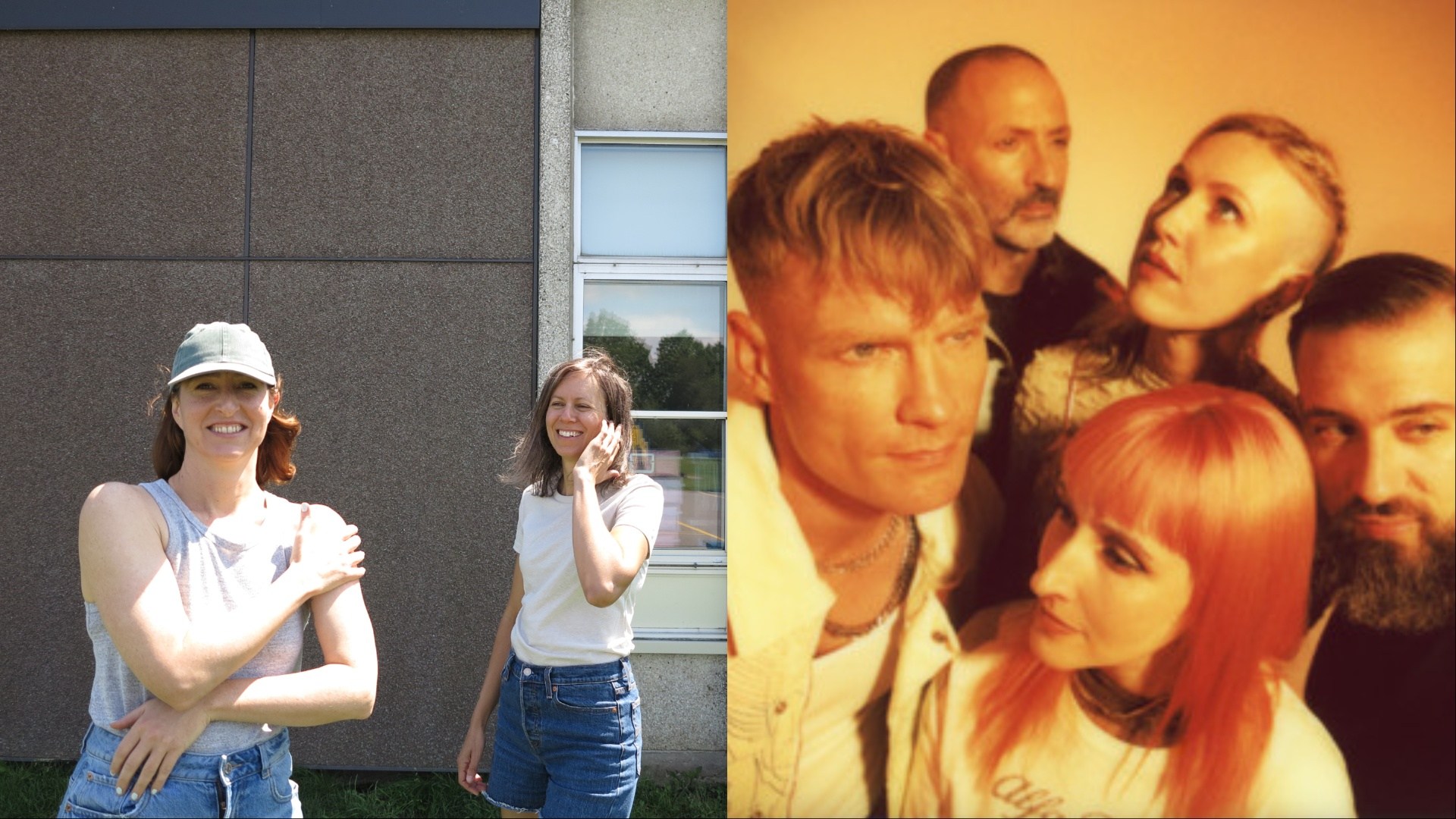
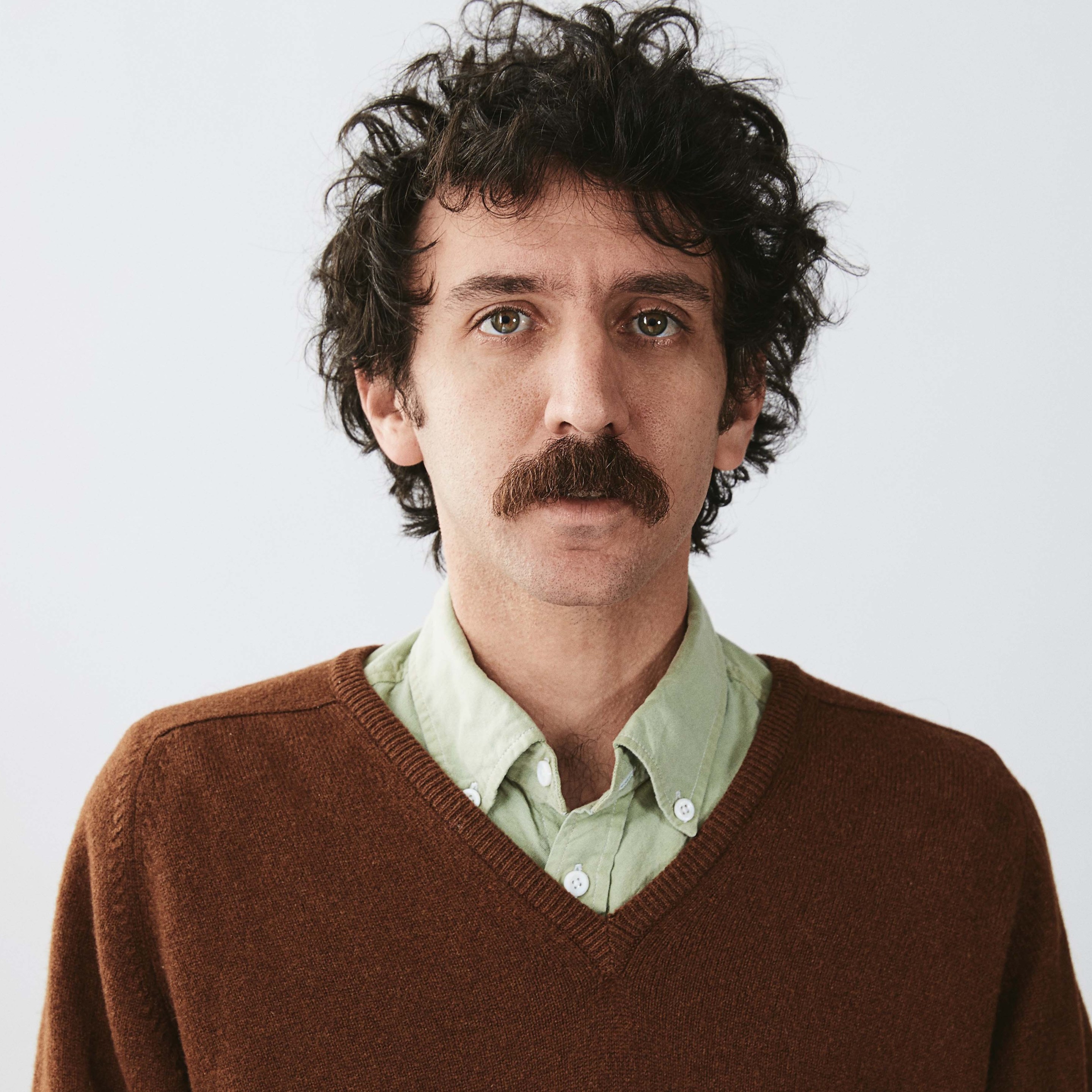

Chris Cohen is a singer-songwriter, producer, and multi-instrumentalist who has released records under his own name and with the bands Deerhoof, The Curtains, Cryptacize, and more; Aaron MF Olson is an LA-based musician and composer. Aaron’s new record Songs Album II is out now via Country Thyme/Drag City, and to celebrate the release, the two longtime friends got on Zoom to catch up about it, and much more.
— Annie Fell, Editor-in-chief, Talkhouse Music
Chris Cohen: I’ve got some questions in my little notebook. It's cool to be on the other side of this, because I'm always feeling like I'm getting grilled.
Aaron MF Olson: Well, I'll try to grill you a bit, just so you feel comfortable.
Chris: [Laughs.] Before we get into the questions, I was going to try to introduce who we are to each other.
Aaron: I have one note, in my notes of questions, that says we've known each other for maybe over 20 years.
Chris: Is that possible? I guess it was probably 2006 that we met… That's pretty wild to think about. That makes us old.
Aaron: Yep.
Chris: So, I met you through Nedelle Torrisi, who I was doing a band with at the time called Cryptacize. We were just starting and we were looking for people to play with, and you and Nedelle were at SF State in the music program together. Right?
Aaron: She was in the jazz program and I was in the classical program, and you had to take other arts classes so we both ended up in this theater class and became friends. I think it was when you were finishing up Calamity, the Curtains record.
Chris: Oh, really? Yeah, that would have been 2006.
Aaron: Because I remember you guys were looking for a drummer. I didn't really play drums, and I still don't really play drums, but Nedelle was like, “We're looking for a drummer. Do you play drums?” And I was like, “Oh, sure!” I think you guys sent me the unfinished version of the album. I still have it.
Chris: Yeah, Nedelle and I kept bugging you to play music with us. Nedelle was playing in the Curtains, which was my project at the time when I was still in Deerhoof. And then we started doing Cryptacize and we came back bugging you again, and you were still in school.
Aaron: Yeah. We started rehearsing early Cryptacize, the first songs you guys had. You were playing hand drums, I was playing guitar, and [Nedelle] was playing autoharp or something.
Chris: There was a couple different eras of Cryptacize that you were part of. I mean, in our obscure corner of music, Cryptacize is an even more obscure band, so I don't know how many people are interested in hearing the detailed history of this band… But to zoom out, we were part of the same community in LA when I was living there, and I would say that you are someone who I see who really loves that community, and who is really loved by that community. I think you're a very beloved character and you've popped up in a lot of different people's projects. When I think of you, the first thing I think is just, Aaron is everybody's friend.
Aaron: Well, thank you. I take great compliment in that.
Chris: This record really is you in the way that I know you. A lot of the things that I know about you are there in a very plain and honest way. I think this record is a great introduction to who you are. To me, that's the ideal in music, to capture something of people's spirit and of the time, and I think this really does that.
Aaron: Thank you for saying all of that. I really appreciate that.
Chris: When you were playing in Cryptacize, at a certain point, Nedelle and I were like, “We're moving to LA.” And then you moved to LA too. I remember at the time wondering, Does he really know what he's doing? Why did you move to LA with us at that time?
Aaron: Well, my family is largely from LA and I had visited. I hated LA growing up, because my vision of it was where my grandma lived, which was right across the street from the Amtrak station in Chatsworth. It’s all just strip malls and it's always really hot. But my tune had changed since being a child; my brother lived in LA in Atwater Village in the aughts and it was like, Oh, there's green stuff here, trees… And then also, you guys were like, “We're moving to LA. If you want to keep playing in the band, you could move to LA.”
Chris: “You have to.”
Aaron: [Laughs.] I mean, basically. And I was like, Well, I love playing in that band. I was finishing school, and it felt like a good time to move. I'd been in San Francisco for seven years or something.
Chris: Right. And you're still [in LA].
Aaron: Yeah. It's the longest I've ever lived somewhere by choice. But, yeah, Cryptacize was the first, quote-unquote, “professional band” I ever played in, and I really cherish that time. I learned a lot from playing in that band, things I still keep with me.
Chris: Yeah, me too.
I have always sought out musical mentors. I've always looked for people to play with that I felt like I wanted to learn how their minds worked and their methods. I feel like in some ways, your new record is telling me that you're putting together all the things you picked up from all the different groups you've been in, and experiences you've had. The song “Nobody Can Tell You” — I could read the lyrics to that song in multiple ways. I could read it as a song about the world, but also I could read it as a personal song in terms of adulthood. Is it a personal song?
Aaron: I think that is my goal in that song. It's a loose connection in my mind. I remember during early quarantine times having this deep gut feeling that, Oh, the people in charge don't actually know what to do or how to best take care of the people. And in my gut, I had this sense memory of when I was a kid — and I don't remember the exact moment, but there's a moment when you're a child where you realize your parents are not god. They are fallible. So there was that connection that is both large and social ,and also personal to aging and growing out of being a child. It is kind of both things.
Chris: I thought the video was really interesting. It is mostly you and your older brother Jonah. You and I are both younger siblings, and I've always felt in our relationship — I'm 10 years older, and in some ways I was like, Ah, this younger guy’s looking to me, I'm supposed to be the one who knows what's going on here and I really don't know… I'm used to being the younger one. I really relate to what I'm perceiving as your moving from being sort of along for the ride in other people's things to then leading your own project. I'm always going through similar trajectories in my mind. To me, being in Deerhoof was a kind of a mentorship. I always looked up to them. And then when I left and started leading groups, I was like, Oh, now there's younger people. I mean, it's not even just an age thing, but just being a leader. That video connected a lot of things for me, because — I mean, this is not really for me to say, but I have sensed that you've always really looked up to Jonah.
Aaron: Sure.
Chris: And when you say that “there’s no adults in the room,” it's sort of commenting on your own situation. This isn't the first project that you've led, of course, but I think writing more songs, specifically writing vocal music and lyrics, this song just set the tone for the record for me that it was about the transition from that innocence into adulthood.
Aaron: I think you've just very successfully psychoanalyzed my album in a way that I hadn't, and I think you're spot on. [Laughs.] This sounds silly because it's my album, but I hadn't personalized the overarching themes. When I was putting it together and thinking about the album art and the title, it was all these themes of uncertainty and untetheredness. And until you just said that — as weird as it is at 41, I feel like I'm actually an adult now, and this is my acknowledgement of that. A lot of the songs are about that, I guess.
Chris: I'm glad that I'm touching on something that feels true to you. But I also don’t want to put you in a box — it doesn't come across to me like you had this thesis before you started. It's very natural, and I think that's what's really beautiful about it.
Aaron: Yeah, I did not consider any overarching themes when putting this album together — until it was all together, and I was like, Oh!
Chris: Bringing up the communal aspects of your music making, you have a song that sounded to me like it was about that communal type of activity, called “Gilded Lawns of Summer.” That lyric about, “move with communal ambition,” I was just like, Yeah, that's how Aaron's always been. I always noticed that you liked to write music for big groups. Is that about community? Is it an aesthetic choice? And now moving to smaller group music, what does that mean for you?
Aaron: I've never intellectually Intellectualized it. The most basic answer is that I think I really like very layered sounding things. I like the way lines interact with each other, harmony and countermelody. LA Takedown had a lot of these harmonized guitar leads as melodies, so that just logistically required at least two guitarists to be playing melodies. So then people have to be comping chords, people have to be playing bass, and you just end up with a big group. But I also really love, as far as jazz ensembles go, when there's really stacked harmonies. So it tends to be an octet or something. So it's maybe chicken and egg: I like the sound of large groups, hence I have large groups. And then I also really like a pared down sound, when there's few things working overtime versus many things. I like all the things.
Chris: Yeah, I don't mean to reduce you to, “This is your aesthetic.” It was just something I noticed from the beginning, because I was like, God, this seems so hard to organize so many people. Why is he making it so hard for himself? [Laughs.] But it also went along with how I know you to be socially, which it seems like you always want to include everyone.
Aaron: That is an aspect. I thrive off of friendships and communally shared experiences, I suppose. For my own sung songs, I've mostly played them with a trio, which is very pared down. I like that too. But I like bringing people together. I like being part of a communal thing. My parents threw a lot of parties when I was a kid — maybe that has something to do with it.
I wanted to ask you about lyrics. The Curtains started out instrumental, from what I can tell, and singing crept in a little. By Vehicles of Travel, there's a good amount of singing, and then by Calamity, it's a vocal record. And then you got Cryptacize, which is all vocal, and then finally [your solo work]. There's been clearly a rise in singing and lyrics over time. What is the nature of that rise?
Chris: Before I started doing the instrumental music, when I was younger, I wrote songs with words — that I mostly ended up hating — but I wasn't self-conscious about myself as a songwriter. It was all just trying to learn how to do stuff. It was very exploratory… I think a couple of things happened that made me turn away from vocal music or lyrics. The first was that I was discouraged as a singer when I was young. Someone told me I couldn't sing, so I just stopped for a long time, even though I really enjoyed it.
Aaron: Was that someone you were in a band with?
Chris: No, it was a family member. I mean, I was very young. But for some reason, I just remember thinking, OK, maybe I shouldn't sing. Then I think the other thing that happened was that, as my tastes evolved, I became pretty disenchanted with song kind of music, and I was more focused on free improv music, classical music, soundtrack music, jazz. I didn't think songwriting was cool, I'm sad to say, because now it seems like a silly bias to have. But for a long time, I didn't even want to compose songs or do revision. And writing parts for other people was kind of taboo in my music-making circles that I was in — this is in the mid-’90s in Santa Cruz. It was very, “No one should tell anyone what to do, and we don't write songs, we just improvise.”
So it kind of was me over the years gradually feeling disenchanted with the results of that type of music making. And then finding that if I could stop time and revise things — I got really back into recording and overdubbing — I started to just be like, Well, this isn't what I thought was cool, but who cares? And I made my peace with that. Then joining Deerhoof and re-embracing rock music in a way, after years of trying to downplay it, felt really natural to me, and then I realized again that I love singing. I mean, writing lyrics is extremely hard for me, but I do enjoy it. It's a real challenge, so of course I want to do it for that reason.
Aaron: I remember when I met you, the music we spoke about was very much song-based music. I remember you were very into the then-new Burt Bacharach album that featured Dr. Dre.
Chris: That stuff is cool. I just worship Burt Bacharach as a composer. He's the greatest.
Aaron: I was into Burt Bacharach at that time, too, and it was cool to see that you were also. I was familiar with Deerhoof and the Curtains, and I wouldn't have put those things together.
Chris: There is a connection, for sure. Greg [Saunier] is a big Burt Bacharach fan. I remember my friends in Santa Cruz all loved those Dionne Warwick records. It was mainstream pop music of its time, but it's so sophisticated musically. The lyrics are sophisticated too, the way that they use meter and everything. But harmonically and melodically, that music is almost mystically perfect. It's so challenging. On the one hand, it's just so satisfying, but also it has these mysterious turns that just hook people in. [It’s] proof to me that music doesn't have to be dumb for everybody to like it. Everybody is hip to good ideas. It just has to be heartfelt and well thought out and well executed. I still feel like that's the gold standard for songwriting.
That was something I bonded with Greg on immediately. When we started becoming friends, I remember for my birthday, he gave me a record that was Judas Priest's Screaming for Vengeance — it was that record cover, but inside of it was a Dionne Warwick record. And then on the front of it, I think someone had written “Beethoven Sonatas” or something like that. It was basically like, to me, if you could crystallize Deerhoof into their essences…
Aaron: Having played in the Chris Cohen band, especially on keyboards versus bass, I notice in your songs there's a lot of what I was taught to call “planing.”
Chris: What’s that?
Aaron: Kind of like parallel motion with flexibility towards the key it's in. So like chords moving wholesale — and it might actually be that a lot of the chords have these extensions and suspensions in them. The sound that I summon when I think about your chord changes has a freeness from key.
Chris: So like the notes and chords not following keys, but the same shapes kind of just moving up and down.
Aaron: Yes. Which is something I associate with Debussy in particular.
Chris: I know what you’re talking about. None of them are really conscious things; it’s more just using what skills I have available to me, which are limited. I'm not trained, I'm mostly self-taught, and I think I'm just following what sounds cool in my ear. The logic to it is purely internal in terms of my taste. I care about key, but I don't care about having too many key changes in my music… It took me a long time to even understand what key was. So I'm coming at it from a bit of a naive approach, I guess. But it's also been reaffirmed by [the fact that] this is what I like to listen to. I often find that music that doesn't change key very much has got to be really inventive in some other way.
Aaron: Playing your songs on a keyboard gets confusing at times because there's so many adjacent notes. It's hard, as someone who's thinking about chords, to remember how a song goes, to map it out on the actual keyboard. But I love it. Can I make a guess on maybe an early influence on parallel motion as a sound that you gravitate towards?
Chris: Let's hear it.
Aaron: Black Sabbath.
Chris: I do love Black Sabbath. I don't know as far as writing on keyboard, but on guitar maybe…
Aaron: I think of Black Sabbath and a lot of metal as power chord-based, so it frees you up to disregard key more easily because you don't have a third. Even Misfits songs, they'll hit some weird chords. Because the chords are so simplified, it allows them to do his motion that I find interesting.
Chris: I feel very inspired by what you're mentioning, in terms of people working with the limitations of their instrument, working in kind of happenstance ways. I guess what I really like about music is that it forces you to have to find a way to make something. [Laughs.] This is getting really basic. But there's something in this Black Sabbath approach that's very intuitive and organic and collective, as I understand the way that the original Black Sabbath worked — because I just read Tony Iommi's autobiography, which is incredible. He did a lot of the songwriting, but the way that they worked together was very collective. And Tony Iommi's story of overcoming his injury, his disability, is really inspiring to me. He had to make his own instrument, basically: getting lighter strings, making his own fingertips out of his old leather jacket that he would cut up little pieces from and glue them onto these pieces of wood. That is true music —the way that they gave birth to a completely unique form of music that was based out of their random circumstances.
Aaron: Well, I feel like we should wrap it up.
Chris: Yeah, let's leave it at that. Thanks for inviting me, and congrats on your record!
Aaron: Thanks for doing this, Chris. Talk soon!