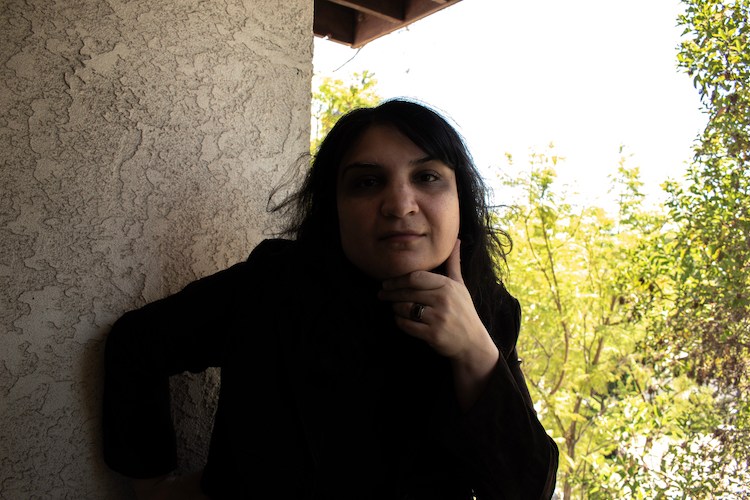
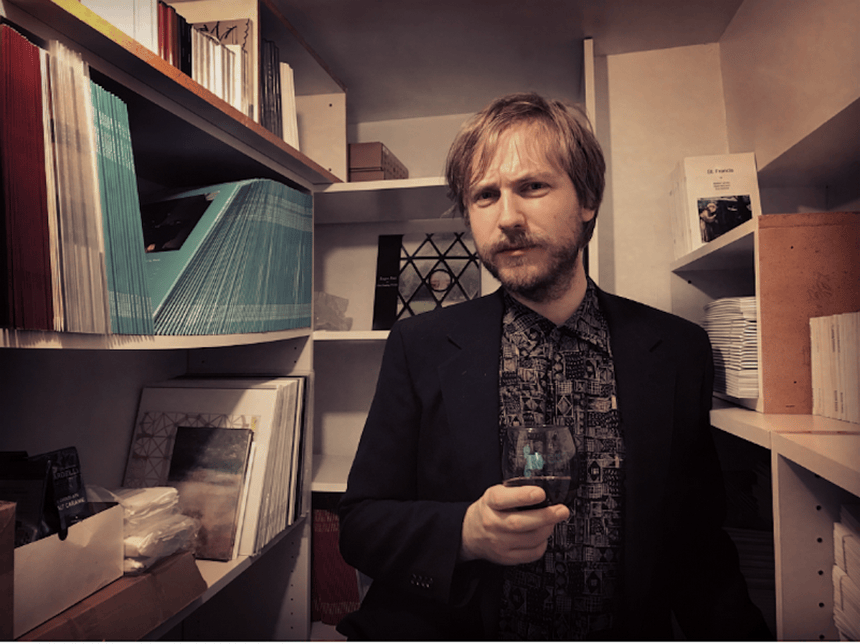
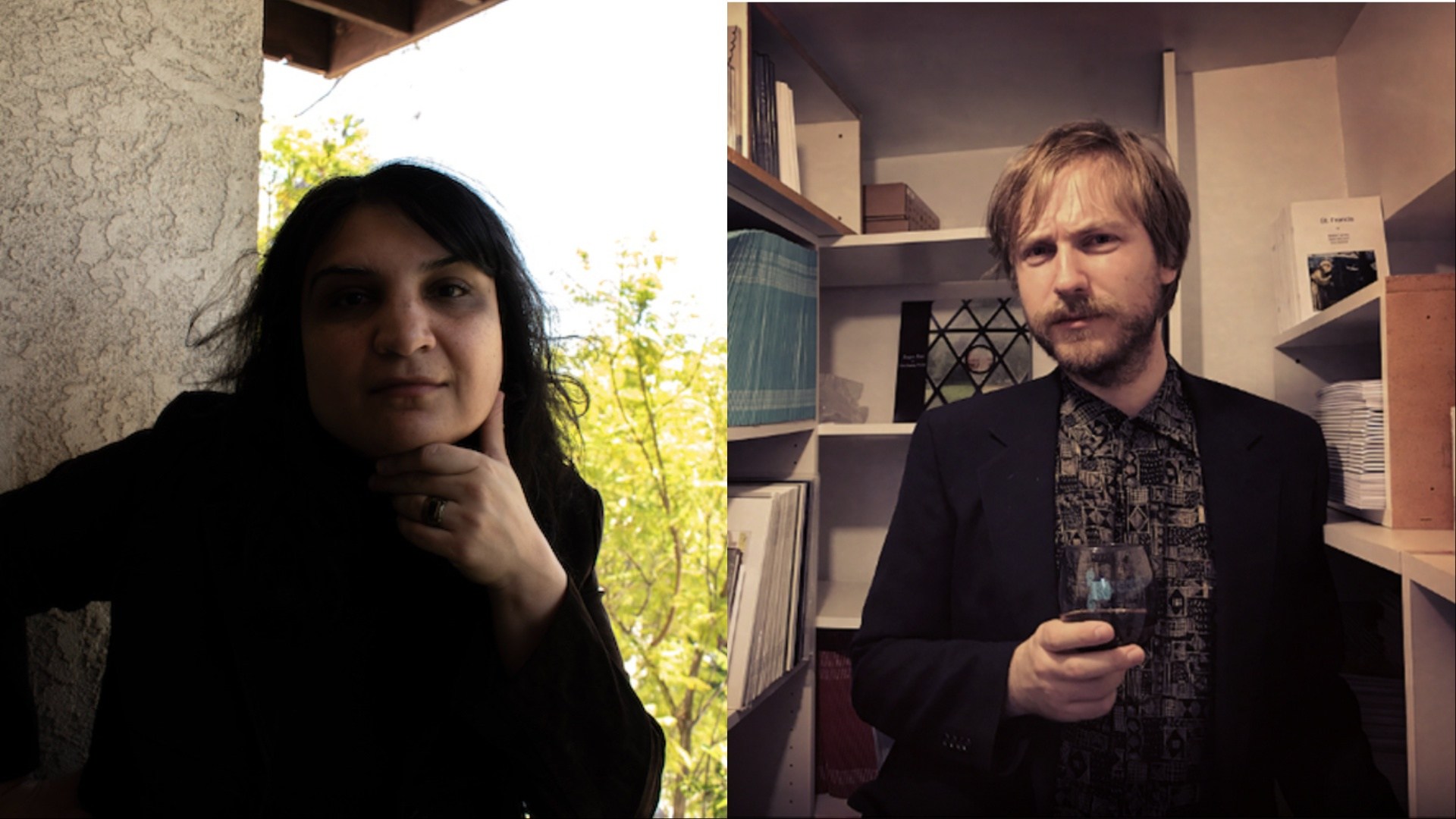
Sarah Davachi is a composer and performer; Sean McCann is a composer and experimental artist, and the founder of the label Recital. Sarah put out two records this year: her latest studio album The Will of Tongues, and now Book of Carols a collection of longform and commissioned music. Sean’s latest collection, Bitter Sea 2008-2011, also just came out last month. Over the summer, Sarah sat down with Sean, her partner, to chat about it all.
— Annie Fell, Editor-in-chief, Talkhouse Music
Sarah Davachi: Hi, Sean. How are you?
Sean McCann: I'm OK. How are you doing?
Sarah: I'm doing well, thank you. We are broadcasting live from our living room in Glendale, California. It's where we’ve lived for about 10 years. What are you opening right now, Sean?
Sean: I'm opening the CD that I’m releasing of my ambient music that I made a long time ago.
Sarah: [Laughs.] You don't sound very enthusiastic.
Sean: Yeah, I don't feel very enthusiastic about anything with music stuff.
Sarah: Why is that?
Sean: I don't know, because it's not fun when you have to try to market yourself.
Sarah: Mhm. Well, I know what the CD is because I've heard it and we've talked about it, but can you tell people what it is?
Sean: The CD is a compilation of 25 of my favorite ambient pieces that I made from the years 2008 to 2011 when I was living in San Francisco. It's like lo-fi ambient bullshit. None of it's that good. It's OK. I mean, I'm biased. But I made it in order to, if I have someone from my work or someone I don't really know who's like, “Oh, you make music?,” I can be like, “Yes, here is the least embarrassing cross section of the music I made in another life that's oddly more approachable than the music I make now.”
Sarah: I would agree.
Sean: Although I don't even really make music now. But the opera I made, The Leopard — if I played that for somebody, they would probably just be like, “Oh, OK…” But this ambient stuff, at least there's some lowest common denominator to grab onto with it. And it does convey some sort of emotion. I feel like there's elements of it that drip into what I do now, whatever feeling is still there.
Sarah: Also, you were really young when you made some of it.
Sean: Yeah, I was 19 when I recorded some of it. I'm 37 now.
Sarah: That's a long time ago… I started making music when I was 20, which I guess would have been the same [year] because I'm a year older than you.
Sean: When did your first tape ever come out?
Sarah: That was way later, like 2012, 2013. The Untuning of the Sky. I was 26.
Sean: See, that's smarter because then you can actually have some sort of coherence and be slightly less cringe-y with your decision making.
Sarah: The music I made when I was 20, nobody will ever hear.
Sean: I have some of it… But it was like a compulsion. It's still a compulsion to make music. But you don't seem to treat it like a compulsion, although you release copious amounts of music. You have a plan. You're very plan-y with it.
Sarah: But I think the plan is a compulsion for me. I think I compulsively plan and organize things, and organize the music that I'm gonna make. That's what makes me excited about making it.
Sean: I get that. With Recital, I do the same thing where I'll plan out releases, and then when it actually comes time to finish them, I'm like, I don't want to do that part of it. That part sucks.
Sarah: Well, my favorite part is the finishing. That's why I release records all the time, because I enjoy finishing them.
Sean: What part of finishing them?
Sarah: I like all of it. I like having the plan, and then I like trying to execute the plan. And then I like when it goes in a different direction and I can modify the plan into something new. And then I like hearing it all come together at the end.
Sean: I hear you, but that's not what I'm talking about. I'm talking about releasing it. Doing the things leading up to releasing it is horrible to me.
Sarah: Yeah. I mean, parts of it are stressful, but it's fun to have people hear stuff that you're happy about. It's fun to present it live and engage with people.
Sean: Well, you have a large following and a listenership that is pretty steady.
Sarah: But when I tour, a lot of people talk to me about Recital, which you don't really get because you don't go out in the world very much…
Do you want to talk about the project of yours that is already out? Before the compilation.
Sean: The project that came out this time last year, on Halloween of 2025, was this opera radio play thing I made called The Leopard, which is a very ambitious hour-and-a-half long quasi-narrative-based sound story. It was a huge undertaking for me, and I really learned a lot from making it and writing it.
Sarah: I think you started working on it shortly after we met. You'd been working on it for a very long time.
Sean: Yes, a very long time.
Sarah: Which is what's interesting to me about you. The way I work is so focused — I go into a project and I go super hard beginning to end, and I finish it pretty quickly comparatively. Within a year, usually, I can finish making a record. Maybe an extra year, factoring in the planning part of it. And you can spend years working. You work on it over and over again and start again and edit it and remove things. I find that scary. But you have no fear of, “I don't like this, so I'm gonna throw it away and start again,” or “I'm going to completely change this thing and try to make it different or better.”
Sean: Actually, I don't agree with that last thing, because I'm so lazy that I will manipulate anything into being usable. I will milk the shit out of something even if that means completely mangling it to be something else.
Sarah: I don't mean starting again from scratch. I mean if it sounds OK but you don't like it, you'll completely change it, and you don't even save the original version in case you want to go back to it.
Sean: It's funny because I learned a lot going through this process, and actually, I kind of learned how to be a dialogue editor through working on The Leopard, and my day job now is a dialogue editor. I'm currently working on Dune 3 as a dialogue editor and all the shit that I did on The Leopard I'm now getting paid to do on a movie — pitch shifting the inflections of words, grabbing from multiple different takes to see what sounds best, de-clicking things. On The Leopard, I was insane about this stuff. Almost every word has been pitch corrected. Now I would feel like, Who cares? It doesn't really matter as much. I think I matured a bit going through this grueling process of working on it. I had to burn myself out…
We have such different approaches — I slave over every sound and every little thing is so important to me, I want it to be perfect, and you are like, “First take, let's move on.” And I think I'm learning that somewhere in between the two is probably a healthy approach.
Sarah: I'm not “first take, move on” necessarily. But when it gets to a point where I'm happy with it, I can stop. I don't keep going after that.
Sean: Yeah. And I could definitely take a page out of that book.
You ride this weird line of inapproachability. Do you think that that's true?
Sarah: Yeah, to some extent. I think in the grand scheme of music, my music's longer and maybe less easily digestible and you have to actually listen to it. If you just put it on in the background, you're going to miss everything about it. I think you have to actually be willing to listen to it in a certain way. So in that way, maybe it's not easy music. But I think also, I've made a lot weirder music. Some of the commissioned pieces, those are definitely weirder because I can be longer and more crazy with stuff.
Sean: Yeah, there's that new piece that I love that I mastered recently…
Sarah: That piece is called “Diptych,” and it was a piece that I wrote for viola… I'm surprised you like that piece. I love that piece, but it's pretty weird.
Sean: Why are you surprised?
Sarah: Because you tend to not like that kind of music. I mean, this is a conversation we've had — you don't really like La Monte Young or Éliane Radigue for those reasons, because it can be kind of intense and feels longer.
Sean: I don't agree with the intensity part of it. That's not what I don't like. And also, it's not like I don't like them. It’s just, they're not my people. That's not my go-to shit. I don't resonate with it.
Sarah: What is it that you like about “Diptych”? Because I think that's actually one of the weirder pieces.
Sean: “Weirder” meaning…?
Sarah: Like my kind of weird. Like brutal.
Sean: You don't think I like brutal stuff?
Sarah: You definitely like brutal stuff, and the shit that you consider brutal is stuff that I don't like.
Sean: Paul McCarthy records.
Sarah: Yeah, it's not for me. I have a pretty high tolerance, I think, for long, difficult, weird microtonal stuff. And if I'm pointing to pieces that are like, “That's especially brutal, that's a weird piece,” then it must be really weird. And I'm surprised that one of the pieces that I think is on the weirder end of things that I've written, you like.
Sean: Well, I think it's a more active piece of yours. And it has this kind of upper register rasp to that's interesting to me, and kind of grating which I normally don't associate with your music. So it's different in that sense, which I really like. It's a beautiful piece.
Sarah: How do you feel about Feldman?
Sean: I've had my Feldman moments, but I also don't give a fuck. It's too conceptual—
Sarah: You're somebody who loves Fluxus saying that—
Sean: I mean, I like interesting sounding recordings and there's a lot of weird, interesting sounding recordings that came out of Fluxus. But, yes, there's a lot of equally annoying bullshit with Fluxus stuff too.
Sarah: I guess I don't mean Feldman like the structure, I'm talking about the experience of sitting and listening to Feldman, something that's that sparse.
Sean: I do not want to sit down and watch whatever-the-fuck four-hour “For Bunita Marcus” or whatever…
Sarah: That's a beautiful piece.
Sean: I know I'm sounding like a total total dipshit here, but honestly, I would rather do something else.
Sarah: I guess that's what I'm tapping into, aspects of my music that don't really have a lot of melodic aspects. Because The Will of Tongues — it's funny, for me, I see that record as actually quite accessible. There's the choral stuff, a lot of stuff that moves much quicker than it would if I didn't have the time constraint of vinyl. The organ pieces on the record have some melodic stuff going on that I think is graspable. But I think a lot of the commissioned work that I do, I lean more into making it weirder because I don't have to worry about how long [it is]. I mean, it has to fit into a concert, but 60 minutes versus 70 minutes is not really a big deal.
Sean: In terms of the difficulty of music, there's that record Sleeping Beauty by Junko, which is just screaming. Would that be difficult music for you? It's just distorted screaming and shrieking [for] two sides of a record.
Sarah: I guess when I think of difficult music, I am using it in the pejorative. I don't think that music that's inaccessible is a bad thing, but that doesn't mean that it's difficult… I think that would probably be hard for me to listen to, just like my music is hard for somebody else to listen to, [in the sense that it’s] uncomfortable or just not what they're used to. But it wouldn't be difficult in that I think I could still hear things in it and find something in it that I find interesting or beautiful. But that one, for me, the only thing that would be unapproachable is just that I don't think I really like loud, intense sound dynamically.
Sean: It's funny that on the Venn diagram, you and I don't really overlap with experimental music.
Sarah: At all?
Sean: No. Well, we both like that piece by John Cage, the whale one. “Litany for the Whale.”
Sarah: [Laughs.] That's the one overlap.
Sean: I think that's why we are a compatible couple, because it's not just with experimental music — most things in life, we're so close to overlapping, but even in this hyper-specific thing that we both like, we're the opposite aspects of it.
Sarah: I like the inside of a bread bun and you like the crusts. [Laughs.] But I think we both appreciate the same conceptual aspects of experimental music. And I think that's something that I've discovered through you as well: there's a lot of latent conceptual aspects to the way that I compose or the way that I think about music that maybe don't come across in the finished product. But the way I think about sound… Somebody I really look up to is James Tenney — who I wouldn't call a conceptual composer necessarily, because his music feels more like fully formed pieces — and I think of my own music as being composed in the same way where it starts from a conceptual idea, and then turning into something else. Whereas I think earlier music that I made was a lot more like, “Let me explore this thing and go from an emotional, intuitive place,” rather than starting with some kind of concept and then building a piece on that. I think that's something that we both appreciate, whether we know it or not.
Sean: I agree with that, that we both start there.
Sarah: But we also don't overlap in popular music. There's some music that we like.
Sean: Like what?
Sarah: Genesis.
Sean: Yeah, that's about it… [A timer dings.] Our pie is ready.
Sarah: [Laughs.] We were making a pumpkin pie this whole time, and now it's ready. So maybe that's a good place to stop.
Sean: Pie o'clock.
Sarah: Well, it was really fun to talk to you. We've talked about this kind of stuff before, but it's nice to be more pointed about it.
Sean: Yeah. I like that we are very different in most things in life, but I also like that we're different artistically, and I think that we can push each other and learn from each other. I think that's a really beautiful thing. I'm very grateful to you for pushing my threshold of curiosity around music. I like to be very well cemented and I appreciate you for loosening up my jelly a little bit.