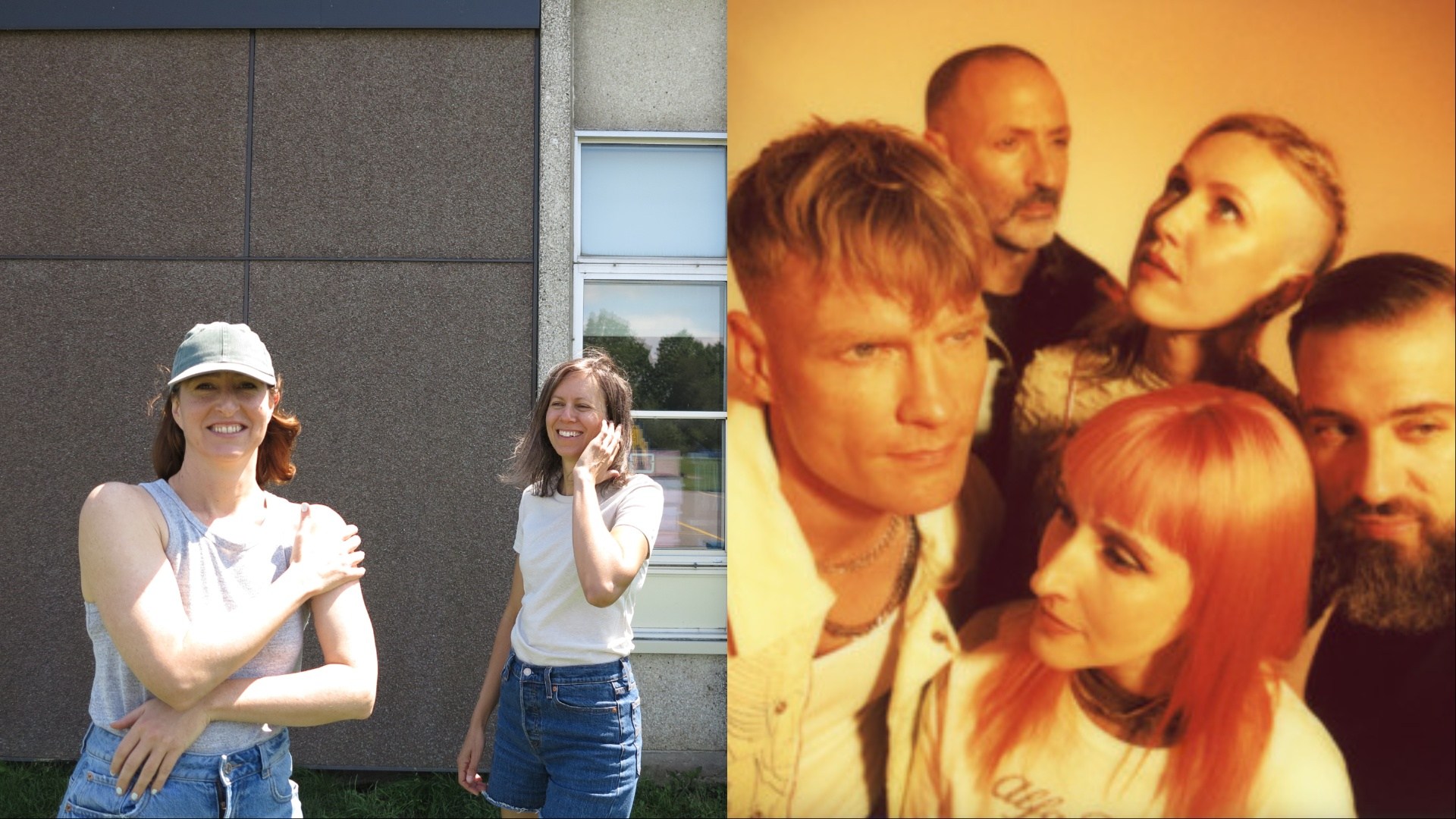

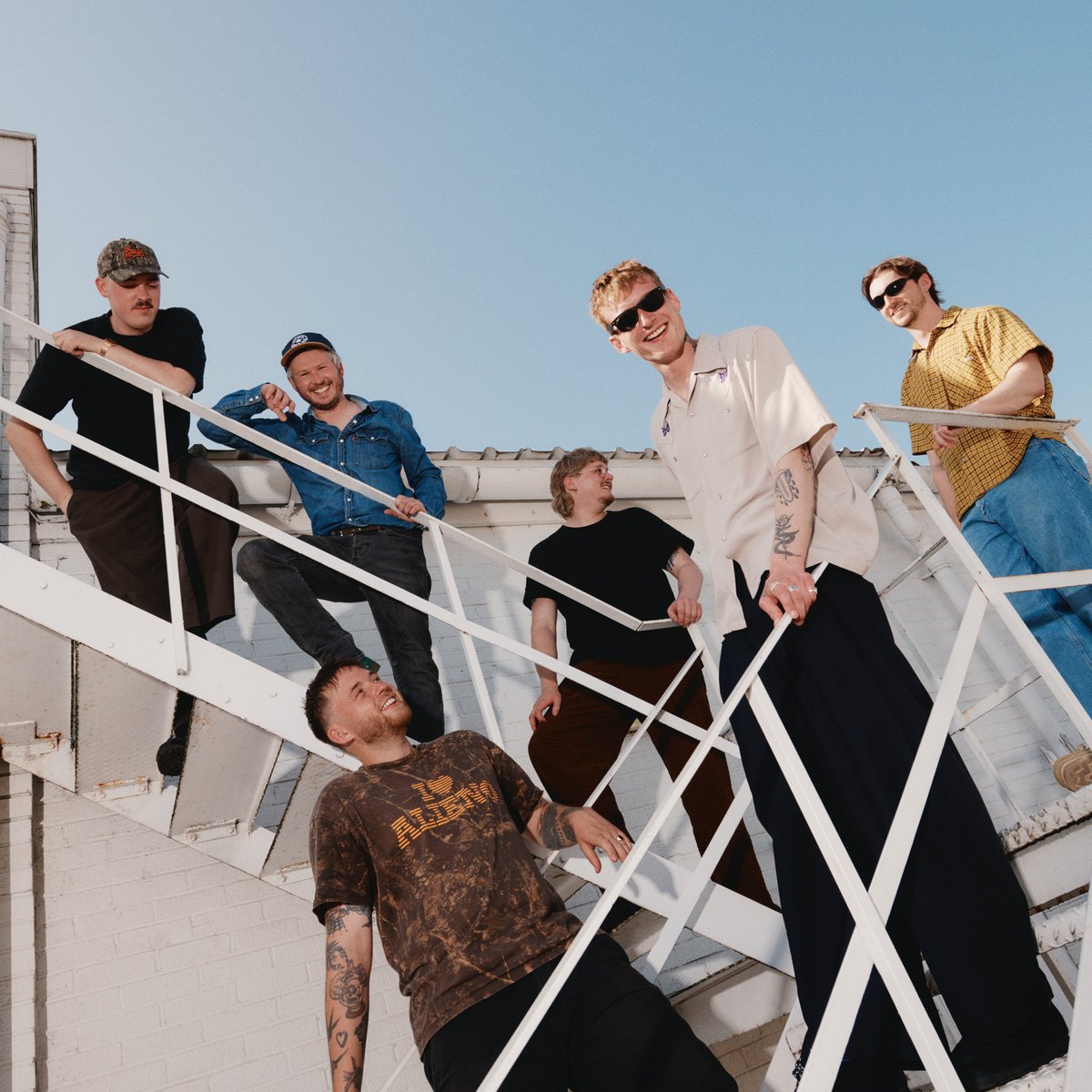
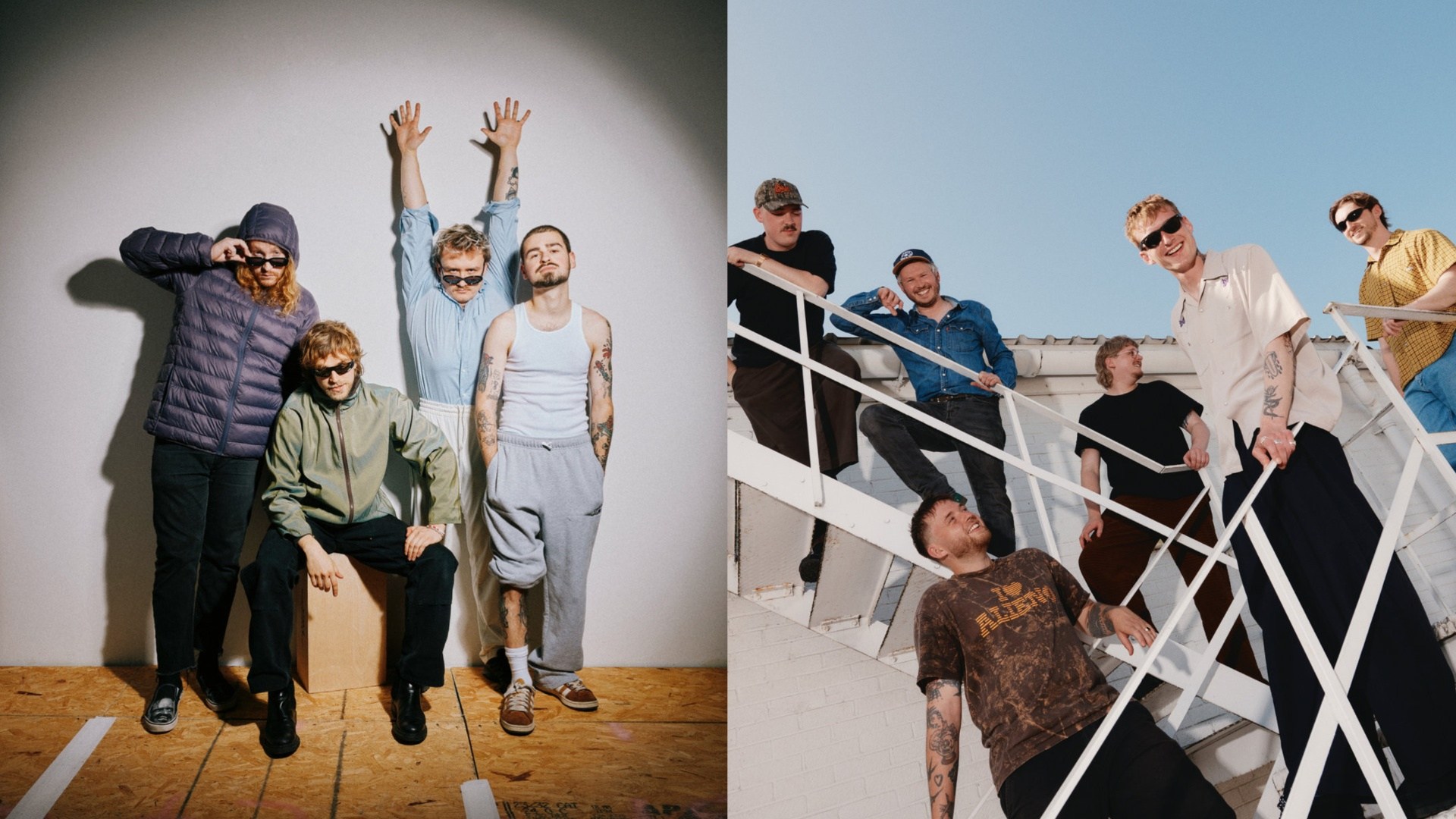
Bret Kaser fronts the Brooklyn-based band Lip Critic; Danny Blackburn, Greg Lonsdale, and Harry Hanson are all members of the Leeds-based band Adult DVD. Lip Critic’s latest record Theft World came out on Partisan this past spring, and Adult DVD’s self-titled full-length debut came out last month on Fat Possum, so to celebrate, the four got on Zoom to catch up about it all.
— Annie Fell, Editor-in-chief, Talkhouse Music
Bret Kaser: First off, massive congrats on the album. It is so sick. I've been aware of you guys since 2025-ish — my friend’s in this band Public Circuit, and I think I was listening to them and you guys autoplayed after on Apple Music. Usually the algorithm on that thing is horrendous, but it was so sick. I feel like a lot of people that are into dance music and people that are into punk music are coming to this weird inflection point right now where we're all kind of realizing we want the same thing.
Danny Blackburn: It ticks all the boxes.
Bret: Yeah. Me and Connor [Kleitz], who produce all the electronics and stuff, both come from a rave and dance music background. I got into producing through dubstep and really dumb 2012 Ableton stuff. And then both Mikey [Sandvig] and Danny [Eberle] are hardcore and death metal people. And I love death metal records, and they all love dance records as well. It feels like you guys came from a similar [background]. I'm seeing you have a Nails shirt and a Power Trip shirt.
Greg Lonsdale: Nails played two days ago, but because it was the American dates, we missed it.
Danny: You know how you guys put the month first, then the day?
Greg: We put it in the calendar like, “Oh, we should make it,” and we were sat at the pub, like, two days ago—
Danny: I saw an Instagram story and I was like, “Wait, Nails at the Brudenell…”
Greg: “I thought that’s a bit down the road…”
Bret: It really doesn't make any sense how we do that.
Harry Hanson: Where are you guys from?
Bret: We're from New York. We’re all from different parts, but we're now basically centered around our studio space in Gowanus, Brooklyn… We're in a very weird pocket — we were just talking about this the other night, how we feel like scenes have kind of dissolved. Maybe overall this is happening, but we've just noticed it in New York. There was kind of a defined digital hardcore scene and a punk scene and a crust scene and then an indie rock scene, and it feels like it has all dematerialized to the point where people are just playing shows with whoever their friends are. A lot of the bands that we were seeing when we were playing a ton in New York, we never really ended up doing gigs with them. We just would see them play. And then the scene kind of exploded and disappeared. It’s just bands now. There's no real cliques of bands that are sticking together or anything.
Danny: I think that's one of the things that when you're growing up and you go through different phases — you have an emo phase and you're only listening to My Chemical Romance or whatever, and then you get into metal and you're like, “I only listen to thrash metal.” And then when I've gotten older, I'm like, “You know what? I'll just listen to everything.” And it's good that that seems to be the case now, that people can just play with anyone and it’s more fluid.
Greg: I think now in Leeds, there's this punk electronic scene though. There's a lot more electronic bands coming up in Leeds. Because I feel like there was a lot of post-punk — every fucking Leeds band was post-punk.
Danny: Yeah, it was like, put a suit on and just do kind of derivative post-punk.
Harry: As soon as the singer wears a suit, I check out.
Greg: [Laughs.] When the singer wears a suit and there's a saxophone…
Bret: [Laughs.] When you're putting together a bill to play, are you thinking about playing with other dance punk-centric things? Or are you guys trying to play with rappers and hardcore acts and punk acts?
Harry: The tour that we've got coming up, the UK one, we got leeway on what we wanted to put forward. I think it's a mix, innit? Because you want to take all the Leeds bands with you, because you're so proud of Leeds bands. But I think because Leeds has got a scene, it feels pretty coherent.
Danny: Yeah, it is quite a coherent lineup, despite what we've just been saying. They're kind of doing similar things.
Greg: Also, our audience is pretty old — that 6 Music audience, if that means anything.
Bret: Yes. We have had a similar thing happen where we'd play one show in London, like the Windmill, and it would be, you know, 20 year olds. And then we'd play 6 Music and the next day, 60 year olds would pop up at the show like moss. They would just be there.
Harry: But they buy the records.
Bret: Yeah, they're awesome. They're always the chillest people I've ever met. So the BBC 6 dad is like an archetype?
Harry: Yeah, definitely.
Greg: Sometimes you do a gig and you have, like, two rows of Radio 6 dads, arms folded, just looking like they're having the worst time in their lives. Then you come off stage and it’s like, “Ah, that was amazing!”
Brett: “Best show of my life!” [Laughs.]
A few of the tracks on this record — I almost don't even want to compare you guys to them, but — a big part of the vibe is very Prodigy-reminiscent.
Danny: I unashamedly fucking love them.
Bret: Yeah, they're one of my favorite bands of all time. I wish I had a Spotify Wrapped for just my entire life, because I'm sure Music for the Jilted Generation is one of my, if not my most, spun record of all time. Do you guys feel like there is some form of a responsibility to not become a legacy feeling thing, or something that feels like you guys are rehashing?
Harry: I think we kind of get away with that because of the lyrics.
Bret: That feels like a huge part of what makes it feel fresh for me.
Harry: I mean, we love Chemical Brothers and Prodigy and just straight up fucking rave music. But I think because we don't write songs from our point of view and we just write stupid lyrics that are taking the piss half the time…
Danny: It's got more of a punk thing.
Greg: But when we are writing, we are like, “This is a Prodigy tune.” There's no shame in that. “This sounds like Prodigy. Class.”
Danny: But I think even if we tried to write something that was directly ripping off the Prodigy, it still sounds like us. We don't have to try that hard. Because we can't write songs as good as them, but we can write something that's definitely a bit like that.
Bret: I think you guys have a very fresh take on it. And a big part of that does feel like this embrace of a very contemporary sense of humor. It feels like it couldn't happen at any other time. We get compared all the time to Death Grips, and we'll get compared to Machine Girl, both of which are acts that we love of course. But I'm always just like, “If MC Ride was out here talking about enjoying the act of brushing his teeth or buying scratchers and hoping that you're gonna get yourself out of debt or something…” It would almost be below him. What I'm doing so much of the time is trying to get somebody to crack a smile or go check the lyrics like, “Did he really say that? Was that actually what I heard?” I feel like there's a real embrace of humor that we both share that separates us from the stuff that came before us.
Harry: Yeah, it definitely feels similar lyrically. Do you say on one of the songs, “I'm in a drunk space, I'm a drunk guy?”
Bret: “In that junk space, I'm the junk god.”
Harry: [Laughs.] I thought it was drunk!
Bret: [Laughs.] That's honestly kind of fire.
I wanted to ask — a lot of the tracks that are on this new record feel like they came out of some form of jamming. I don't know if they did or not, but…
Harry: Literally the opposite.
Danny: Categorically no. I think we've all been in bands before where that's how we've written in the practice room. But with this band, this is really quite boring, but we just literally write sat around the computer. We've been demoing everything with MIDI drums and then build it up from there.
Harry: We've never been in a room all together writing a song; we do it in twos or threes and then pass it around the Logic session or whatever. And then when we go in the studio, that's when we actually put the final drums on. So Johnny [Newell], our drummer, he doesn't touch the songs ‘til [we’re in the studio]. Sometimes he hasn't even heard ‘em ‘til he’s at the studio and we’ve got two weeks booked out.
Bret: We honestly work in the exact same way. Connor and I produce basically just sending sessions back and forth. And we'll do days where he's at my studio and I'm at his studio, and then once we have a version of the track together with a MIDI drum in, we'll basically mute our MIDI drums and go to the practice space with the drummers and have them play over it, get their fresh takes. And then we'll be like, “Here's our take,” and we'll merge the ideas.
Harry: We should do that with Johnny and not let him hear the drums.
Bret: It's an interesting way to work. There's moments where I hate it more than anything, where I'm like, This feels so divorced from the idea of being a band. And then there's moments where I'm like, This is so cool, because I end up getting these things where, we'll put the final drum pass over something, and then I'll completely delete the production from the section they were playing over, and I'll reproduce over now their drum part because it's re-influenced me, like, “Oh, man, this would sound cooler with something else.”
Harry: A chicken-and-egg thing going on.
Bret: Yeah. It's kind of the sickest thing ever. And then, you know, sometimes I'm just like, God, I wish I could just be playing a bass. I wish we could just be in the room.
Harry: Well, that’s kind of why we didn’t do it. We're better now at playing synths, but we were all really quite shit at playing synths. So the four of us all in a room together, it just sounds…
Danny: If you said to me, “Play a G sharp on that keyboard,” I'd have to go, “Alright…” [mimes poking at a keyboard]. [Laughs.]
Bret: I wanted to ask a selfish question on merchandise, because I design all of our merch and it's almost become an even job between that and making albums. I'm like, Dang, I have to finish mixing this album, but I also have to design nine pairs of socks today… I almost value it on a semi-equal footing, because there's so much design space and cool stuff you can do with it that goes beyond it just being a thing you do to make money when you're on tour. I wanted to ask how much you guys value merch as a creative space versus this financial necessity in keeping your music going.
Harry: Well, I think merch is the only thing that we don't really do, to be honest. We do everything else and we kind of farm merch out. Recently for the album launch, we did a collaboration with a skateshop, and Sam who runs the shop did all the designs, and he's now designed some for the actual tour.
Danny: We used to do it ourselves.
Harry: We used to do it as cheap as possible. But now we're getting the heavyweight cottons in there and the box fit. Now that we know there's going to be a demand for it, we can actually care a lot more about it.
Greg: Also, because there’s six of us, it was a case of everyone having input in the merch, and everyone just arguing for six t-shirts. But when we farm them out—
Danny: Since we've been getting Sam to design them, we are actually all happy with them.
Harry: Having another person come in and be like, “I think this is what the band represents. I think this is what’s good,” and not caring about how heavy it is with the logo or how heavy it is with the album cover and just doing this sick design, that's been pretty refreshing. And that means you can charge more money. [Laughs.]
Bret: How do you guys feel the transition has been from being releasing stuff independently and now moving to a label that's got an infrastructure and press and all this stuff?
Danny: We did the EP, and that seemed to go pretty well even though we did it all ourselves. But having a label behind you…
Harry: Yeah, they don't really step on our toes. They come up with ideas and suggestions, but they're not gospel. You don't have to do them. So it's been nice, definitely.
Bret: How much input did they give on the actual songs that ended up on the record? Were they being like, “This needs a bridge,” or something?
Harry: Sam from the label, who's like our A&R guy, he did this thing every time where he'd be like, “Yeah, I'm not sure about that song on the record. This stuff needs work.” And then he'd always sign off with, “But at the end of the day, it's your record. You can do what you want.” Which is the worst thing you can tell a band. It’s like, “Cool all of the last half an hour of what you've just told us, we're going to ignore.” [Laughs.] But how about with Partisan?
Bret: I feel pretty similar. We were self-releasing and releasing with tape labels. We met with a few labels when we were going to release Hex Dealer and we couldn't have been more turned off by the prospect of being on a label. We were self mixing, self recording, self-releasing like, what do we need? And then I met with the guy who owns Partisan, Tim [Putnam], and it kind of instantly changed my tune because of just how antithetical to every other label he was running his label. I was like, “OK, let's try this one out if they'll have us.” And we've had an amazing time working with them. A lot of our ideas come down to, we have an idea, but we can't execute it because of budget or manpower, and it's helped a ton where you can propose something completely ridiculous and they'll just be like, “Cool, let's see how we can do it.” I was trying to get a stilt walker in the show we played in New York — I was like, “I want a nine foot tall dude. Can we get that done?” And they were like, “Yeah, absolutely.”
Well, it’s so nice finally talking to y’all. I’m hyped to see y’all play the States! I'm sure it's going to rip.
Harry: I'm excited to go to New York.
Bret: And congrats on the record. Shit is fucking awesome.
Danny: Same to you.
Greg: Cheers, man.