I was surprised at how easy it was to get a film deal, after just a quick email. And equally shocked at how easily that turned into me directing two films. At the same time. With a six-month-old at home. I’m not sure if it’s true, but I’ve been telling people I’m the first person to ever do it. In hindsight, it was an incredibly foolhardy thing for a first-time director to do.
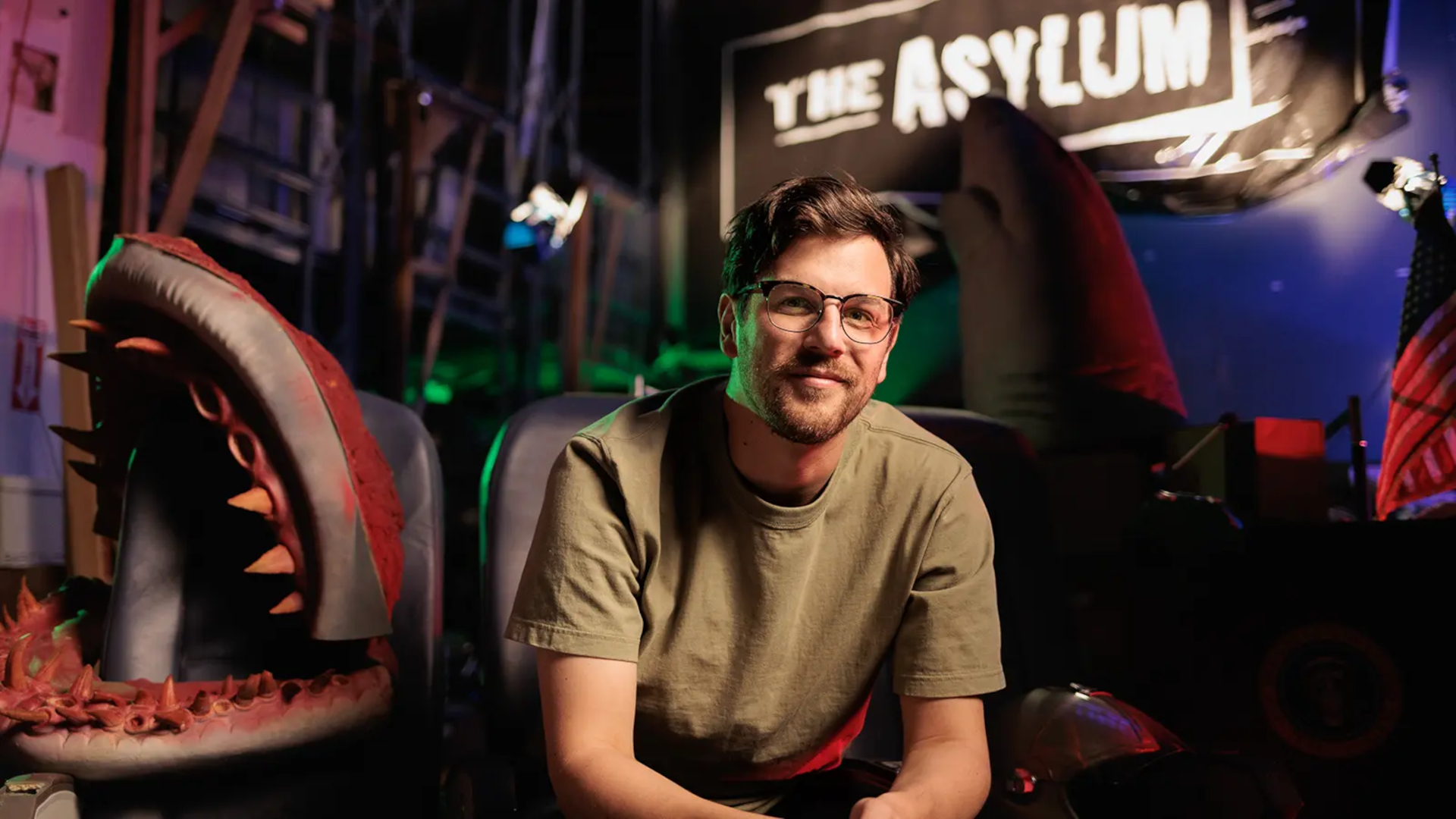
While not a massive industry player, the Asylum is legendary in its own right. The fact that someone at the company replied to my cold email, offering me a chance to direct a movie, speaks a lot to the character of the three heads of the Asylum: David Rimawi, David Latt and Paul Bales.
The Asylum’s filmography includes the unforgettable Sharknado series and the television show Z-Nation. But their bread and butter is films like Transmorphers, The Da Vinci Treasure and Tomb Invader. These are called “mockbusters,” and they are movies that capitalize on the marketing campaigns of much larger studio films.
So I did what any budding documentary filmmaker would do and decided to turn my new directing gig into a film of its own. A behind-the-scenes documentary chronicling my journey through the Asylum wringer. I decided to call it Mockbuster.
When the documentary crew and I arrived in Los Angeles to visit the Asylum, I learned that the film I would be directing would be a loose adaptation of the Edgar Rice Burroughs novel The Land That Time Forgot (which is now public domain). The reason for this new iteration was apparently that dinosaur films are a hot property in Japan. I also found out that the script wasn’t ready, the budget was laughably small and I had six days to shoot it in my hometown of Adelaide, Australia.
I then met with the Asylum heads and their regular collaborators – from Oscar-nominated actor Eric Roberts, to stage manager and screenwriter Joe Roche – to learn what went into making a film for them. I came out understanding that I’d have to go in prepared, getting a shot was better than getting the perfect shot, and to keep shooting, no matter what.
Back home, my first goal was to try to crew the film. But no one believed it was a real production. I kept hearing, “There’s no way we’re making a dinosaur movie for peanuts in less than a week.” And when people found out about the documentary, they became even more skeptical, suspecting it was part of something like Candid Camera. I even started to doubt whether this film would stay afloat, until in a final Hail Mary, Brendan Petrizzo, a line producer from the Asylum, flew down to Adelaide and refused to let it sink. But once the film was crewed, and cast, and the script finally arrived, I thought things would get easier. They didn’t.
The script was filled to the brim with guns. In Australia, to shoot even with toy guns, you need an armorer on set. And armorers are expensive. So, all the guns were swapped out for axes and pocket knives, leading to scenes where a tiny pocket knife takes down an enormous Tyrannosaurus Rex, and there are constant decapitations of Velociraptors with painted red fireaxes.
Day one of the shoot, I’m on set of my debut feature, ready to shoot both films simultaneously. But issues arise immediately. The costumes aren’t ready; the Asylum heads have a specific vision of what they want them to look like, and it’s completely different from what my costume designer, Courtney Palmer, and I have in mind. The script was changed again the night before, so the actors are forgetting their lines and even I am getting lost. Everything I have prepared up until this point has been rendered utterly useless.
Day one was supposed to be an easy day. Only 11 pages needed to be shot that day, compared to the rest of the shoot, which was edging closer to 25 pages a day. It was a studio shoot where we pulled together the inside of a submarine from a few cheap flats, some Christmas lights and ethernet cables. Things were contained, though at close quarters. The shoot was a pressure cooker already. So it was no surprise when an argument broke out between David Margetts, the lead actor, and Aaron Schuppan, the cinematographer. Non-confrontational by nature, I stepped back and hoped it would resolve itself. But, also, in the back of my mind, I knew this scene would probably make it into the documentary. Then there were more arguments, people sleeping in, inaccuracies with key costumes, a constantly changing script …
So, as things started falling apart, the documentarian in me saw opportunity, but the fiction filmmaker in me saw only disaster.
I realized quickly that you can only control so much when you’re making documentaries. While your notes and treatments can inform the spine of the story, real life will do whatever it wants. The same is true with making mockbusters. Yeah, you have a script, but you work at the behest of the studio execs, the cast and crew and just the general chaos of making a film for the Asylum.
Throughout all of it, there was a constant whiplash between directing the film and directing the documentary. And the worst part was this: the more chaotic production on The Land That Time Forgot became, the better the documentary would be.
Meanwhile, I was trying to hide that reality from The Land That Time Forgot crew, so they could forget the fact that this whole thing was being filmed.
By day two, we were in the swing of things. Most of the costumes had been approved, so we could get out there and shoot. We accidentally booked a location near a school and had to spend our day fighting against the sound of yelling children, and the freshly mowed lawns didn’t look too prehistoric … but we just had to keep shooting. We had a film to deliver.
On day five, the scene we had to shoot was so dry and lifeless, the documentary team and I had no idea how to cover it. It was a nine-page scene, which equates to about nine minutes of screen time, in which a man speaks about the terrain and a search for a water source, in the driest way possible. It was the most lost I felt on both projects – having no idea how to make this scene in The Land That Time Forgot interesting, and not knowing how to represent it in the documentary.
It was somewhere in the middle of shooting that scene when I gave up trying to treat both films as separate and realized they were part of the same job. I’m still not sure if that's a good way to make a film. But it's the only way I was able to make these two.
The Land That Time Forgot is already out there in the world, sitting on a humbling 2.6 on Letterboxd. Mockbuster is just finishing up its festival run. I haven’t directed anything since, so I can’t tell you for sure if this has changed how I’d do the job, but I do know that no amount of preparation would have made this shoot easier. My job was to just make sure we kept shooting both films. If I had to do it all over again, I’d still jump at the chance to direct both movies.