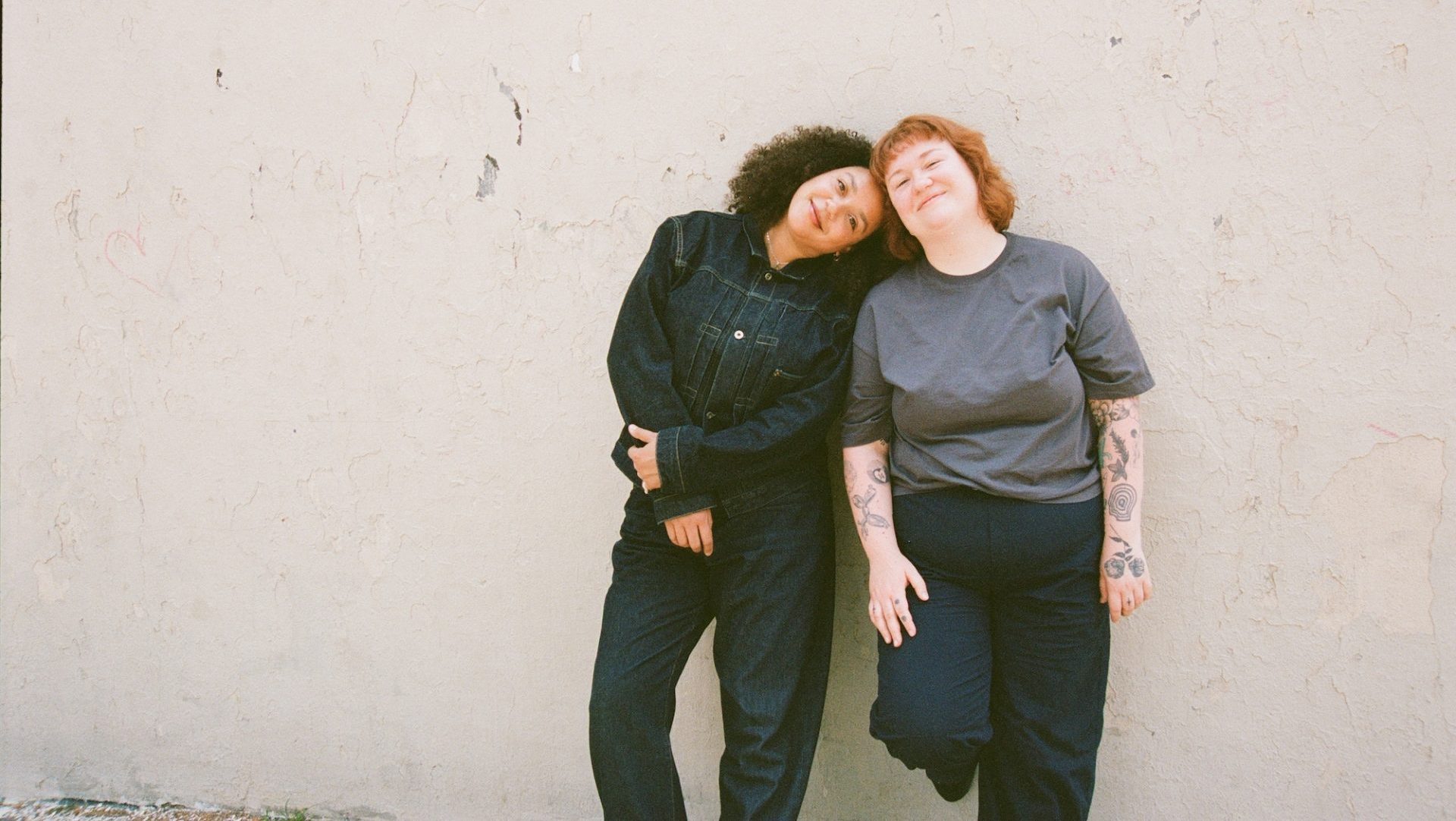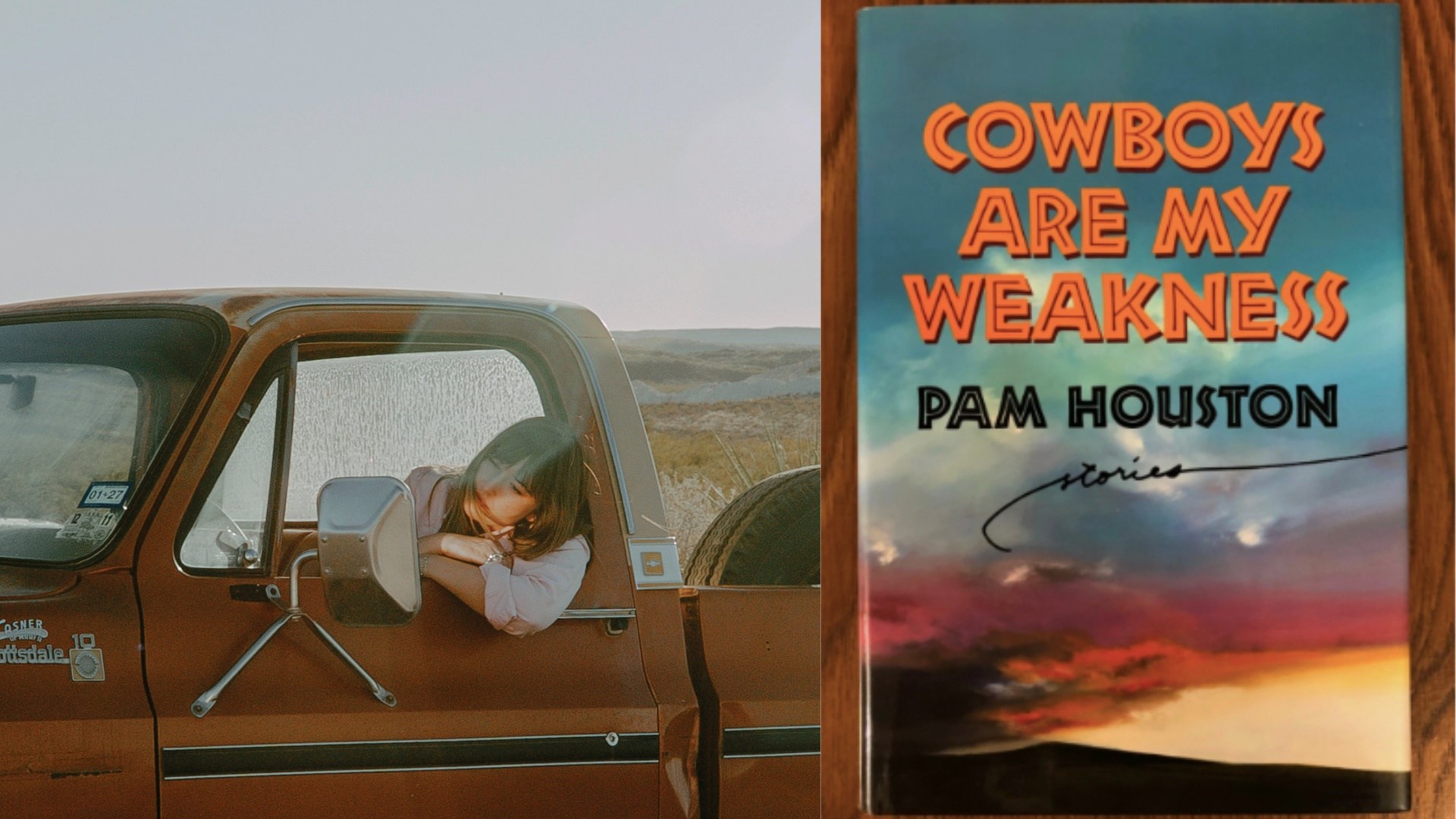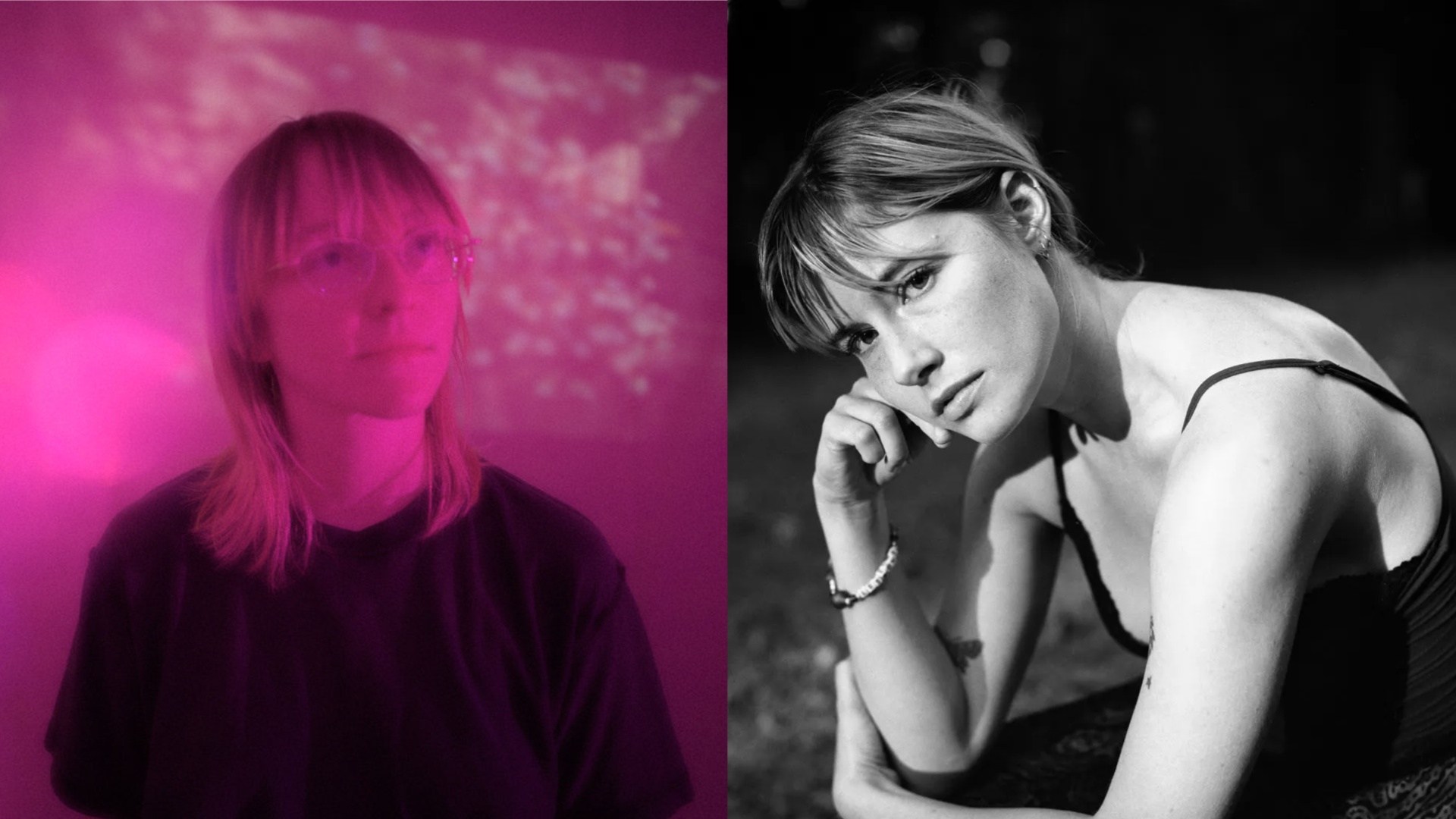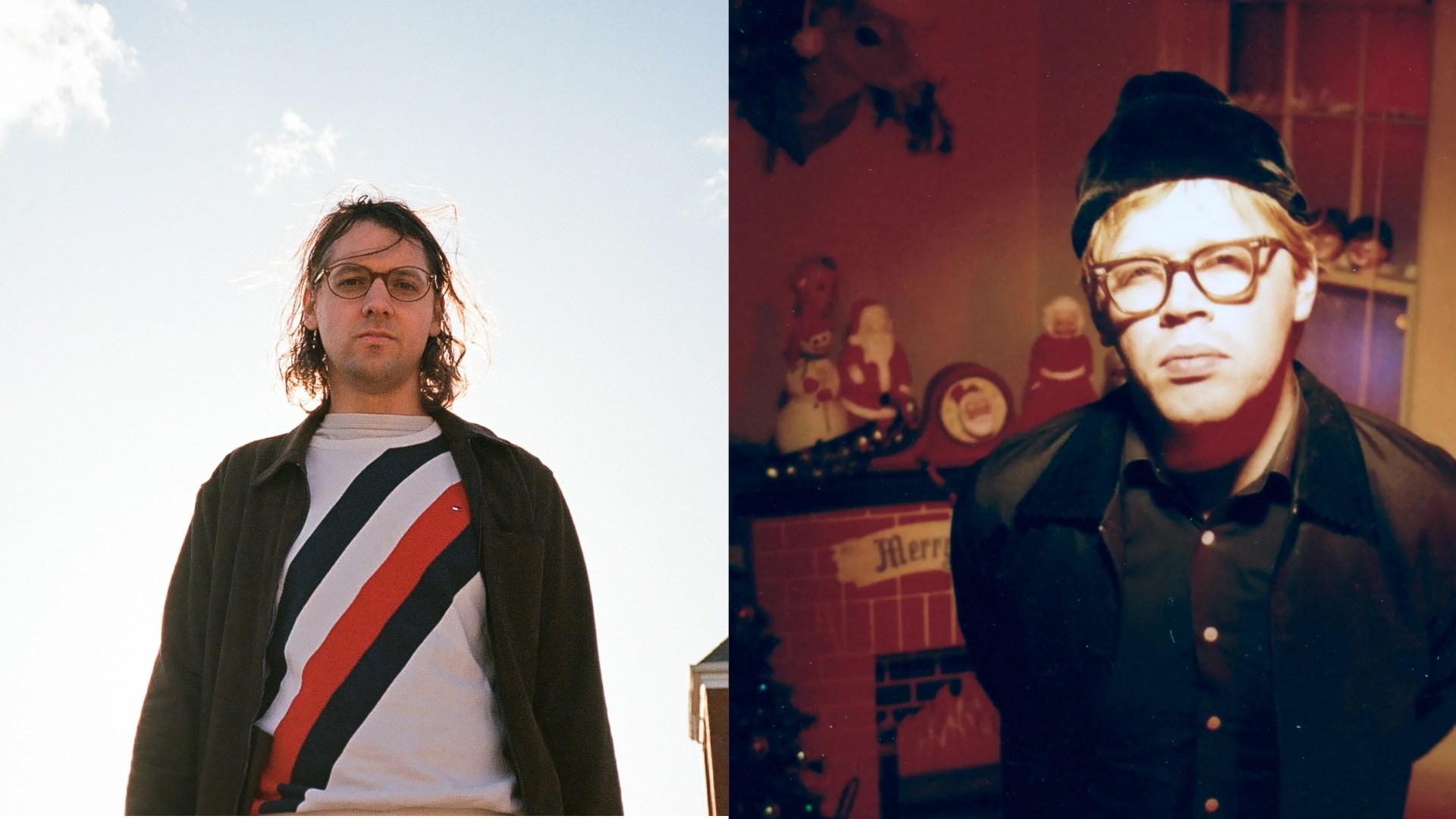
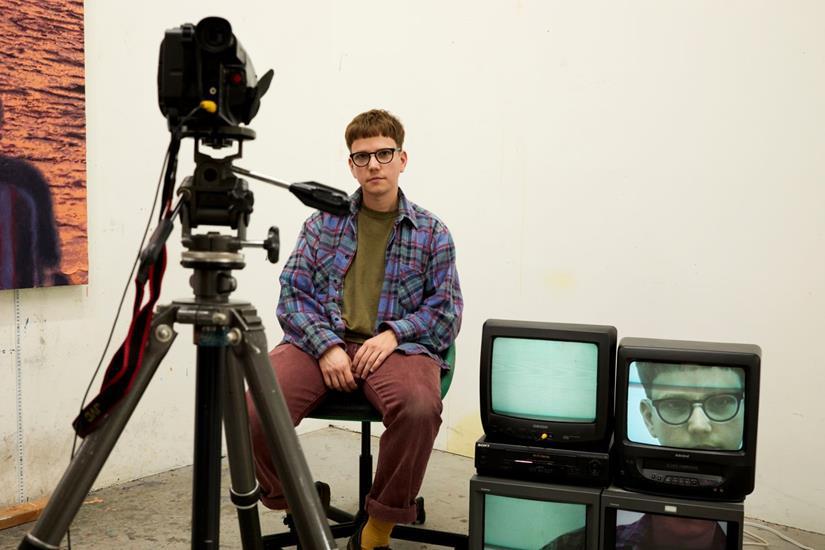
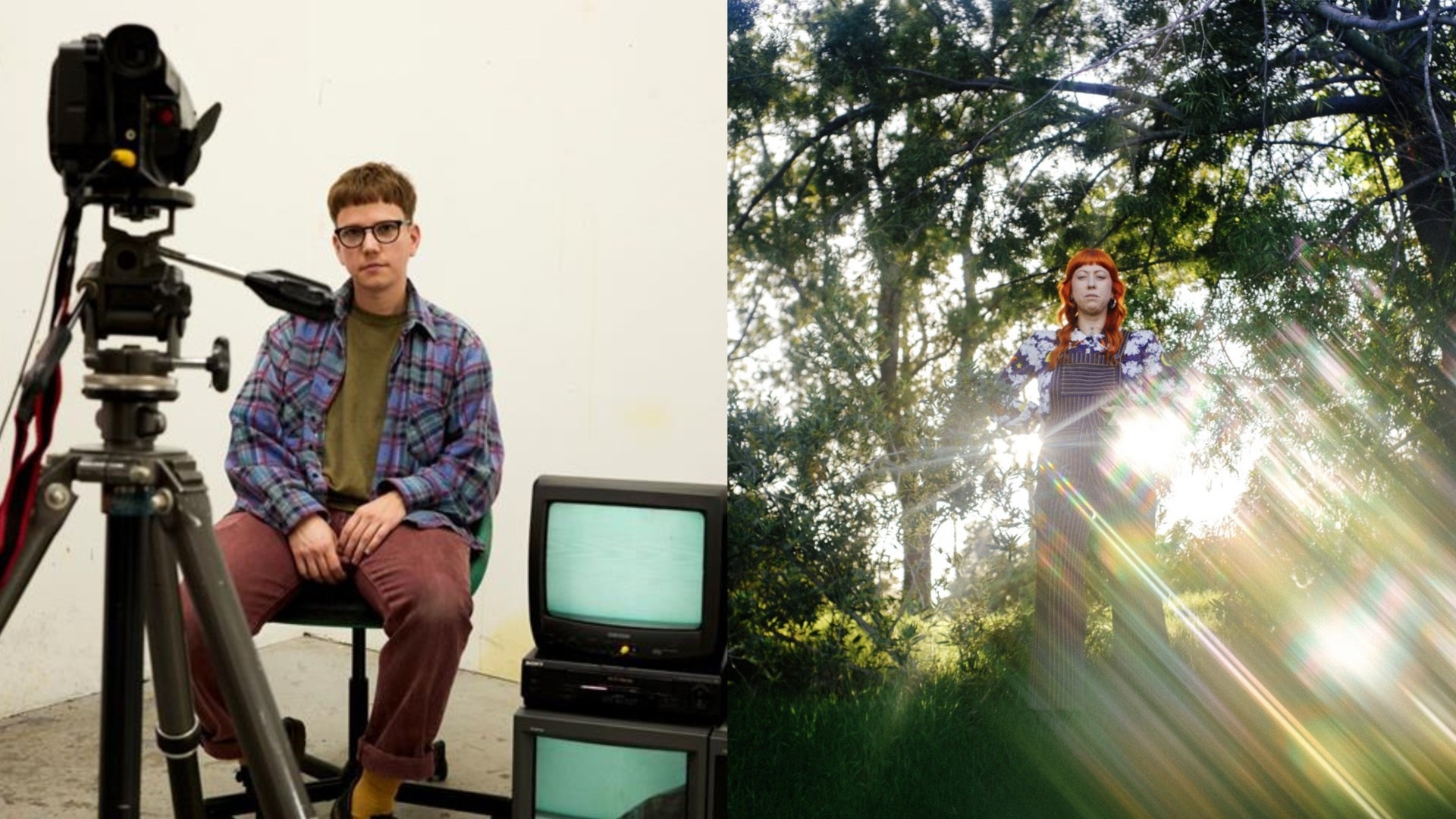
Sean Solomon is a musician and animator based in LA; Shannon Lay is a singer-songwriter also based in LA. Sean is releasing a deluxe edition of his debut record The World Is Not Good Enough, which will be out this Friday, October 16, and includes VHS renditions of the songs, both digitally and on VHS tape. Shannon features on the record, so to celebrate the release, the two longtime friends got on Zoom to catch up about it.
— Annie Fell, Editor-in-chief, Talkhouse Music
Sean Solomon: I guess we should talk about how we know each other, because it's kind of fun.
Shannon Lay: That's true.
Sean: We lived together. And what's so weird about that is, not only did we live together, but that's how we met. You were moving into the house and you started unpacking all this Simpsons stuff. That's my first impression of you: you just start pulling out Simpsons toys like a magician. I was like, “No way!” We were kind of like children in kindergarten — you were like, “Look at my Simpsons toys!” And I was like, “Wait, look at my Simpson toys!” And then we became best friends.
Shannon: [Laughs.] And then a friendship formed, yes.
Sean: And I think what's also interesting — well, actually, before I keep rambling, was that your memory of meeting me?
Shannon: Totally. I don't even remember how I found that house… I feel like it might have been through you somehow — we might have connected before I moved in.
Sean: Oh, I think you're right.
Shannon: I was definitely guided there by some divine energy that had my back. I remember that house and living with you so fondly, and I think joining forces with you in that house made me realize how important Simpsons nerds are in my life. It's such a fun basis to connect with people and usually means that there's going to be a deep bond no matter what the circumstances are.
Sean: I agree.
Shannon: As a Simpsons fan, as a musician, as a person, that house was so formative for me.
Sean: It was a famous house to me because, you know, we had the practice space in the back, and when I was in high school, I actually recorded music in that house.
Shannon: Woah.
Sean: But, so, I was living somewhere else and I was like, I gotta get out of this house. I’d moved in with this girl who worked for Forever 21 — she was a designer, she made the shirts that said, like, “I Love Avocado.”
Shannon: Doing the Lord's work.
Sean: Yeah. I don't know how I met her, through Craigslist or something. I moved in with her and the walls were really thin and she would do this thing where she would talk to me through the wall — like, “Sean, are you awake?” I moved in and then one week later I was like, “Actually, there's a room in this house that has a practice space, I know I just showed up here but I have to go.” I moved twice in one week so that I could be in that house. And I thought I would never leave — I thought I was going to die in that house, maybe buy the house, I don't know. And I meet people all the time that are like, “Oh, I recorded in that house.” Like King Tuff, or Patty Schemel practiced in that house. It's kind of a famous house. I don't know who lives there now or if it's still going, but…
Shannon: Legendary domain. I know Jess Cornelius took my room after I left.
Sean: So many musicians have been in the house. And then Abby Banks after her, the author of Punk House.
Shannon: Another Legend. My room in that house was fun, too, because it was literally the size of a queen bed. I had a full size bed and all of my clothes were hanging up from the ceiling around me. And I had one tiny dresser.
Sean: Your room was magical for sure.
Shannon: It was such a unique space. It was such a trip. Having that practice space was huge. I always sang in a pretty head voice because I didn't want to bother my previous roommates. I would just be in my room being as quiet as I could be. [Laughs.] And then having the practice space, you could really let it rip. That's such a unique thing to have.
Sean: It was pretty amazing. And another thing that's special about that house is, because of how disgusting it was, we had rats everywhere. You were like, “Hey, maybe we should get cats because we have so many rats.” And I was like, “Oh, yeah, I'd love a cat.” Maybe my memory is making this up, but I'm pretty sure the next day you were like, “I found these two kittens behind Permanent Records. This one's yours, this one's mine.” And Maggie's still going strong, dude.
Shannon: [Laughs.]
Sean: Named after Maggie Simpson. He's in the other room recovering from his tooth surgery.
Shannon: Maggie's a majestic beast. We thought he was a girl when we first got him because he was so pretty. He had this, like, white eyeliner. And then when we took him to get him fixed, they were like, “That's a guy.”
Sean: Yeah. And he was very masculine later, his personality…
Shannon: My cat was Asa. She was quite the lady. She was a short hair, all gray.
Sean: There’s so much lore, because you have a song called “Asa.”
Shannon: I do, and I wrote that about being at that house. It was about how good the sunsets were in that backyard. I smoked ciggies at the time and I would go in the backyard with a little glass of wine and a ciggy, and I would just enjoy the sunset.
Sean: It was an amazing house. I'm hoping that one of my creative pursuits blows up so I can afford a house in Echo Park in the hills with a practice space again. A unique thing, and I don't think it will ever be possible for me because I don't want to live with four roommates ever again. [Laughs.] But it was a great time.
Shannon: I'm holding out hope, man. We can do it. We can get our four bedroom mansions just for ourselves.
Sean: I'll listen to something and then [the algorithm] starts autoplaying stuff, and yesterday it started playing FEELS. I was like, “What is this? It sounds like Shannon… Oh, it is Shannon! She's in a rock band!” What I thought was so strange about FEELS is it's just the same beautiful, folk, mystic voice you always have, but it's over garage rock. I thought it would be a little bit different, but it was very similar.
Shannon: Yeah, I remember getting a little punky and screamy in that band, but we had fun with the harmonies too. We always kept it pretty. [Laughs.]
Sean: And I saw you writing the songs in the house.
Shannon: It really was a launch pad for the rest of our lives, is what it felt like. I moved out of that house in I think 2018, and then 2019 was such a whirlwind. And then the pandemic hit, and it just felt like without that foundation of building that confidence… It reaffirmed that I could do it, you know what I mean? That I had it in me and all I needed was either a computer or another good bud to hit record. Everything was so within reach. I remember making my first record while living at that house, and it was with Jeffertiti [Moon] in his garage. He lived just a stone's throw away and had this great garage studio. That whole neighborhood was just so impactful. Echo Park in that era was amazing. It raised us all.
Sean: I'm like an old man. I'm like, [old man voice,] “This used to be a liquor store…”
Shannon: I know, now it's a Crossroads.
Sean: [Old man voice,] “Now it's a thrift store. This was called Bright Spot and they had an incredible vegan club sandwich once, and now it's a weird chicken restaurant…”
Shannon: All the places I used to go — I don't go to the Echo anymore, or the Gold Room. I remember going there all the time. They had that taco and beer and shot special… It's a completely different vibe down there.
Sean: Now we're old.
Shannon: [Laughs.] We got too old. You live in Burbank, I live in Pasadena. We're retired now.
Sean: Things are changing… Anyway, we moved out, the pandemic separated us. No one wants to hear about the pandemic. And then I recorded a bunch of demos, I sent them to you, and you were the one that convinced me to record an album. I like to give you credit. I don't know if it's 100% true, but it's part of my lore that I've created. But you did motivate me to do it, and you introduced me to Jarvis [Taveniere, producer] I remember it meant so much to me because I hadn't shown anyone the songs. I was just like, “Shannon, I want to send you these.” I felt safe with you. It was kind of in the same genre, almost. You were really the one that got the gears going for me, and so in a lot of ways shifted the trajectory of my life.
Shannon: [Laughs.] I'm OK with the weight of the lore because I remember it like it was yesterday. It was an impactful moment for me too. You're such a multifaceted artist, and so when you homed in on your solo stuff, it was so exciting. Because you've obviously been pretty band-central for most of your musical life, so to hear what you wanted to do on your own was so epic. And I've always related to you in so many ways. We have a very similar background of our childhoods and just parent stuff. So it hit me in this spot, and I knew needed to be heard by more people, because it can be really isolating having a mentally ill parent. And the way that you put it, it was so touching and so relatable, and just made this isolation that can kind of wrap you up just dissolve in this really beautiful way. I think in the end, all we need is to remember that we have way more in common than we think we do and that it's not the end of the world to feel different and so trapped within your experience. Those kind of records are like a door into the real world out of your perception.
Sean: I think it's so important to find purpose in what you're doing — I know this sounds like some therapy speak or whatever, but sometimes I'm like, What the fuck? Why am I doing this? And it's easier when you're 20 or something. You're like, “I'm trying to look cool.”
Shannon: And you're just a freight train. You're just like, “Yes, yes, yes, yes, yes,” and going, going, going and there's not really any logic to it. You're just like, “I have to forge ahead.”
Sean: Yeah. And I think as you get older and you're like, Well, I could get a job and have children, or I could tour in a rock & roll band. And you kind of have to be like, Why am I doing this? And I think what you said, to me, is why making music is so important: to be able to transmit complex feelings in ways that are easy to digest and everyone can project onto. And I feel like music is such a great way to filter out people. You're like, “I relate to this song.” “Oh, I relate to it too.” And even if you have a different background or a different experience, there's something almost deeper about it that makes you relate to it.
Shannon: Well, I also have this theory that everybody's saying the same thing in a different way. You know what I mean? Every genre is kind of echoing each other and this whole hero's journey that we're on… But I love how I met you and that immediately you felt like family. You're a great person to have in my life.
Sean: I feel the same way. Shannon. And I mean that even though we're being recorded and I’m obligated to say that back. [Laughs.]
So, now, I’ve rerecorded the whole album as these VHS lo-fi versions the way I play them live, and I'm doing an art show October 16 to celebrate the VHS versions. Just yesterday, I framed a hundred drawings, because the music video for “Black Hole” — which is the song that is about the family drama stuff that we were talking about — I made the hand-drawn animated video and it was 99 drawings looping. This is so complicated that I don't even need to explain it, but it's an experimental animation technique where I used 100 sheets of paper and kept drawing on and looping and messing with. And I framed all of them yesterday for my art show.
Shannon: I love how you merge your visual art with your music. I think it's so unique. And it's funny because I know your cartoon journeys in a way that other people don't — you've made so much stuff that's almost gotten to the point of getting greenlit and then it doesn't. You’ve fleshed it out to the point where I've watched an entire episode of a show that you've created. I can't even imagine living in that world and putting in so much work. There's just such a big ebb that must happen after you put in so much effort and then someone will get swapped out at a company or something and everything will change. That must be so frustrating. But I love how you merge the two worlds. I think it's incredible.
Sean: Up until now, I will keep flip-flopping like, “I'm an animator. This is a real industry. They pay you.” And then someone will be like, “Hey, we're not going to make your project. Sorry.” And I'll be like, “Fuck this, I'm a musician. Musicians more real and authentic.” And then they're like, “We're going to pay you $200, and no one came to the show,” and I'm like, “I'm an animator again. Screw this.” [Laughs.] It seems so simple that you would be like, “I’m an animator and a musician. I should mix those things.” But it took me until now to do it.
But, to go back to what you were talking about: no one knows about my secret life as a commercial TV pilot writer. I've been trying to make a TV show — because of my love of The Simpsons, honestly — since I was 20 years old. I went to school for animation, because my parents wouldn't let me go to school for music since hey said that wasn't a real job. Turns out they were right. [Laughs.] But anyway, I went to school for animation with the intent of, “I'm going to make my own animated series. How hard could it be?” Turns out, it's a little bit complicated. But I've been really lucky. I'm on my fourth or fifth development deal where a TV network pays me to, after writing the scripts, make the storyboards. And I've had a really bad time. The one that got the closest was HBO Max, and then, famously to people in the Hollywood TV industry, there was a Discover Warner merger and they fired everyone I worked with. This was a week after they told me, “Yep, everyone wants to make the show. We're really excited. We're just waiting to see what happens with this merger and then we'll greenlight it…” That's happened to me a couple times, things like that. But I have about 45 minutes of animation and storyboards and development material that no one's seen and I'm not allowed to put anywhere. So I will say, I think that is something that happens less in music. Unless you're in the mainstream pop music world, normally you don't shelve albums. If a record label doesn't want to put it out, you normally can just self-release it.
But I'm doing it again, I'm developing another show, because I’m in too deep. There's a lot of people in the animation industry that believe in me and want to give me these opportunities, so I can't give up, even though this is so painful. But I've been really lucky that music has taken over more of my life. Sometimes I'm not replying to an email about my TV show because I'm like, “Well, the song is coming out tomorrow, so you're going to have to wait.” And even though I'm not getting paid necessarily to do the music all the time — a lot of it you do for free — but like we were talking about before, it comes out into the world and I get messages from people that it helped them. So even though if the TV show got greenlit and I could buy that house on the hill in Echo Park, I tend to put just as much effort into the music, even though that's not necessarily realistic unless you become Sabrina Carpenter or Olivia Rodrigo or something. It's been really interesting balancing the two.
Shannon: I think it's just a matter of timing. Because what you make is so good — I want to watch it! I'm so grateful that you have the dedication you do to it, despite the fact that it's kind of constantly disappointing and discouraging, because I really do believe it's just a matter of time. And the fact that you keep getting opportunities is just further proof that what you're making is worthwhile. I guess music can be like that, if you have a label and you get advances for records and stuff like that. But, you know, as an independent artist, there's a lot more thankless time spent just hoping that it will pay off later.
Sean: Yeah, they're so different. That's why I keep flip-flopping between them. There's a lot of parallels, but the reality is they're completely different industries. Animation takes millions of dollars and many, many people, whereas music, you can write and record an album by yourself.
Shannon: You can voice memo that shit.
Sean: You don't need a label. You don't need anything. And I think that's why I've been gravitating towards music. And the times are changing. As much as we all love the concept of having a television show, more people are watching YouTube than are watching Netflix. So who cares? It's just a weird time, a weird place to be in. And even if none of the TV shows get made, it's a cool day job to have. That's the shift I've had recently: I used to be really upset they weren't greenlighting the shows, and then I was like, Well, whatever. They're paying me to think about them. And in a lot of ways it's kind of better. I don't have to make them. If I had to make it, it would take over my whole life and I'd have to sit in a freaking conference room with a bunch of comedians beating our heads against the wall trying to figure out what season two is going to look like… So I don't care. But what I do care about is music and friendship.
Shannon: I've loved over the years learning that “no” is really spacious. It's when you say yes to something that you have to then close yourself into it. Because if you are going the route of an artistic life, you are going to experience a lot of rejection. And then also at some point, you're going to start becoming more discerning about the things that you do. So “no” is something to get used to. And I think it's a much friendlier environment than it's made out to be, because there really is a lot of space.
Sean: I've been rejected a lot, so I got really good at it.
Shannon: [Laughs.] You gotta practice to get good at it for sure.
Sean: And to be honest, this solo album is because one of these pilots didn't get made. I remember when the HBO Max show fell apart, I went and bought my acoustic guitar, like a fucking old man having a midlife crisis. “Fuck this. Fuck you guys. I'm a musician, I don't even know why I tried to do this.” And actually, yesterday a development executive from Netflix, who I haven't spoken to in a few months, texted me a video of his three year old son running around the house singing one of my songs. So I think all of the different creative pursuits an artist can have all feed into each other. Like, I did a music video for Death Cab for Cutie recently and now they're having me open up for them. All of these different things I do feed into each other. They're not isolated.
And it reminds me of you, too: You've been making these ceramics that you're selling at shows. That’s so cool. I think people that come to shows… I mean, I don't need another CD. But, “Oh, shit, Shannon made this cup that has Marge Simpson on it, and I can have it and drink coffee out of it every morning?” That's almost more impactful. It’s about thinking outside the box and doing something you've never seen before. I've never seen an artist selling ceramics at the merch table. I've never seen an artist animate all their videos, put it on a VHS tape, and play along to it.
Shannon: Exactly.
Sean: Something I've been trying to do is just block out all the noise. Turn off my phone, not worry about what other artists are doing. I mean, it's nearly impossible, but I can attempt to do it. Sometimes we're like, “Well, is anyone going to listen to this song?” And I try to just just shut up all those voices and be like, “I actually don't care what anyone else wants to see. What is pure to me?” But, anyway, easier said than done.
Shannon: I think it's so crucial to follow your curiosities. And for me, ceramics was just something that was nagging me to try. I'm such a crafter. I have a whole closet full of dead hobbies, but this one really stuck. And after I really took it on, I stopped calling myself a “musician” and I started calling myself an “artist,” because I realized that just living creatively is so important to me. I will do anything to not have to clock in and have a day job. Next year will be 10 years that I've been self-employed doing music and art, and I just think that whatever you feel called to, go after it viciously. And in this country, you do have to be vicious about it, because there isn't a lot of support. You just have to leap and the net will appear. Every time I've done that, it has.
Sean: I want to just say I love you, Shannon. I feel like music brought us together, and I hope music brings us to more interesting and great people too, and we just keep building this community of artists around us.
Shannon: I'm so proud of you and so grateful to have friends like you that keep me motivated and stoked. Thank you.
Sean: Same here. Love you!
Shannon: Love you!