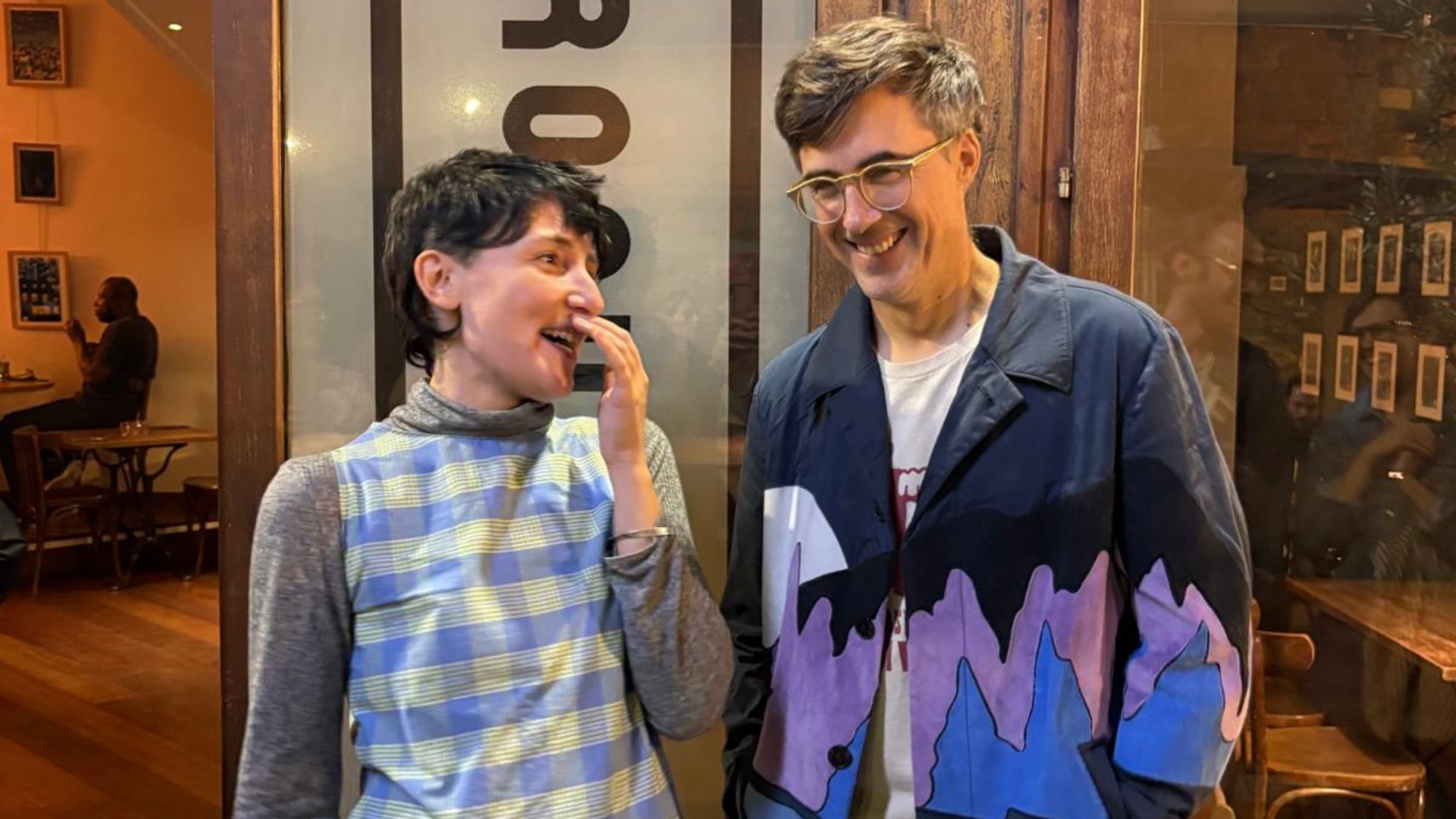
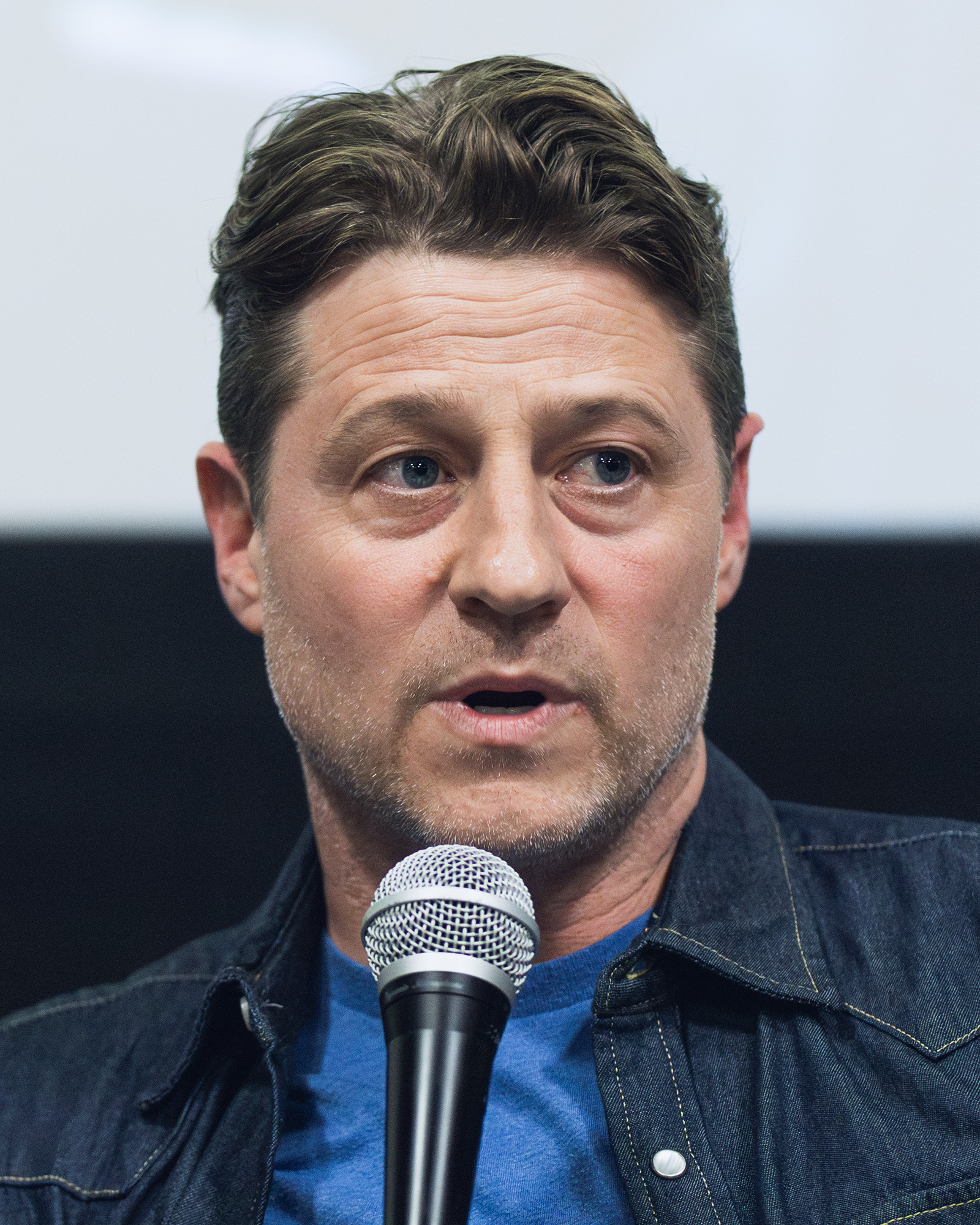
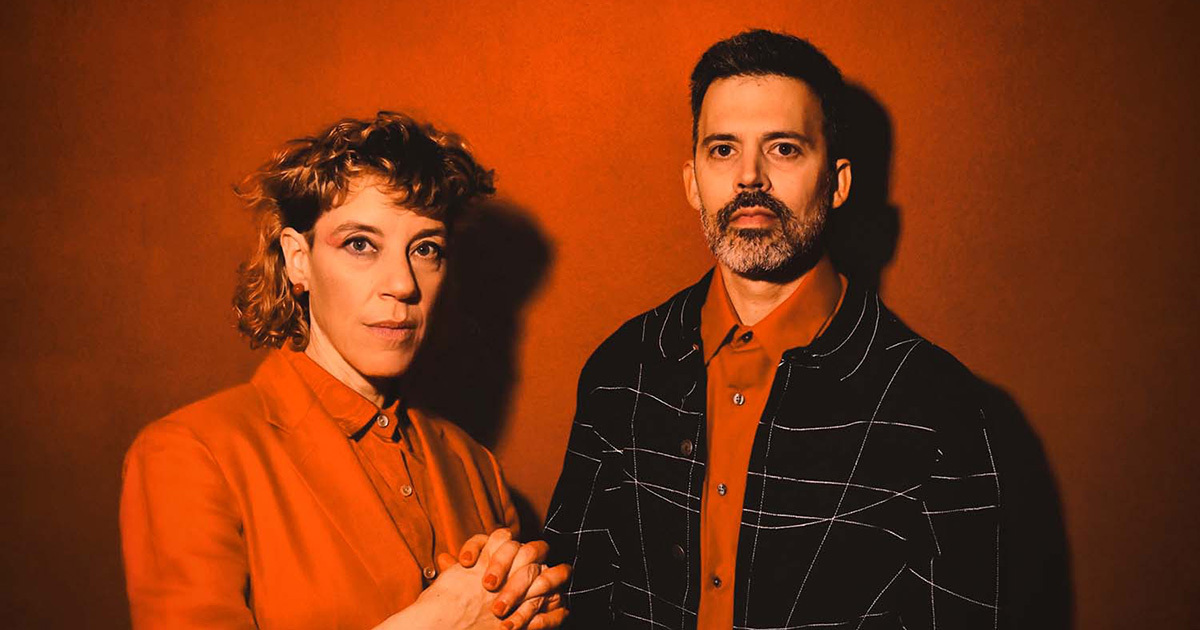
Merrill Garbus is the frontperson of Tune-Yards, and a composer whose work includes scores for director Boots Riley’s film projects, most recently I Love Boosters; Ben McKenzie is an actor (The O.C., Southland, Gotham) who has become a prominent critic of cryptocurrency through his book Easy Money (2023), and his recent documentary Everyone Is Lying to You for Money (2026). Everyone Is Lying to You for Money will be screening at everyoneislying.com/watch from August 22 to September 6, and tUnE-yArDs have gigs scheduled in the Western US from Aug 21 to Oct 10.
This conversation is a preview of Is Not Music. zine issue 003. That is the print-first publication from Is Not Music, founded by Xander Duell as a way to create the artistic infrastructure he couldn’t find in the industry. Is Not Music cultivates projects at the intersection of music, performance, and design. Grounded in collaboration and process, we champion artistic autonomy and ownership.
— Alec Hanley Bemis, editor of Is Not Music.
This conversation was moderated and edited by Alec Hanley Bemis and Is Not Music managing editor Valerie Kamen.
Is Not Music: Scams seem to permeate the modern world, from the smallest details of daily life to the broadest reaches of finance and geopolitics. Everywhere, it seems, something is being extracted from us while we get less in return.
The permission structure that made all of this culturally acceptable had to begin somewhere. We suspect the cultural elephant in the room is what happened to our brains — and our culture — in 2020. By that, we mean COVID. Did the pandemic years change our relationship to scams, making us more willing to tolerate, participate in, or simply accept them as part of everyday life?
Ben McKenzie: It certainly marked a shift for me. During the pandemic, you couldn't be on a set for almost a year. The film and television business just kind of froze for a minute. I didn't know what to do. I am not a guy who has a lot of hobbies
But I do have an undergraduate econ degree that I really had never done anything with. I got fascinated by what was going on in the economy. It's always been interesting to me that economics is thought of as this dry, mathematical science. But, in fact, it's the study of how people relate to each other, and this thing called the economy based on this thing we made up, called money.
Economics is the study of human behavior and humans are not rational. Humans have hopes and dreams, and while those hopes and dreams are wonderful, they can be taken advantage of.
I fell into learning about crypto through this friend Dave who said I should buy some. A lot of us have this friend who, you know, does not have the best judgment. He had given me terrible advice before….
Merrill Garbus: I'm so sorry. How much money did you lose?
Ben: The financial loss was not that bad. But what started my journey with this doc was him not being able to explain what this crypto was. And then I just became obsessed. During the pandemic I didn’t have anything else to do and decided, alright, I'm going to spend more time looking into this, which led to the aha moment of, How do I make something out of this experience that I'm having? Oddly, I thought of writing a book first rather than making a movie. Pretty ironic given my background.
Is Not Music: Well, writing is less resource intensive than making films. Merrill, maybe this is a good place to insert your experience composing music for Boots Riley’s films, which happened pre- and post-COVID? How did you get into that?
Merrill: We first worked on his 2018 film Sorry To Bother You. But it feels like I Love Boosters is especially resonating now because it feels like we all live Boots Riley’s imagination. [Ed. note: I Love Boosters is about a crew of professional shoplifters who target a fashion mogul after she steals their designs. The absurdist heist narrative spirals out into a critique of labor outsourced to China, while also accommodating sci-fi laser guns, a demon puppet performing cunnilingus, and antagonists with removable skin suits.] There’s a massive desire to see that kind of cartoon image because what we're living in feels like a cartoon — cartoon travesties, cartoon bad guys, cartoon billionaires. At the same time, Oakland at least is a place filled with unhoused folks living in tent encampments. We're living in Boots Riley’s world because he has been giving voice to these economic realities for so long with his group The Coup. [The Oakland hip-hop group Riley co-founded in 1991, known for its politically charged music, including songs like “My Favorite Mutiny” and “5 Million Ways to Kill a C.E.O.”]
Is Not Music: Ben, do you feel like we’re living in a different post-pandemic reality? “Boots Riley’s world,” as Merrill puts it?
Ben: It served as an accelerant for a lot of things that existed beforehand. For example, there's nothing wrong with having a culture that exists exclusively online. But if something just exists online it's a lot easier to rip people, and it’s a lot easier to run a con. It's much more difficult to fake everything in real life, because you encounter real people in real spaces saying real things and you can use real human intuition.
When I actually talked to crypto people who had been scammed, the wool fell from their eyes as soon as they saw there never was a community to begin with. The illusion that there was a community emerged during those COVID days when we were all living individual lives separated from each other. The internet became a bigger part of our collective consciousness, and not in a healthy way. It was the perfect petri dish for scams to proliferate and that's what happened.
Is Not Music: What drew you to your recent scam-related projects? Was it a general sense that we need to combat injustice in the world, or was it a more personal motivation?
Ben: I come from a family of lawyers so I've always been aware there are two systems of justice in this country — one for the rich and powerful and one for everyone else.
Merrill: That family connection is interesting. Boots Riley’s father has been a civil rights lawyer in Oakland for decades1.
Ben: I've never even played a lawyer on TV, but the cliche is true: my consciousness has been raised by recent events, both on a personal level and in American culture more broadly.
Here’s an example: I’ve been advocating to defeat legislation on Capitol Hill that would further entangle crypto in our economy and try to integrate the scam economy into the broader financial system. [Ben worked with the non-profit organization Indivisible to speak out against the CLARITY Act. Though the act passed the House in 2025 and the Senate Banking Committee in May 2026, it is now considered a long shot to pass the full U.S. Senate.] I discovered there are Democrats who are great on these issues but then there are others where it’s hard to distinguish between Democrats and Republicans.
When I was younger, I had a natural deference to older members of the party. They must know what they’re talking about.
Merrill: …And then you realize nobody fucking knows what they're talking about.
Ben: I've been in Democratic politics for a long time. The, quote-unquote, “civil war” within the Democratic Party makes me laugh my ass off, especially how afraid everyone seems to be of terms like “socialism.” What we're seeing is a grassroots thing that's happening. It's a reckoning that's been a long time coming for the Democratic Party. What do we stand for, exactly, if we're simply another corporate party?
I'm definitely struck by this sense of how unjust everything is.
Merrill: As an actor does that present a problem, because you're mostly restricted to working on projects you're being invited to participate in versus those you might ideologically connect with? How did you decide to connect more intentionally to these crypto stories?
Ben: Well, yes, with TV, you definitely have to have someone else pay for it. The evolution of my crypto projects has been tied to a succession of collaborators. At first I convinced the journalist Jacob Silverman to go on this ride with me, and in 2021–‘22 we started publishing articles to prove our bona fides in places like Slate, The Washington Post, and The New Republic. Eventually we sold a book proposal and had to go into the real world to report on things.
We were filming everything just as documentation, and the very first day we turned the camera on, I ran into Alex Mashinsky, this guy who was running Celsius. He is now in jail.2
Merrill: Instantly, you're like, "This is a movie."
Ben: Yeah. I am an actor and I used those skills and sensibilities. It was particularly ironic to feel like you need to be honest to make a movie that is all about lying.
Over the course of 2022 and early 2023, we captured a lot of footage, interviews with fraudsters like Sam Bankman-Fried. We went abroad to El Salvador, the first country to use bitcoin as legal tender, where the president, Nayib Bukele, had promised to build a place called Bitcoin City. I even testified before the US Senate.
However, I was desperately trying to find a producer who could give all these isolated examples a narrative thread. Eventually I got connected to Giorgio Angelini. Previously he had created documentaries about the housing crisis and internet subcultures.3 There was obviously a lot of overlap with the crypto quote-unquote “community” and other phenomena which operate exclusively on the internet, and are rife with misinformation and fraud.
Is Not Music: Most of the people being scammed in Ben's anti-crypto doc are men. The primary characters in I Love Boosters — both the protagonists and the villains — are women. Do you think there are fundamentally different ways people get exploited and scammed based on gender? Or is it the same underlying scam expressed through different desires and identities? We’re also curious what you make of the media attention around looksmaxxing and its own cartoon mascot, Clavicular.
Ben: The looksmaxxing thing is interesting because it touches on an element of this that I'm fascinated by: the sense that the only way to validate yourself is through your physical appearance, how much money you have, or some combination of the two.
When you throw that onto the internet and into algorithms, you get really extreme versions of masculinity. That draws in some guys, but it also creates a spectacle that other people want to watch. Then the media picks up on it, and it feeds on itself, becoming bigger and bigger and bigger. It becomes a whole crisis of our conception of masculinity. I think about how far off we've gotten as a culture.
Is Not Music: Should I mention Andrew Tate?
Merrill: Please, no. But Ben, can your next movie please be about looksmaxxing? You would have cachet with those guys, coming as the person that you are — as a guy who's been an example of manhood on TV…
I guess this is also a place for me to say gender is a scam. There's a lot of “making up” that we're doing culturally. Women know the scam of patriarchy. I went to a women's college and very quickly you're like, Oh, shit, my entire growing up, up to this point, was a lot of bullshit. There's a sudden ripping away of the curtain that we didn't even know that we were living with. I feel really blessed to have had a different perspective on the world through that experience.
It was equally earth-shaking to then graduate and have male bosses, and be, like, OK, now I have to find my footing here in this, quote-unquote, “real world.” In Sorry to Bother You, the character of Detroit is not a main character.4 But when we were composing music for the film, I felt like she needed to have her own theme. Her theme was built around the words “I believe her, I believe her.” I was like, she's going to get this radical musical treatment. Because I felt like I wanted to uplift her character and her power.
Is Not Music: Was there a sense at all of a gendered aspect to the scams being talked about in I Love Boosters?
Merrill: I guess I just never thought about it from that lens, because for me the whole context of the movie is the criminalization of poverty. It’s interesting — I think there has been a lot written about Boosters as a story about women committing crimes, but not about the crimes being committed against them.
Is Not Music: Are scams now the defining feature of American culture? Or, more worrisome, the backbone of the American economy? Has scamming become the operating logic of American life?
Merrill: I was just reading about the outbreak of cyclospora.
Is Not Music: The salad poop bacteria...
Merrill: We are being sold organic $8 lettuce and the same head of lettuce is being sold for $1 at Taco Bell and that's why we're having these outbreaks in two very different economic worlds. What's not a scam, if lettuce is a scam! I've been thinking about this ever since we were asked to have this conversation: what's not a scam?
Ben: So much of modern existence feels inherently fraught with the tension between just trying to live your life but feeling like you're constantly being manipulated and lied to. Everything is oversold. It’s so hard to find a product that isn't advertised as being the best or the most innovative.
How did we get to this place? Like I was saying about money and the economy, we made all of this up, so this is a collective delusion to some degree. It is under our collective control, but we're so divided and we are being lied to so often, it sows the seeds of more division.
Merrill: Money is a scam. Whiteness is a scam and it very much relates to money. I think these very old scams are the way that the economy in the United States was formed. The criminalization of poverty is based on needing Black and brown people to be portrayed as “less than” so they can provide a workforce that previously, in the days of slavery, worked for free. That's what we're all sitting on right now. There are the age-old scams of the United States.
Ben: The sort of free-for-all capitalistic economy that we've decided on in America in particular feels rife with fraud, as opposed to other places where there's more of a sense of community and togetherness.
Merrill: I feel like the solution goes back to family and community and the people who you trust very, very intimately. Like in Ben’s documentary, there is a fisherman in El Salvador who is being pushed off land his family has lived on for generations, to make way for the development associated with Bitcoin City.
The people who brought him back were his family, right? It was not a promise of great amounts of money, but small amounts, just enough to get back on his feet. In modern life it feels like we have to kind of look at what's real and start from those building blocks, things that are grounding and real and human.
Is Not Music: Merrill, you’ve created a nice segue for us to think about better days ahead. Real life can feel quite dystopian these days, but maybe the solution to taming our dystopian slide will not be utopian solutions, but something a little more boring and meat-and-potatoes than that — just mundane examples of people getting along. Are you two seeing communities or individual people trying to build these new realities in your day to day life?
Ben: First I’ll put a hopeful spin on how things feel right now. Maybe it’s a positive that we're constantly feeling taken advantage of and manipulated for profit? There is definitely a widespread feeling now that we’re being scammed all the time. It’s obvious to many of us that this is due to the absence of any sort of rules around society that would prevent you from being scammed.
One antidote to that is just good governance. On the more hopeful, optimistic side, I see it in New York a lot with Mayor Zohran Mamdani. He is a genuinely gifted politician and a really impressive public servant but he didn't come out of nowhere. There is a real desire to have people like him in public office. He's just way more interactive with the people that he's serving — whether it's keeping the lights on on a soccer field at all hours so people can play sports, or providing child care for this Parents’ Night Out thing that they did. [In summer 2026, the Mamdani administration created a pair of novel programs delivered via NYC Parks. Late-night access to public sports fields was expanded; “Parents Night Out” is a free child-care program offering evening supervision for kids between the ages of 6 and 13 at select Recreation Centers.]
Merrill: New York feels like a beautiful gleaming hope these days
I also keep coming back to all the DIY scenes that I've ever been part of or exposed to. There will always be punk houses, and kids playing freaking loud ass music together, banging on drums. I really think human beings will always go back to making music with other human beings.
That impulse — I have to express my humanity and I need to do that with other human beings and that's really all I want to do here — there's always hope in that.
Is Not Music: A small but tangible example of the vibes in NYC right now: Summer of Ludd was a series of deliberately offline gatherings around Tompkins Square Park, led by a group of kids in their early 20s. We found out about it through a print zine in a coffee shop because they deliberately did not advertise online. It brought together labor activists, queer communities, artists, middle-aged hippies, and punky DIY types. The larger events drew hundreds, not thousands because the point was, “this is where to find your people,” not, “show your internet friends how cool you are in a 30-second Instagram story.” I was touched.
Merrill: As someone born pre-internet, I just want to be here to help young people be like, “You really can put down the phone.” Not only will your life not cease to exist if you don't document every moment of it, but actually you might feel better about being alive — a connection to the non-scam, to what feels really real.
Footnotes
- Walter Riley grew up in the Jim Crow South, where he was active in the 1960s civil rights movement, organizing sit-ins and voter registration drives with the NAACP and the Congress of Racial Equality (CORE). He later moved west, where he has worked as a human rights and criminal defense lawyer since the 1980s. His most recent book is Civil Rights and Structural Attacks: Conversations with Walter Riley (2026, Legacy Left Books).Return to content at reference 1↩
- Celsius was a crypto lending platform that promised users high yields for depositing cryptocurrencies. In 2022, soon after McKenzie talked to Mashinsky, Celsius froze withdrawals and filed for bankruptcy. In December 2024, Mashinsky pled guilty to commodities and securities fraud and forfeited $48 million. In May 2025, he was sentenced to 12 years in prison.Return to content at reference 2↩
- Angelini’s films as a director and producer include 2018’s Owned: A Tale of Two Americas, about how U.S. housing policy helped create racial and economic inequality; 2020’s Feels Good Man, about Pepe the Frog, a cute indie cartoon character who was appropriated as the symbol of the alt-right; and 2024’s The Antisocial Network: Memes to Mayhem about the real-world consequences of digital communities, from 4chan, QAnon and the January 6 riots in DC.Return to content at reference 3↩
- Detroit’s boyfriend, Cassius Green (aka Cash), is the film’s protagonist, played by LaKeith Stanfield. As Cash begins to “win” within the capitalist system, Detroit remains skeptical of the idea that individual advancement should come at the expense of collective liberation.Return to content at reference 4↩