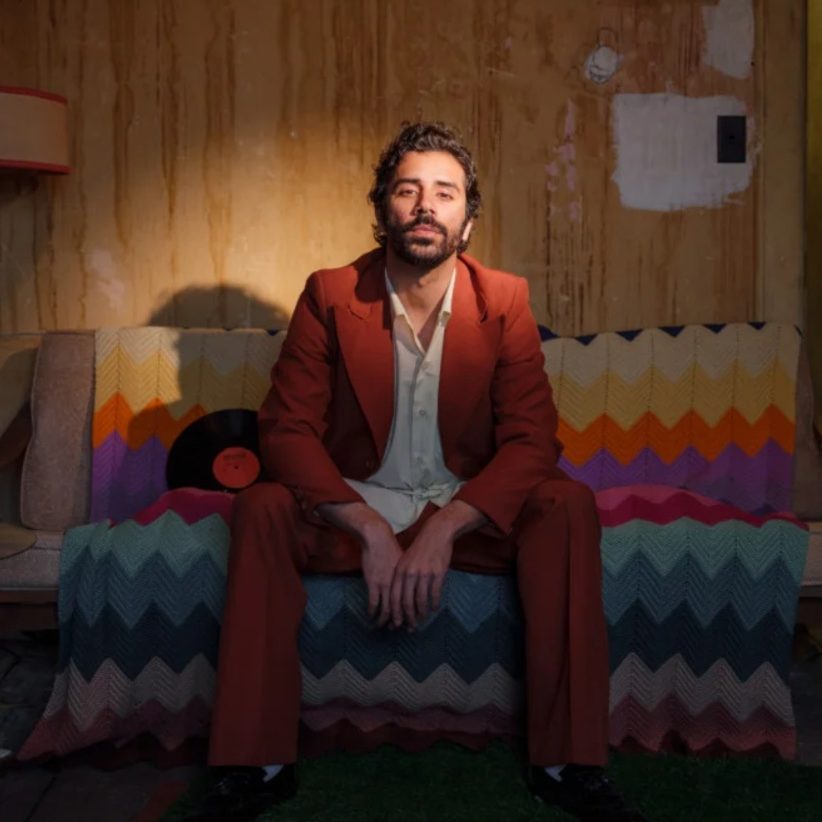
Ravi Shavi is a no wave and garage pop band from Rhode Island, led by Rafay Rashid. Their new record Wild Rock Dove is out today. To celebrate the release, Rafay got on Zoom with his friend actor Kevin Corrigan (who this year starred in the film The Projectionist) to catch up about the making of it, and more.
— Annie Fell, Editor-in-chief, Talkhouse Music
Rafay Rashid: I was listening to an interview you did and you were talking about “false moments,” and how in a movie you were doing, you were aware of the fact that the actor you were acting with was not exhibiting any false moments. And the fact that you don't wear makeup in a lot of your movies ties into that for me.
Kevin Corrigan: Just to update: we were talking about how I don't wear makeup, because I have this very ruddy skin — I'm half-Irish, half-Puerto Rican, and I have characteristics of both. I was at a wedding and someone said I looked “Irish as hell.” Go figure. I'm Bronx Irish Catholic, Puerto Rican Catholic, whatever… It's the way you define yourself. This is my palette, these are my colors… But I find that on an acting job, when they cover it up, it really looks false. And we were talking about false moments with acting. You have a lot of really good moments in that video for “Accidental.” Is that from an old album or from the new album?
Rafay: That's from an old album. That's from our first self-titled album.
Kevin: The video is brilliant. It's just you raging at yourself in the mirror.
Rafay: Thanks so much. That was made by Matt Palmer, who plays in that band Sheer Mag, who I love. We went to SUNY Purchase together… And that was me showing up as myself, which I think, like you not wearing makeup on sets, as an actor still maintaining yourself, makes you you. It seems paradoxical, but I think it shows in your work because every time you show up in a movie, it just automatically becomes electric. And that's something.
Kevin: Well, thanks. It helps me to think of it as just a part — like, I'm not really this character, but I'm very interested in the lifestyle of the character. I have a very rough technique. Maybe there is no technique or method. I said that to an actress once, a very good actress: “I don't even know what I'm doing. It's a roll of the dice.” And she was like, “No, you have a technique. You definitely have a method. There's a character there.” I'm like, “Oh, yeah? Cool.” I try. I went to Strasberg Institute, so I am rooted in some kind of method. I’m not method certified. I never got a degree in it. But I did get in Goodfellas…
In that video for “Accidental,” there's a question of what makes an artist, what is an artist. That's what your character's frustration is all about: Am I a real artist? And that's a constant question. It never ceases to be a relevant question that I put to myself. I don't think it should lose its relevance. It should always be an open question whether or not we're really artists.
Rafay: Absolutely. I think that question creates a lot of charge. Whether it's acting or music, it creates a bit of… it's not quite desperation, but it's something akin to that, where you're not resting on your laurels so you have to show up fully. And I think the audience senses that. There's an unpredictability. I was watching The Projectionist and I had to rewind certain lines because I was just like, There's no way a director thought about saying the line like that. There's no way he gave you a line reading like that, the way you did it. It was hilarious and real and it was just fully charged.
Kevin: I'm glad you thought so. It was a low budget movie. Sometimes you can be more giving when you're working with a low budget. When you're using a limited palette as an artist, you can become super creative with those limitations. You take it as far as you can go. When there's a little bit of distress in play, it can be interesting. It can give texture to the piece.
Rafay: Absolutely. That's why for a while it was almost a rule I'd made for myself that I would only play with people in the band who hadn't really played their instruments in a band before. Because it does create this sort of high-wire tightrope kind of situation.
Kevin: Yeah. Cassavetes would make people do things that they didn't do. He promised the producers of Love Streams behind-the-scenes footage in order to sell the film, and he gave the job of directing that to a guy who had only been tasked with getting an interview with Cassavetes. He was a writer, and Cassavetes gave him a camera and said, “Now you're a filmmaker.” And so the movie that came out of this guy who had no experience making a movie is called I'm Almost Not Crazy, and it's great. It's better than any other documentary about Cassavetes that I've seen, because it's part of the process of the artwork that it's supposed to be covering. The documentary format, I think the goal is for the subject to merge with the filmmaker. It's the objective of documentaries on some level for the director to become part of the story they're documenting. But that's what you do when you make a record. That's what we do when we embark on the making of a film. You show up with your art and with your palette, and you're going to tell your story. It's just inevitable.
Rafay: Absolutely. You get rid of that idea of perfection and this illusion of objectivity. It's the same thing in anthropology, for instance: The idea of capturing a culture or a people as they truly are in their essence just doesn't exist. You have to insert yourself and it becomes a sort of true intersubjective experience.
Kevin: Couldn't agree more… When I was looking at the video for “Fresh Hell” — which is also amazing — the idea of of Ravi Shavi being a persona never occurred to me consciously, but I realized that is how it's fallen into my perspective. I've been around for a few iterations of Ravi Shavi and I love them all. I went on tour with one version of the band. It's a totally different lineup now, and now I love this version of the band. What version of the band do you have the strongest feelings for? It's like asking someone to say who their favorite child is or something, but I'm curious to know what your relationship to Ravi Shavi is today, what it was 10 years ago, and where you see it 10 years hence.
Rafay: For me recently, it's been trying to embrace the fact that it is a persona. And — you said in an interview I saw that anything worth doing requires the support of other people, and I feel that a hundred percent with this project. I don't know that I could be a front person without all the people who have supported me by playing music with me. But as of late, I've realized that I have been the throughline, and it's been empowering to be able to tag in the people who I'm vibing most with on any given day and just see what is produced out of that. Each new person bringing their tastes and their sensibilities into the picture to me has always been the essence of the thing. And the other essence is the social aspect of music. The idea of making music as an island is sort of unthinkable. So it's been this dual process of keeping Ravi Shavi very much as a persona, but then also recognizing that it's a social project.
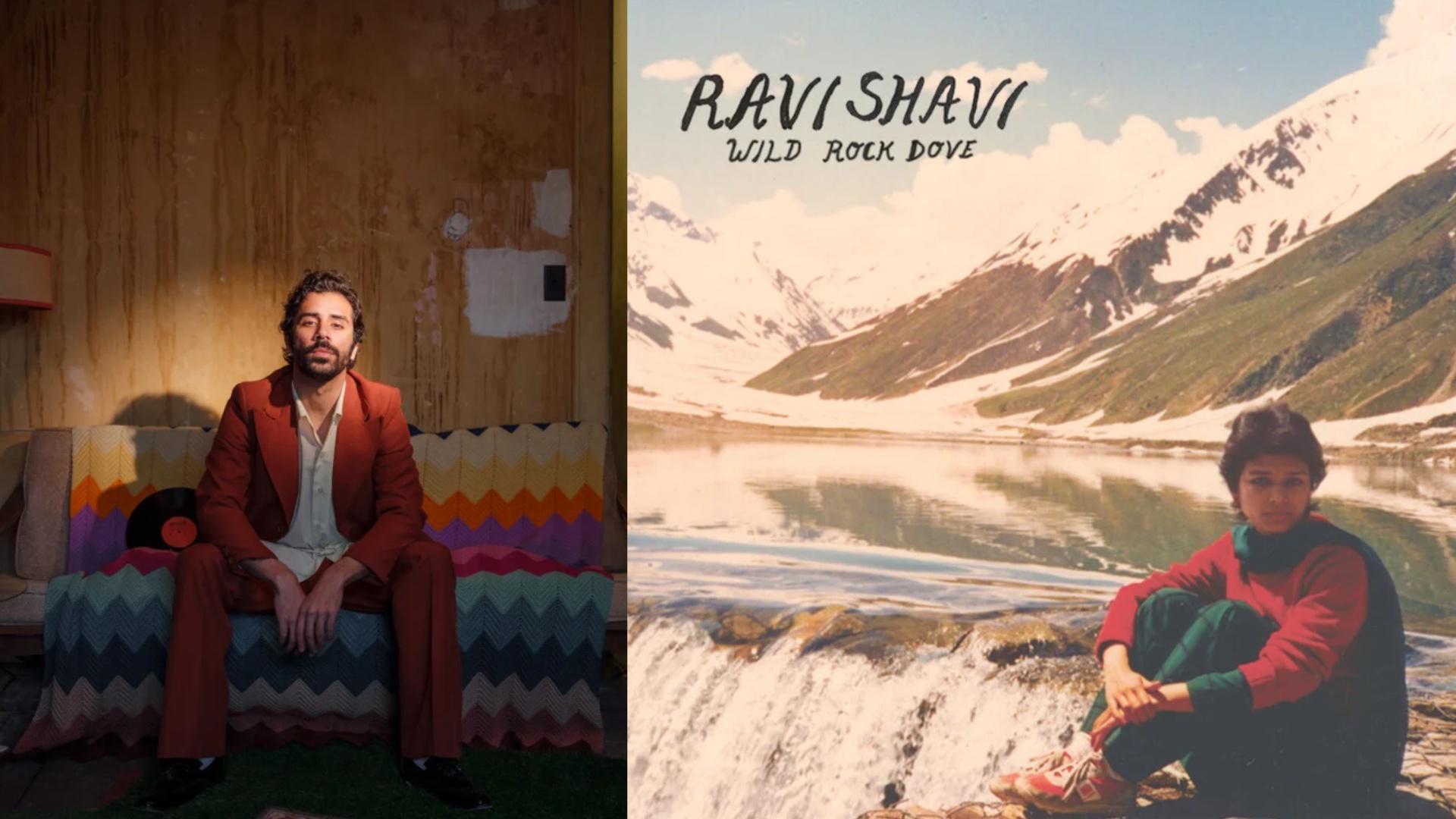
Kevin: The Wild Rock Dove album cover — why did you choose that photo?
Rafay: The photo is just a beautiful photo taken by my father of my mother in 1990, the year I was born, in Pakistan on a sort of honeymoon-esque vacation. So that's my mom on the cover, and I love my mom and I love that photo.
Kevin: What's your favorite song on the new record?
Rafay: “Wild Rock Dove” and “Fresh Hell” are my favorite songs.
Kevin: Mine too!
Rafay: Oh, yeah?
Kevin: Yes! You sent that to me when I was in Toronto last fall, and “Fresh Hell,” I think I texted you to say—
Rafay: You wrote back just the two words “fresh hell,” which I appreciated.