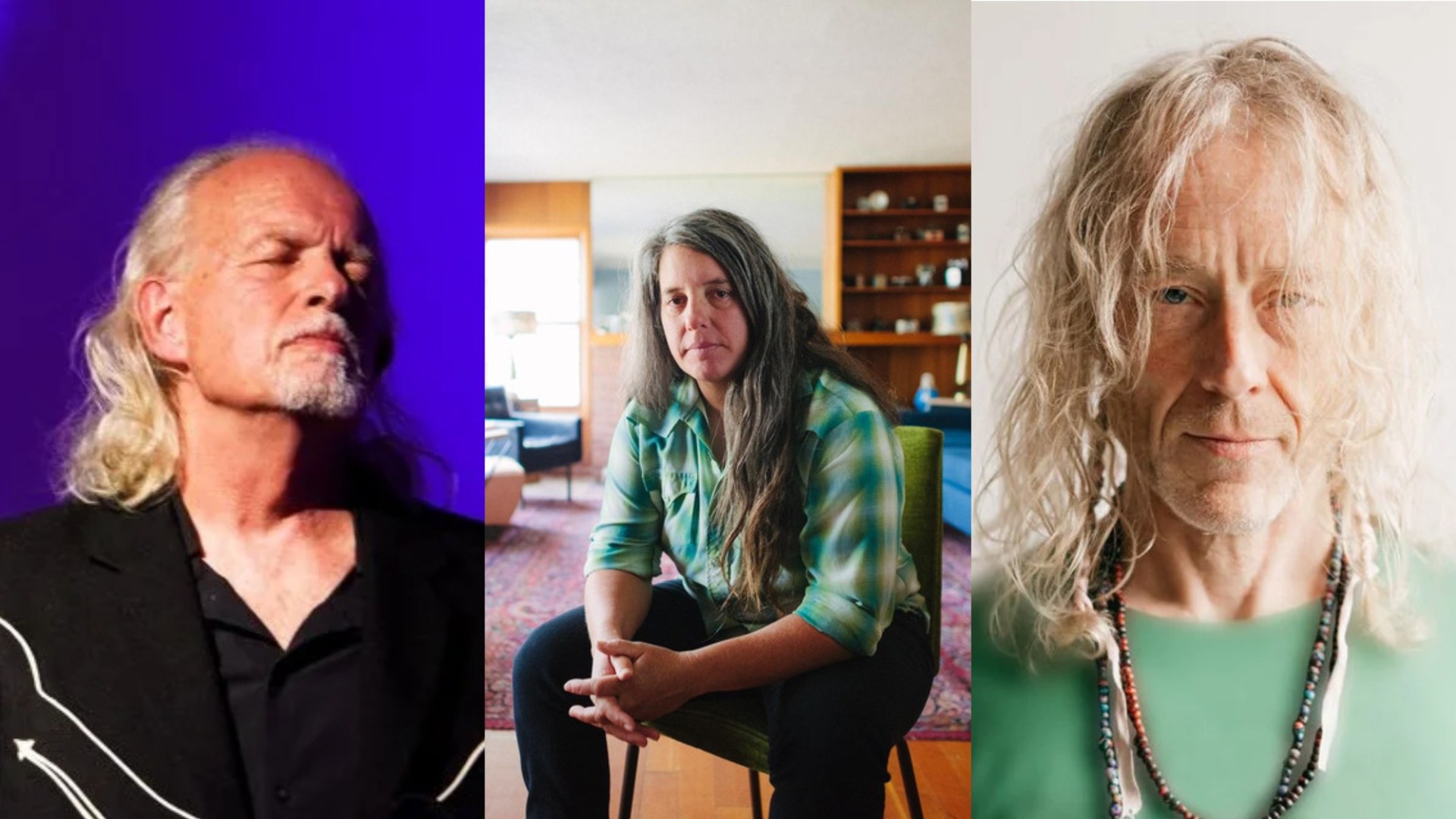
Across the Horizon is an artist-curated series created by Northern Spy Records and the musician Bob Holmes, a member of SUSS and host of the Ambient Country Podcast. Guitarist and composer Marisa Anderson and Low’s Alan Sparkhawk contributed to Vol. 1 and Vol. 2, respectively, of the series. Each volume is released in drops of three tracks throughout the year, with each drop being curated by a different artist.
— Annie Fell, Editor-in-chief, Talkhouse Music
Bob Holmes: A lot of the reason that they pulled the three of us together is because of our common association with the Across the Horizon music series. Marisa was in Vol. 1 and Alan is currently in Vol. 2. His single just got released last week. I would say pretty definitively that they are both defining artists of each of those volumes. And one of the things that ties them all together is last year at Big Ears Festival when we had two Across the Horizon nights, Marisa and Alan played together. It sort of came up at the last minute, and it turned out to be one of the highlights of the night.
Marisa Anderson: I think that was how we met.
Alan Sparhawk: Yeah, that's the first time we met. I knew of you and we have some common friends — Charlie Parr specifically, and Haley Fohr. But that was the first time we met. I think I just asked if you'd be down for playing on something—
Marisa: And I said yes.
Alan: Yeah, it didn't take much talking, really.
Bob: SUSS played with you that same night. We did a bunch of your songs, sort of a mini set with you, and Nels Cline came on, Yuka Honda came on. It was quite a night.
For people who don't know what the Across the Horizon music series is: I was asked by Northern Spy if I was interested in starting a label that was loosely based around what I was doing on my podcast series, which was just interviewing artists, talking about music — not so much the music that they make, but the music that they love to listen to. To be honest, I wasn't really interested in [starting a label]. And I asked them, “I'll start a label under this condition: every artist that I ask on the label, that artist gets to ask two other artists to provide music for that label.” So in Vol. 1, I asked Marisa to be on, and she asked Charlie Parr who has an act called portal iii. She also asked EDT, or Emily Dix Thomas, who is a cellist. And of course I'd heard of Charlie Parr, but I'd never heard of portal iii, so the combination of the three of their tracks for Vol. 1 was just astounding. Marisa, give our readers an idea of how you did the curation process and reaching out to those artists.
Marisa: Well, I wanted to do something known and something unknown. So Charlie came to mind because we've traveled a lot together and he's talked to me about portal iii. So I knew that he would be excited to put something together and it would be easy to work with Charlie. So that was a kind of an easy call: a known artist with an unknown project. And then, it's funny because there's a lot of people that I thought about asking who did end up already on the series. Walt McClements was a person I thought of talking to, but he was already roped in. Natalia Beylis was a person I thought about asking, but I didn't really have a personal relationship with her, so I felt a little shy. But then she ended up on it anyway, so that's good. And then I was playing in Rhode Island, and Emily EDT was the other act on the bill. I stayed at her house that night and we were talking, and I just really liked her show so I just asked her. I had just met her and I knew her music a little bit. It was kind of a time and place thing that felt right.
Bob: Well, the end result was amazing. What she provided for the series was just beautiful. When we started this project — and it was Vol. 1, so we weren't exactly sure how the rules of engagement were going to go — I reached out to eight curators. They all said that they would do it, but a lot of those curators wanted to collaborate with Marisa. I said, “No, you can't, she's already a collaborator.” [Laughs.] So you are somebody on the top of everyone's mind when it comes to collaboration. You ended up doing a collaboration with Luke Schneider, which came out really nice. So you actually showed up a couple times on Vol. 1.
Marisa: I would have said yes to whoever asked. [Laughs.]
Bob: Alan, you chose Liz Draper and Kenneth Gregory, both of whom are also Minnesota musicians, correct?
Alan: Yeah. Liz is actually in portal iii with Charlie Parr. But Liz was the bass player in Low for the last year or so that we were touring, so she's a good friend. It just worked out. It's kind of similar to Marisa's approach: somebody that I'd known for a long time, and then Kenny is someone who I only met recently. He's very local, he's from Duluth. He has been doing music with my daughter's band, and I found out that he puts out his own cassettes — sort of ambient synth music — and they're pretty cool, so I thought this would be a great place for him to maybe see a wider audience.
Bob: That's cool. I love both of their tracks. And I didn't realize that Liz was also in portal iii, which really ties everything together in a strange way… One of the reasons that both of you were at the top of my list to get in the two volumes is that you're both really known for the community of artists that you engender. Whether the artists are established or young, you're both known for connecting. And even in the conversation here, I didn't even realize how connected your connections were. Marisa, what's your view on community? I know you're based out of the Portland area. Do you have that same thing going on in Portland?
Marisa: I suppose so… In terms of music and community, I've been doing this a long time, as has Alan, which involves a lot of travel on a lot of different scales. Who was it that was like, “Who you meet on the way up is who you meet on the way down,” or something? We're all just kind of traveling these same roads and playing same stages and sharing equipment. And I'm a solo performer — a lot of times I see people in bands and when they travel, they just kind of stay in their band and talk to each other and are an autonomous unit within whatever else is going on. But I don't have that dynamic built into what I do. I travel alone, I usually don't even have a tour manager or anything. So wherever I am, it's just me and I'm going to be like, “Hey, how's it going? What are you doing? Can I sit by you?” Because it feels better than sitting alone.
Bob: Oh, that's that's interesting. I never thought about that. The band has themselves and sometimes under certain stresses, keeping that family close can help sustain and pace things. You know, it's got its own dangers of course, but…
Marisa: Sometimes when you’re in a band or if you're traveling with a large crew, which I've done, you're looking for any moment to get by yourself. You have a built-in crew, but when you get a chance to just peace out, you do. But for me, since I travel alone, when I have a chance to connect, maybe it's that opposite reaction.
Bob: You’re more inclined to take the step.
Marisa: Yeah, yeah. And I’m more approachable too, as a single person. It’s easier for someone to be like, “Hey, come stay at my house,” or whatever. It's not complicated.
Alan: Of course, from that comes countless friendships. You're hanging out with and working with this person who you may have only met once before, or even never. You work close and there's a friendship that builds there because you're forced into a trust situation. And with accomplishing that task in a trusting way, you become friends. I've met so many great people and made so many friends traveling, but I wonder if there would have been even more if I'd been in a situation like that where you're sort of forced to interact with those three or four people you gotta interact with at the place.
Bob: In SUSS, the other two guys — the pedal steel player, Jonathan Gregg, I've known since the mid-‘70s, and Pat [Irwin] [since] the ‘80s when we were both in touring new wave bands around the same time. And our road manager, I've known since I was five years old. So at first I was worried that it was going to become too insular, like what Marisa said, how you just move around like a tight group. But I think, rather than being insular, we've actually found that we enjoy meeting new people and building new relationships and that sense of community and finding out what motivates people. We've been through collectively three or four different generations of what it means to be a musician and what it means to be in the music business. So we act like baby bands that are just learning anew from the very beginning. It's so different than when we all started in the early ‘80s. I mean, neither of you ever had to worry about MTV — everyone complains about Spotify and streaming, but I can tell you horror stories about having your life predicated on a commercial TV station like MTV. I know that Low dabbled in that in the early days as well.
Alan: Yeah. By the ‘90s, there was a window that opened up and they were sort of entertaining playing more independent stuff… It comes and goes in different ways and different vibes and different times. I think it would be difficult to be a new band for sure. But it's always been that way, you know?
Bob: Yeah. I think that's a good point.
Alan: In the collaboration that opens Vol. 1, with Luke Schneider, is Luke doing sort of the more affected… ?
Marisa: He's a pedal steel player, who plays also with a lot of effects pedals. And then I had set my guitar on that kind of strobe-y effect, which I never play with, and also some delay. I've started playing a little more with delay these days, but when we recorded that, I was still just having fun with it. So because he's playing pedal steel and he fills up quite a lot of sonic space, my challenge in there was how to create a distinctive sound or texture without it just being this guitar sound cutting through.
Alan: Not cutting through, but present.
Bob: It definitely had kind of a shoegaze vibe to it somehow.
Alan: Yeah. But when you come in, it's so distinctive and clear. I know that's, for one reason or another, the approach that I've seen you most on, this very large but clean tone, and the minimal building of chord movement and melody. I love it. I always cheer a little bit when something really clean and very much depending on literally the player’s hands cuts through an otherwise very large and frequency filling backdrop. When something so clean cuts through, it's ecstatic to me. A musical level endorphin rush. The other piece you do as well, with the piano, the second your guitar comes in, it's so distinctive to me and so immediately like, OK, this is the voice of the phrase that is about to be spoken to you. It's great.
Bob: Marisa, you explained this to me when we were talking about that song, “Friday Afternoon, November,” about recording it with and without the background loop.
Marisa: Yeah. I live next to a school, so there's always the sound of kids playing, kids running around and screaming, and it gets into the room where I practice. I had recorded that guitar bit and I was like, Something's missing from the space that I'm in. And I realized that it was the sound of the kids that was missing because that was in my ears when I was playing it, but I close miked to not pick that up, of course. So school was just letting out and I just went out with my microphones and field recorded the kids running around and screaming, and then put that into the recording.
Alan: That's genius.
Bob: I've listened to that song so many times, I feel like I know the kids. I recognize their voices. Spatially, I can imagine where they are on the playground as the song is going on…
Marisa: Yeah, I know some of those kids too. [Laughs.] When I went out to record them, I ran into my friend whose kid goes there and we were talking and I was like, “Oh, I gotta record!” There's one edit that I made — I wanted to pull out anything that sounded like English so there'll be no words. I just wanted screaming.
Bob: Alan, can you tell us about the process behind your song “Temple Towers”? Because everyone who I've played it for, it's been a shocker. It's like, “Woah, Alan went there?” And I said, “Yeah, that's where he chose to go.”
Alan: At the time I recorded it, it was sort of when I was in the middle of the learning process for this vocal piece that my partner Haley has been doing and that I've been part of performing. It's called Wordless Music. It's a piece that is just vocals and it's a lot of extended repetition and really slow moving harmonic changes and deviation from what starts as unison. So in that process, I was in the middle of the idea of using a voice as a tone and making sounds and exploring where the line is and where the surprise is. And so that's kind of a vocal loop or freeze that I recorded one night that kind of happened serendipitously, unexpectedly. So I recorded it, and then I wanted to play guitar because I'm trying to build the guitar a little bit more lately. I'm always trying to figure out new ways to use the guitar to generate sounds that make sense.
Bob: It has the unique property of using what you would normally think of as dark sounds, whether it's distortion or guitar or aggravated vocals, and the end result feels very light and uplifting somehow. It's a beautifully uplifting piece of music.
Marisa: I feel like that’s a thing with your music in general — it feels pretty transcendent regardless of darkness or lightness within the content.
Alan: Oh, thank you. It might be dangerous to say this, but I hope so. In sometimes a blindingly romantic way, I've always aspired to make something that was transcendent, something that lifts something that makes a difference in someone's soul, perhaps.
The guitar is what I use to actually make harmonic variation underneath, and I just kind of wanted to make something that was monolithic. It seemed like it was moving organically in a bit of an arc.
Bob: Plus, you had to do all of that in three-and-a-half minutes. One of the guidelines was that the songs had to be short, which most of the artists, you guys included, are not used to.
Alan: It's harder when you want to do something that's minimalist and even sort of ethereal, if you want to call it… My approach was to just go very minimal and have just the slightest sprinkling of things that would call attention to themselves and in some way try to encapsulate something very large and large gestured in a just small moment of under three minutes.
Bob: Well done. All I can say is thank you, because the results blew my mind.