Given our general human fears of robots taking over the world, could a female robot be a way to thinly veil misogyny with machinery?
We know there aren’t enough women directing major studio films. Authentic female protagonists and superheroes are in short supply too. But watching Ex Machina — the debut feature by novelist turned filmmaker Alex Garland — made me think about female robots in movies. Do we value them for their complexity or are they hot bots in male-dominated stories?
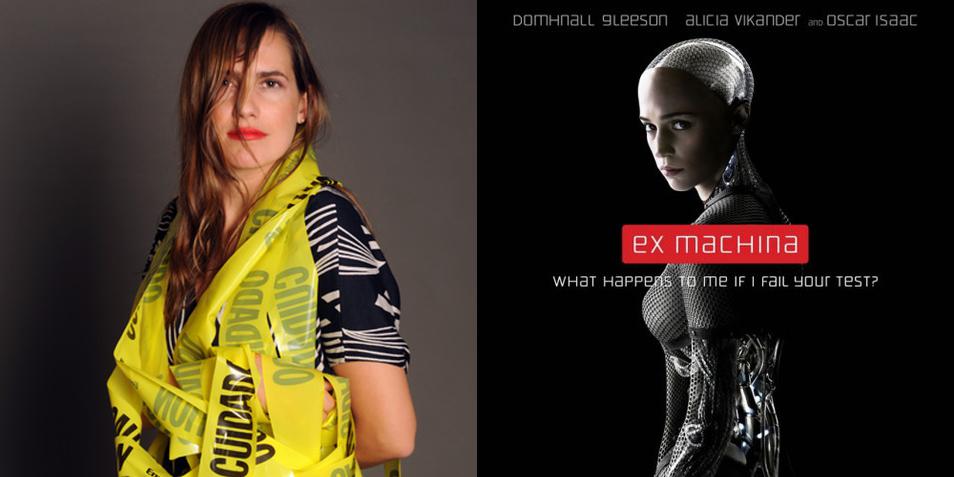
In Ex Machina, a “beautiful robot girl” named Ava (Alicia Vikander) has her human qualities evaluated by Caleb, a young male programmer played by Domhnall Gleeson.

“What happens to me if I fail your test?” she asks.
Technically, the proper pronoun for an inanimate individual like Ava is “it.” However, it seems we like to impose gender norms on our machines the way we do with people — male and female, boys and girls. (I have yet to see a trans robot, though I hear there’s a black lesbian robot out there somewhere named Bina.) Alex Garland chooses to make his central robot female and absolutely gorgeous.
But Ava isn’t the first good-looking android. So what are we saying, if anything, about women when we make machines in our likeness? To be fair, male robots in films haven’t always been portrayed in a positive light. Just ask HAL 9000 from 2001: A Space Odyssey. Though there have been bad guys, we’ve never truly sexualized a famous male robot, have we? There’s R2-D2, C-3PO, WALL-E, Baymax and Bender. Johnny Five is alive but so innocent. Oh right, there was that gigolo robot played by Jude Law in A.I. Artificial Intelligence, but that’s the only one that comes to mind.
Where does Ava fall in the spectrum of representations of the feminine in robotics?

Lady robots entered the zeitgeist in 1927 Germany, thanks to Fritz Lang’s Metropolis. Lang’s robot Maria was a real evildoer in what was seemingly more a statement about technology than women. The next major robot that springs to mind is Rosie from The Jetsons. She was strong and her name recalled the strength of Rosie the Riveter, but those positives were duly undermined by her French maid outfit and domestic duties. The Jetsons was originally created in 1962, so I guess that explains that.

The Bionic Woman is the next notable machine, though she was born a real human woman and then became “mechanized” after a skydiving accident. A pretty, athletic spy with super-hearing in one ear, she was one of the good guys. Lindsay Wagner was an iconic independent woman of the late ’70s.

Then there was Blade Runner, taking feminism in robotics backward. Rachael (Sean Young), Pris (Daryl Hannah) and Zhora (Joanna Cassidy), the replicants, are objects that get objectified. Pris is a “basic pleasure model” and Zhora does a striptease with a snake, for heaven’s sake.

On the more innocent side of robotics, along came the lovely V.I.C.I. (Voice Input Child Identicant) in Small Wonder. She was a fantastic, made of plastic, 10-year-old “girl.”

The ’90s brought a throwback to a different era of Bond girls in the Austin Powers movies. Not sure Simone de Beauvoir would have wanted to “Bring in the fembots!!!” Regardless, they do have pretty awesome bras.

Björk’s music video for “All is Full of Love” made us feel oddly voyeuristic watching mechanized lesbians make out. They weren’t doing anything wrong, it just felt like by watching maybe I was.

Of all of these mechanical sheroes, the most captivating, complex, female A.I. may have been played by Scarlett Johansson in Her. The operating system “Samantha” feels like a fully fleshed-out real woman even though she’s never in the flesh. We never see her body, we only experience her mind. She communicates her thoughts and feelings and insecurities in such a human way. Sex is still part of the equation, but it feels consensual, like in a balanced relationship.

The current full-metal female in Ex Machina is a complex character who will keep you guessing the way she/it does for coder Caleb. At the start of the movie, Caleb wins a “golden ticket” to visit the mastermind behind the world’s largest internet company, Nathan (the scariest version of Oscar Isaac yet). Caleb is dropped off by helicopter in the middle of the woods and told to follow a stream to get to the secretive, high-tech home where Nathan lives and builds female robots. Nathan wants Caleb there to administer the Turing Test to determine if Ava has intelligent behavior equal to and like that of a human. Thus Caleb is charged with determining Ava’s “humanity,” all while Ava develops a crush on him, which may or may not be all part of the test.
At one point in the film, Caleb suspects Nathan created Ava’s looks using Caleb’s pornography profile from his internet search history. Despite that, Ava has a certain innocence, dressing in a childlike way as she gets to know Caleb better during the course of “the test.” Her idea of the perfect date is to go stand at a traffic intersection to see the flow of life and people. She asks Caleb if he’d go on this date with her, introducing romantic attraction and all the joys and perils that come with it. Add her intelligence, attractiveness and ability to win the hearts of men and smell the scent of singularity in the air.
The theory of the singularity, the idea that A.I. will exceed human intelligence and possibly takes hold of humanity’s steering wheel, captures our imaginations and frightens us flesh-and-blood beings. So, given our general human fears of robots taking over the world, could a female robot be a way to thinly veil misogyny with machinery? Is this Garland’s point in his directorial debut? Probably not.
Now, of course, I’ve talked a lot about robot sexuality and Garland’s film is about more than that. Like other A.I. before her, Ava wants to exist and be free. She asks Nathan, “Why won’t you let me out?”
But why? What’s the difference to her? Why would a robot want to live so badly or have freedom? Because that’s what we want. The assumption that a machine would even want consciousness is a human projection. Could we be projecting our own fear of death onto machines? Perhaps more than anything, our subconscious minds are reflected in the metal panels of the robots we create. Maybe these machines are more human than we ever knew. They are us.