Getting a movie made is like waiting for an empty bathroom when you can’t hold it in anymore.
First you knock on the door and wait for a response to your script. Then you pace. When you can’t pace any longer you sit tight, really tight, because now you need a casting director. As you turn green and clench muscles you didn’t know you had, your casting director has to find actors. The agents of the actors have to read the script. Now you’re about to throw up on yourself. Could this really take any longer? If an actor ever gets your script, and if they like it, then you have to find a financier who likes your actor and your script. Stiff as a two by four, you hobble to the door and knock again.
While I hold in every bit of cellular matter I can, I prepare for another kind of waiting …
It was the end of an era when the basketball stopped bouncing in our backyard. The dog poop accumulated on an uneven court of stone tablets; the metal net that used to snap all day long with a “ca-chink,” rusted from stillness and rain; the branches of the birch trees held their arms out over the court in a perpetual state of defense. The basketball hoop became a monument dedicated to childhood and a perch for two Mourning Doves.
Behind our home is a city block of small backyards with fences. There are trees and squirrels, and an old woman in a purple robe picks her toes on a small covered porch. A pair of Northern Cardinals calls to us in the morning, a mouse captured in our kitchen has been relocated to the furthest side of the fence. There is a man practicing martial arts on Sundays with a blunt sword. Another neighbor sets traps on her roof to kill the squirrels that I feed. I throw bird seed onto a small patch of grass beneath the maple tree. I drop fistfuls of dove, pigeon and quail food on the fence. I wave to the woman in a purple robe. She doesn’t wave back. We are part of a Brooklyn ecosystem.
In the spring, the Mourning Doves stared at me and my family in our kitchen. They cooed at us from the backboard of the hoop. Since the basketball had rolled into a long silence up against the fence, they felt safe enough to execute their plan.
We watched them carry twigs to the back of our house and build a nest on the outdoor light. By late spring, standing on tippy toes, we could see the heads of two nestlings from our kitchen window. They would wait patiently as their mom emptied breakfast from her mouth into theirs. They gently and gracefully received their meals. They barely made a peep, hardly a movement.
By midsummer, the babies had grown into fledglings. The nest got overcrowded as the heat increased. Feathery bottoms sagged over the corners of the metal lamp. White fluff and debris showered down in front of our screen door every time one of them shook their bodies or stretched their wings.
My two sons, 19 and 22 years old, are still at home. They are bigger than they once were. Maybe as big as they’ll ever be. They eat a lot of beef and rice! And they dirty a lot of dishes! They take up a bigger amount of space on the couch. Their energy is the same, but expressed from 200 pounds of muscle and bone. Their future quests are riddled with danger and uncertainty. Their destinations too far for the eye to see. They will be leaving home soon.
They’ve outgrown our polite language and fill the space with post-pubescent voices celebrating the release of the “f” word. They use it as a verb, pronoun, noun, adverb and adjective. The language in the house is not appropriate for anyone who grew up with five channels and a TV antenna.
Testosterone rising and estrogen diminishing, our different stages of life clash. They notice the flabby arms I wave around and suggest lifting weights. They observe my pace getting slower as theirs speeds up, they notice everything – “Mom, you already said that.” The getting old jokes. Oh my god! I’ll be 56!
Are we horrible at parenting? Are we enabling them? Do we give them too much love? Will I ever get used to them not being here?
I wake up to a positive phone call. A financier is reading the script! I smile and strut about with a renewed faith in the movie. But a couple hours later, I frown as a failure; I was parenting them again and a battle ensued. They are too old for parenting.
“You don’t know what it’s like to be a parent!” I yell in desperation, as I attempt to hold on just a little longer. It’s true. They don’t know what it’s like to be a parent. Why should they?
The house is filled with skirmishes over independence. Don’t ask, “Are you OK?” Don’t show them pictures of their smaller, seven-year-old selves. Don’t suggest they get some air, or take a walk, or tell them TikTok and Instagram stop them from thinking for themselves. Don’t tell them social media is as much a drug as the drugs you did when you were their age. Don’t push the veggies.
One morning, I peeked through the window on my tiptoes to look at the nest. It was empty. My eyes desperately scanned across the green, brown and grey palette of our Brooklyn backyard. The young doves were there, blending in with our wooden fence. They waited. They sat on their bellies a foot away from the piles of seed. They could fly, but didn’t know how to feed themselves yet. They still needed their mom and the regurgitated seed from her throat.
“There’s no food in the house!” my younger son yells, as he opens the fridge and pounds of beef fall to the floor. I’ve never been good at starving my kids. But … were we supposed to stop feeding them? Would the Mourning Doves stop feeding their young soon?
Another morning, I watched those fledglings on the fence as they made their legs disappear beneath them and waited like boats bobbing on a wooden sea. I said to my older son, “You see those fledgelings? Know why they’re just sitting there on the fence? Because their mom is still vomiting food into their mouths!” He looked up at me from his phone, seeing my lips move but hearing no sound. He removed an earbud from his ear, and responded, “What?”
We have to stop feeding them. Then they’ll leave the nest, fly from the fence and into the blue open sky. No more beef. No more dove, pigeon and quail food, no more responsibility for growth and safety. We must encourage their release.
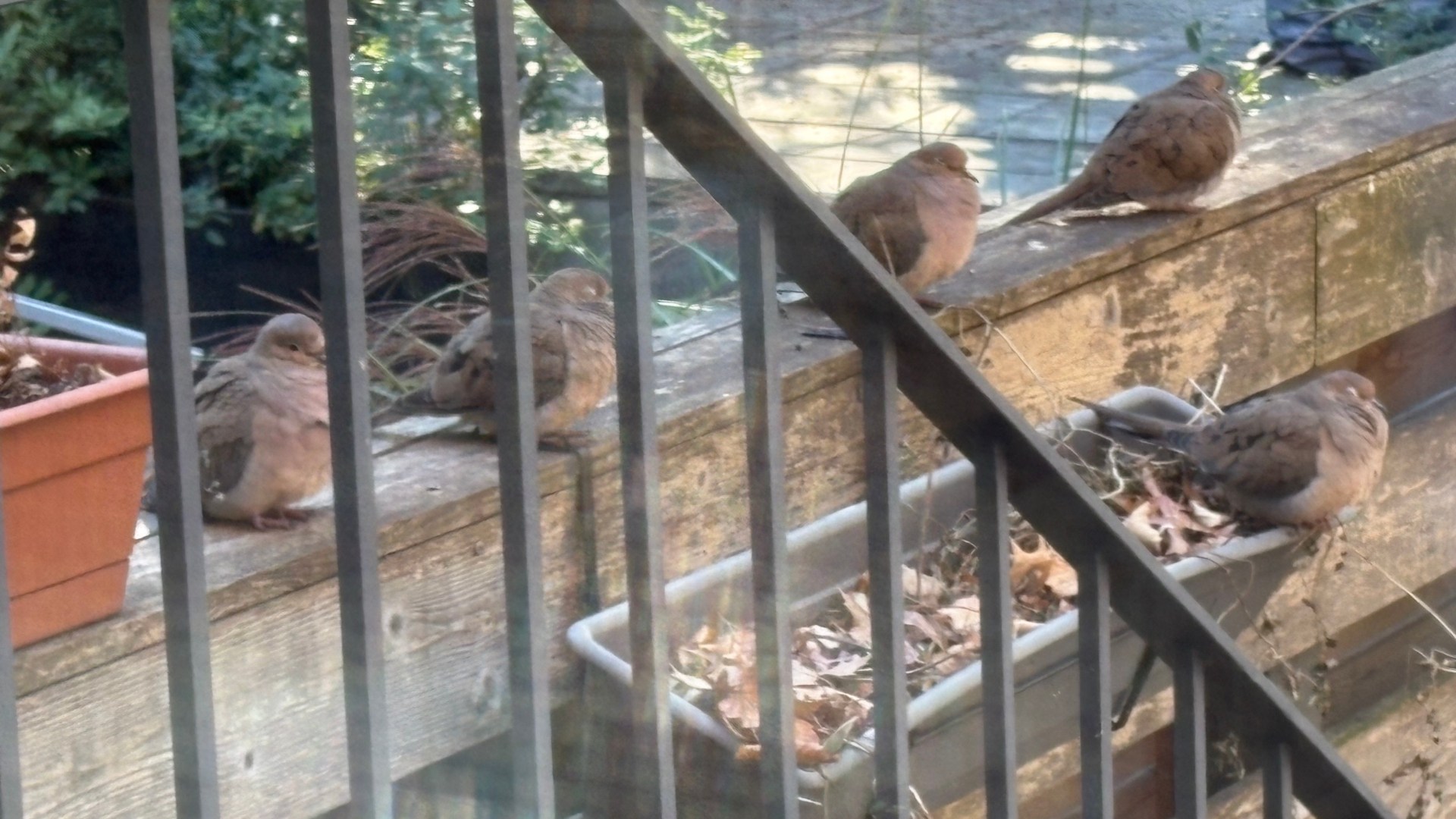
I watched as the fledglings got bigger, and hungrier and hungrier. They were out of the nest, but still waiting on the fence. Their confidence was building and their appetite growing. They demanded food. They became aggressive. They stalked their mother. They flapped their wings around her. They attacked, both fighting to get their beaks at her throat. They toppled her. A storm of feathers and coos like a squeaky toy between a dog’s excited jaws, bodies flipping and fluttering, a tumbleweed of fluff rolling along the fence. She came out of the brutal huddle with wings rearranged and a walk that wasn’t quite straight.
I call home to check on my sons, to ask them if we got an Amazon package, to see how they slept and what they ate for dinner. One of them says, “Mom, I love you, but we talk all the time. I’m gonna go.” Do I really want to know what he had for dinner? It was probably beef and rice. I know this. I’m in pursuit of any connection; one that lasts a minute, an hour, just a few sentences more.
How does the Mourning Dove say goodbye to her young? Is it just a flap of the wing? A turn of her head? Is it some gesture invisible to the human eye? Lately she approaches the pile of bird seed alone. It’s only herself she has to feed.
I’m holding on tight, waiting for an actor to read the script, waiting for the bathroom to open up, waiting for a moment to say, “You’ve been everything to me, and now, I turn my head so you can become you, without me.
The fledglings became Mourning Doves and I’ve now lost track of them. They joined the groups of birds that fly high above the neighborhood, that land on our court, every now and then.