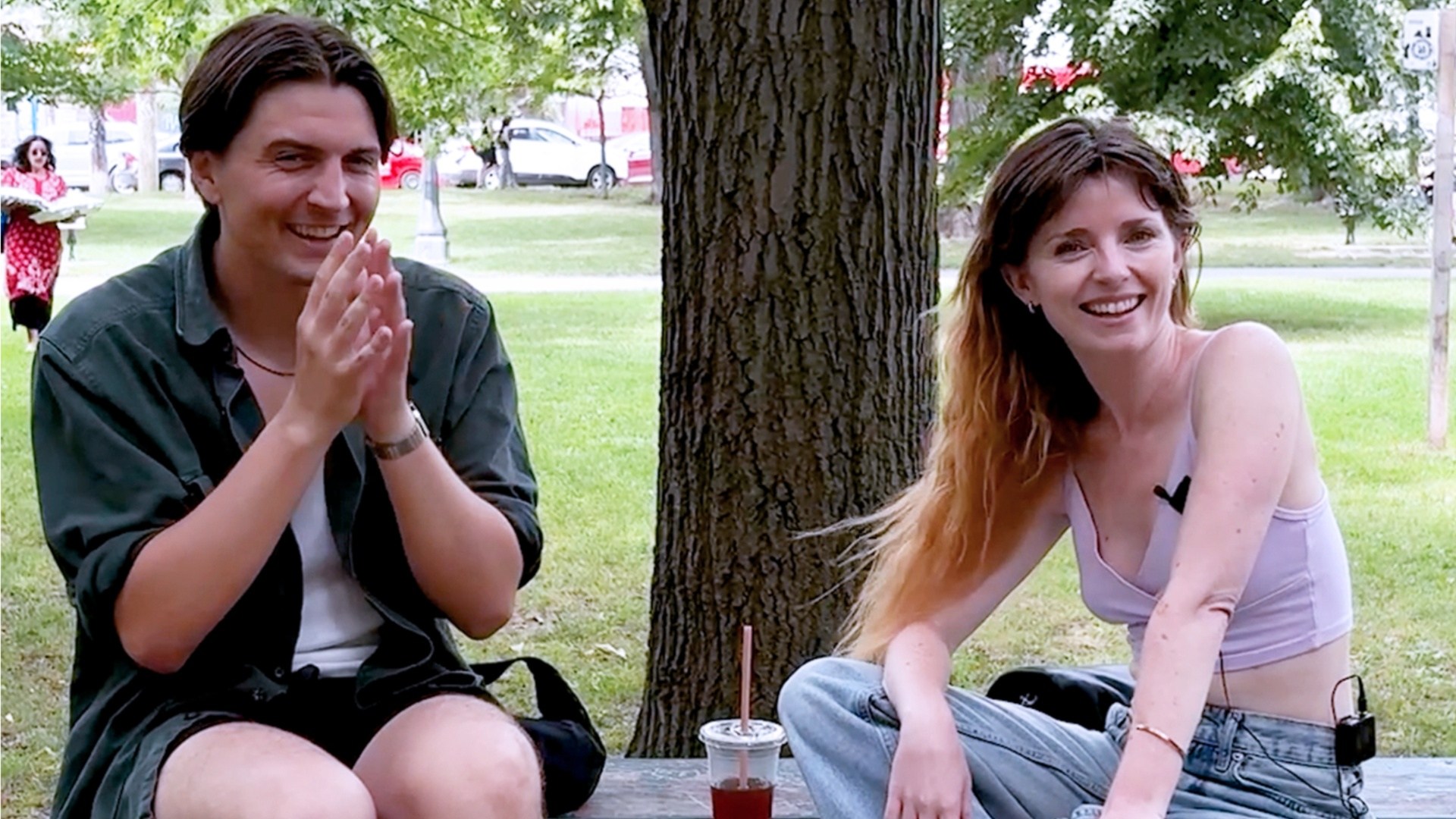
Tristan Wheeler is a Toronto-based filmmaker whose debut feature, Toronto Apartment, was released this year; Ember Knight is an LA-based musician and comedian. Ember is the creator of the Ember Knight Show, an instructional etiquette web series, which they have been showing on the road this past month. If you’re in LA, you can catch the physical release party October 3; otherwise, it’s available to stream on NoBudge.
Ahead of the Toronto showing of the Ember Knight Show, Tristan and Ember met up in a park to catch up about “being evil,” and much more.
— Annie Fell, Editor-in-chief, Talkhouse Music
Tristan Wheeler: One thing I was thinking about when watching the Ember Knight Show was this [idea of] creating a world, and then how that world you create interacts with the real world. I think we're all kind of doing that when we make a movie, completely creating our own little world that we get to control and no one's allowed to be mean to us.
Ember Knight: And we get to look exactly as cool or as evil as we want to.
Tristan: Exactly.
Ember: And, in fact, you look more cool if you make yourself more evil because you seem honest.
Tristan: Because you're like, “Yeah, I have a lot of self-awareness, actually. I have a lot of humility.” That's what I like to do.
Ember: “In my movie, I don't get laid.”
Tristan: [Laughs.]
Ember: Watch Toronto Apartment. He does not get laid in that movie.
Tristan: I don’t. The next one…
Ember: Maybe you’ll earn it? Maybe a little pussy?
Tristan: A little crumb… But I was wondering what your take on that as a filmmaker was, creating a world and then how that world interacts with the real world.
Ember: I think it's the only thing that interests me. It's the only thing that I want to make stuff about, that discrepancy. Because I'm a very dissociative person. I'm very often having an imaginary conversation. If you guys started talking to each other for five minutes and I'm not included, the opacity on this layer goes way down. I'm hanging out with other people that I maybe don't even know — people who are famous or imaginary.
Tristan: Who's in your mind palace that you talk to?
Ember: I can't tell you that.
Tristan: Nick Fuentes.
Ember: [Laughs.] But that is pretty much what interests me about film as a potential because it's the only way to kind of communicate what's going on up here and then how that is failing to translate. And what we don't want to do is we don't want to do Scrubs.
Tristan: We don't want no Scrubs! But, so, you're talking about creating it, but what about now that you've created your world and then you show it to people in the real world? How does it feel sharing that?
Ember: Terrible.
Tristan: You hate it?
Ember: Thinking about screening this in front of people now makes me want to put a gun in my mouth.
Tristan: Did it just go right on online when you were making it?
Ember: Yeah. I mean, we would have premieres for it but… I'm such a bulldozer, Pied Piper person — I try to get more and more and more out of the people who are working with me. So the fact that the Ember Knight Show started as me being like, “I wrote this 10 page script, it's going to cost $300. Are you guys down to make it with me?” And everyone was like, “Yay!” And then it balloons into, we're doing a season, there's smalls for Adult Swim, we're trying to pitch the series, we're going to build a giant lunar surface, we need to go out to these sand dunes and wreck someone's car. The fact that we were able to finish the season getting one or two takes of everything was just skidding into home base. So all I see when I watch it is how much I wish we had spent more time workshopping stuff, making it more off the cuff, making it more like something that actually makes us crack up. Screening it, changing it. We would finish it and screen it once and put it online, and that was that. And now all I see is, Fuck, I don't like that line reading.
Tristan: But is that the case with everything you make?
Ember: I think that's probably just what it's like to make things.
Tristan: Because I feel the same way.
Ember: But now Eamon [Shea] and I have been shooting test stuff for this new project and figuring out the character relationship and working with a new DP, and we're just getting stuff that makes us laugh. We're sharing clips with friends. It's more from the heart, in a way. Like, for example, in the Ember Knight Show, we would often shoot the verité scenes after shooting the studio scenes, so we were forced to try to make reality fit into the script. And there was no reason to do it that way. We could have shot everything that we were getting on the freeway or at Echo Park Lake first—
Tristan: Because you knew you were gonna get that stuff anyways.
Ember: Right, and then go into the studio and make it fit like clockwork. Which is what we're going to do now. Because that is the smart and obvious way to do it. But, yeah, it's hard to share it with people. But what is awesome about sharing it with people is — like episode three, the more animated one about getting mad and having a resentment world, I've been told that gets shown in therapy groups. People use it. It has a utility. It's not about me looking cool. It's about, is the show emotionally honest? Does it say something that is helpful? Ultimately, that's more important.
Tristan: Yes. Another question related to this: do you have to be polite to be a filmmaker? Do you have to have good manners to be a filmmaker?
Ember: No. [Laughs.] OK, so there's a few kinds of currency, right? There's money — it's the best one. [Then there’s] love, trade, and clout. So if you don't have money or clout — yeah, you have to be nice to people. Should you be nice to people? Yes.
Tristan: Be nice.
Ember: But I have definitely thought that I'm more of a monster than I am, and been like, “Oh, I used people.” And my friends who work with much more famous people will be like, “No, you're fine. I've worked with people who are so awful…” But what about you, Tristan? What do you think? Because your movie is not so much about inner worlds, but it is about — well, would you call it a self-insert? Or is this a totally a character?
Tristan: Well, the thing is, I wrote it being like, What if a guy was like this? And then watching it when it was done, I'm like, Oh, that guy who's like this is me. I think that is a version of me that's like if I was uninhibited and didn't care about being nice to other people, or if I had no self-awareness. That's how I think I would act.
But, yeah, I think I try to be nice to people. It's nice to be nice to people.
Ember: It feels better.
Tristan: It feels better. And people respond to being around you better when you're nice to them. But I think as a filmmaker making that movie where I'm doing so much and I'm trying to direct, I'm trying to act, I'm trying to be present to all the different people — we have such a small crew of, like, three people and we're just trying to get shit done. I am both really, really trying to be nice because no one is being paid, but also being like, “I don't need to fucking ask the concierge if we're gonna shoot in the hallway. I'm just gonna shoot in the hallway, and I will make him mad and it will make his job harder, but I know that if I ask it'll be ‘no.’ So I just need to do it.”
Ember: Yeah. I don't know that stealing shots is — I don't think that is not nice.
Tristan: It’s annoying.
Ember: That, to me, is different. Eamon and I, when we first started doing comedy together, we really were like, “Oh, we are annoying.” We were trying to be annoying. We were actually seeing how annoying it's possible to be. And that, I think, can sometimes be not nice, but sometimes it has nothing to do with being nice. Sometimes it's just being there.
Tristan: Being yourself.
Ember: Being who you are. Being perhaps unpleasant. But you can still be nice and and be annoying.
Tristan: It's true.
Ember: It's rude that we don't have more money.
Tristan: [Laughs.] That's the ultimate rudest thing. It's so fucked up.
Ember: It’s rude that we have to steal the shots…
I relate to this drive to play a character that is the worst version [of yourself] and kind of exercise those demons. I think that's a very common impulse. Do you think that this guilt or shame around being the type of person who will fuck up relationships for this selfish goal to create this thing — that ostensibly only you benefit from ultimately — that there is a desire to confess that side of yourself in a public way, in a character?
Tristan: Well, I mean, that's what the whole movie's about. It's about a guy—
Ember: Using a space that you're not supposed to.
Tristan: Yes, and going insane from it and feeling guilty. And also knowing that you're self-benefiting at the expense of your relationships, and then coming through it on the other side, having some semblance of understanding of yourself and of a new value in relationships, ideally. I throw that same question to you.
Ember: I wonder about my motives. Because I want to think that I'm making things that are emotionally helpful to other people; I want to think that I'm making something that brings people joy, and in the process of having fun watching it, they're like, “Oh, that's something I was trying to articulate. That helps me understand myself, that helps me understand my relationships.” So that's my favorite version of why I do things. And then there's the layer of, “I want to fly on wires. I want to see what I look like if I do a flip in the sky.”
Tristan: “I want to be up in lights and doing fun stuff!”
Ember: I want to see how awesome I can look and be. And then there's this also this layer that is like, “I want to tell you why Ember actually didn't mean to hurt your feelings. And actually, Ember was in a very complex situation and is aware that maybe she was being a little selfish, and is trying to do better.” So there's this lawyer side also.
Tristan: It’s like, “I see it too!”
Ember: “And I agree and I'm working on it!”
Tristan: “Look, I made this whole movie as penance!”
Ember: “And now everyone likes me!” Actually, now that I've said it, that's the worst one. That's in the basement — “the worst version of me is beloved.”
Tristan: [Laughs.] “You loved watching it. Got your asses!” This is such an embarrassing thing — my movie played at the Mammoth Lakes Film Festival, and afterwards, the programmer who chose my movie came up to me and said, “Yeah, I always like to look at the person when they first come on screen and see the reaction. Most people are like, [hides face]. But you had the biggest smile.”
Ember: [Laughs.]
Tristan: I was like, “Ah, yeah, got my ass, Paul.” Unfortunately, there is that. Which, again, I think I also am trying to think about in the movie: What if I'm not aware that I’m like that?
Ember: I actually want to go ahead and put a spin on what I said is the worst possible reason. I think there's also a way to think about that's like: “I want to broadcast the truth about me and figure out who fucks with me.” I want to get it all out there so we don't have to find out later, and who [still] likes it? And then we can be friends and we can work together. And the rest of you who don't like it, now you know.
Tristan: Have you ever shown it to someone and then they were like, “Oh, that's how you're like? I'm not into that.” Or the opposite, like, “Oh, OK, I think I really understand you now.”
Ember: I don't know that I've sat down with a friend who hasn't seen my work and showed them my work and been like, “What's changed?” This project was finished four years ago, so it is out of date with my taste and my life and my friend group. I think I'll find out through these screenings — people who know me now who didn't know me then are going to see it, and maybe they'll stop taking my calls…
I think that people either click with it or they just don't understand it. I think they're either like, “Oh, fuck yeah, I love this. I didn't know you were a genius.” Or they're like, [limply,] “Oh, yeah, it was great. You must like Pee-Wee Herman.” And then I go home and I kill myself.
Tristan: Do you not like Pee-Wee?
Ember: I really don't.
Tristan: Really? Damn… Let's get into that. Don't like him because of certain life choices he's made?
Ember: [Laughs.] No! Paul, I love. I'm very happy for Paul. I think he was great in the culture. But the character of Pee-Wee Herman is so two dimensional, and never suffers and never learns and never loves anyone. I just don't care about him. Even in the movie — and I know people love that movie. There's some really cool parts visually. But I think that the best thing that the character of Pee-Wee Herman ever did was give some really cool art directors a lot of work. But I can't watch the show. It makes me carsick.
Tristan: Really? There's too much going on?
Ember: Oh, yeah. There's nothing in Ember Knight Show that we don't use that doesn't have a utility. It's not cluttered like that. No puppets, no carnie shit, no clowns… No Pee-Wee Herman.
What do you hate that'll make people not like you?
Tristan: I don't know…. The things that my sense of humor will get compared to are things that I took a lot of inspiration from, but I also feel like I'm very different from that. People have said Nathan Fielder, someone said Jim Carrey — which to me was like, “Are you just saying that because I'm weird and from Canada?” I obviously like those guys, but I think I'm doing something different. I think I care about people in a different way. I'm sweeter.
Ember: [Laughs.] That's an amazing thing to say about yourself.
Tristan: I think they're very jaded! They're very dark.
Ember: Totally. I'm much more like a Gene Wilder or Robin Williams leaning person in terms of what I appreciate. But I think publicly disowning Jim Carrey is a strong stance.
Tristan: As a Canadian.
Ember: I didn't even know he was Canadian.
Tristan: See, this is the fucking thing — Americans don't know who's Canadian, and we have an encyclopedic knowledge of every single [famous Canadian].
Ember: Of course. Because you're mad about it. Because you want your credit.
Tristan: We want our damn credit. Jim Carrey, Canadian.
Ember: Seth Rogen.
Tristan: Yeah, Seth Rogen. Michael J. Fox. Mary Pickford — the first movie star, from Toronto, Canada! Come on, guys.
Ember: What else are you mad about?
Tristan: Racism. I hate that shit.
Ember: [Laughs.] Well, is there anything that you want to plug?
Tristan: Follow my movie, toronto.apartment on Instagram I'll be posting about it playing places. If you are a place that plays things, please reach out. I'm trying to become famous in America.
Ember: Famous in America… Zebras in America… Canadian!
Tristan: What?
Ember: Tom Green.
Tristan: Oh, yes! Ottawa's own.
Ember: I saw Freddy Got Fingered three times this year.
Tristan: That's a perfect movie.
Ember: It's really good.
Tristan: There's no other movie that hates being a movie more. And it hates you. But also, you're gonna laugh.
Ember: I think all the time about the scene when he jumps out the window from the therapy session. I want to make a movie that feels exactly like that. He's a hero.
Tristan: Well, what about you?
Ember: I made a web series called the Ember Knight Show, with people who don't talk to me anymore. [Laughs.]
Tristan: [Laughs.] I didn't know it was that intense.
Ember: Well, the main person that I made it with, I dated for seven years.
Tristan: Oh, that'll do it.
Ember: Everything bad about it is his fault.
Tristan: But it's a good show. I really liked it. I think it makes a beautiful world that I want to learn and be a part of. I think if you're reading this, you should see the Ember Knight Show, which is on NoBudge.
Ember: That's true. And you can buy a physical drive from videostoreage.com!