
“What I Watched” is about the movies that inspired filmmakers, actors, and writers while creating their latest work. A genre, an old classic or new release, a scene or line that stuck in their brains, a soundtrack or an image — how do all the things we’ve loved, hated, and absorbed come together to make something new?
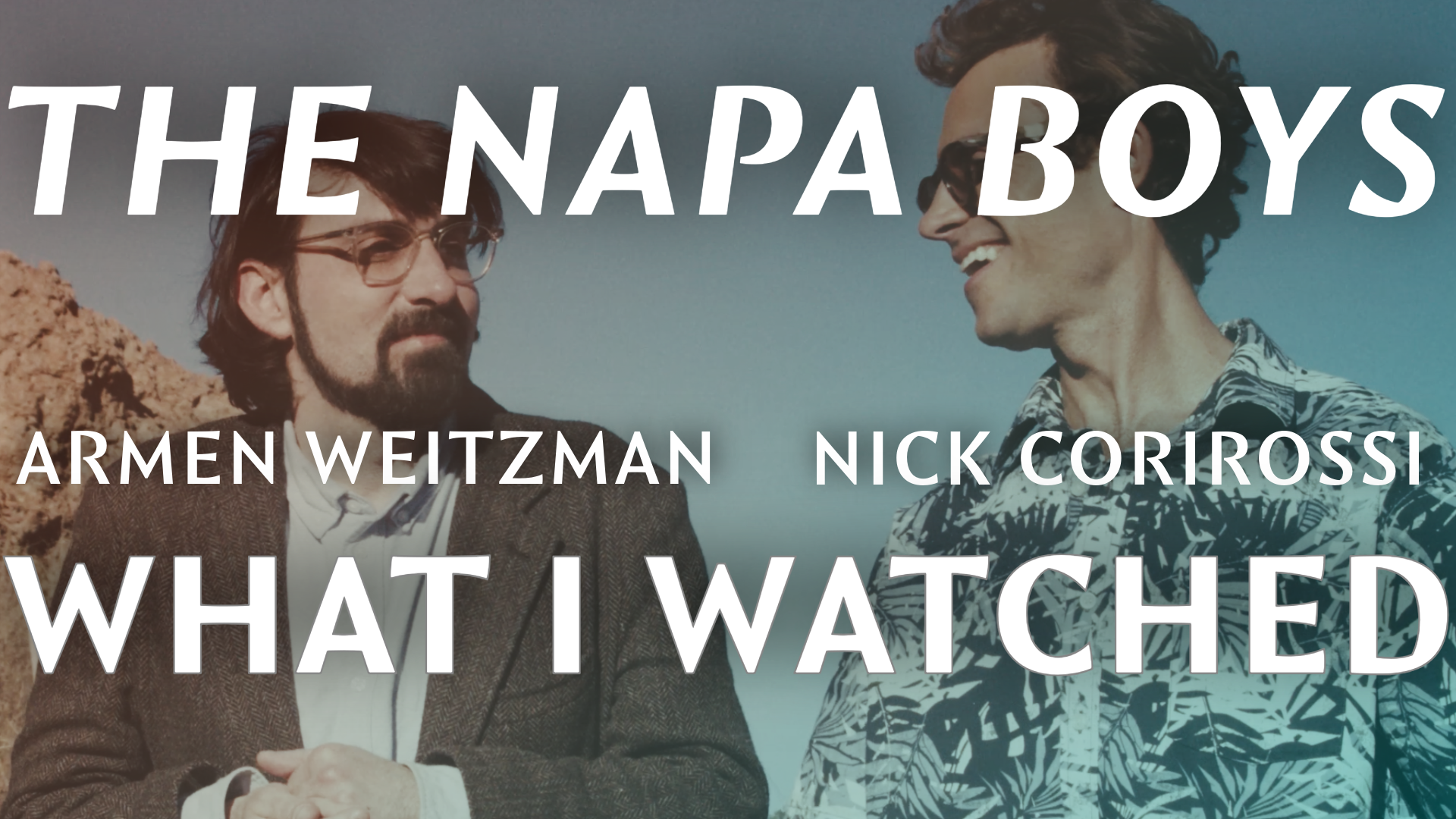
For the first installment of “What I Watched,” I talked with Nick Corirossi and Armen Weitzman, the creators and stars of one of the most original movies in years, The Napa Boys. It’s my favorite of 2026. I even tell Corirossi and Weitzman that I liked it more than The Odyssey, and I stand by that assertion. Nolan’s smash hit of the summer is, as odd as it sounds, not unlike The Napa Boys in many ways - an epic journey that harkens back to the mythology of a lost age, about an evolving mode of storytelling, and with a surprising amount of blockbuster franchise tropes thrown into the mix. But The Odyssey doesn’t feature a literal needle drop of “The Girls of Rock & Roll” from The Chipmunk Adventure, so to me, it’s clear which film comes out on top.
Check out part of my conversation with director Corirossi and co-creator Weitzman below, conducted via the unique combo of a video call and a speakerphone held up to a laptop microphone. "This is good," we all said when Corirossi hit a tech snag and called Weitzman, "this is fun." And it was fun!
The Napa Boys is an almost inexplicable combination of genres, references, and tropes blended together to create a hilarious, whiplash-inducing, and wholly original comedy. If you’ve seen it already, you’ll agree that it’s a difficult movie to describe. The easiest way might be “Sideways as a blockbuster franchise sex comedy.” That’s not the full picture, but it is all technically true. The most recognizable strand of its DNA does come from the Oscar-winning 2004 Alexander Payne film, Sideways. The two titular Napa Boys are named Miles Jr. and Jack Jr. - and yes, they are canonically the sons of Sideways’ Miles and Jack. And as Corirossi points out, "What made it work for this genre play is that, upon rewatch, it is a product of its era. And it is kind of a [....] sex comedy with two bros, and it is closer to American Pie than I think people remember it as, in this prestige sense."
But the movie has a meta concept that audiences are thrown into as soon as its full title, The Napa Boys 4: The Sommelier’s Amulet, splashes across the screen with a jaunty little animation that would look perfectly at home in the Air Buddies series. If you’re looking for the first three installments of the series, you won’t find them anywhere except between the lines of this film; Corirossi and Weitzman have constructed a world built on the tried-and-true (or tired) story beats and nostalgia-inducing clichés that, if you’ve seen even a handful of studio tentpoles in the past 30 years, you’ll understand “subliminally as lazy tropes that just connect things to IP,” as Corirossi says. "Even though we respect the movie and we drew from it, there is an arbitrary nature to its context, that you're applying these similar kind of formats that spin-offs, current day and of the past, would apply to something like that, and make a big deal that there's no good merlot. As though [the filmmakers] hadn't even seen it that many times."
Weitzman explains, “We tried to take it as if this was truly a spin-off of it. So we didn’t want to do an exact copy or a parody one-to-one. So I think we chose the path of, yes, of course, Sideways is very deeply, profoundly important. And we love that movie. The joke is more about why a good movie would even deserve this type of treatment.”
This movie offers an “if a tree falls in the forest” type of philosophical conundrum. Are The Napa Boys still The Napa Boys if no one else participates in the joke? It’s a psychological experiment that completely works, as long as you’re open to playing along with them. And you should gift yourself a richer viewing experience by playing along. The Napa Boys has a way of making you feel almost angry at how well the combination of tropes and references can summon emotional responses and nostalgic pangs from absolutely ridiculous scenarios. By the end of the movie, I felt like I had actually grown up watching The Napa Boys’ adventures. And since I’ve seen several of the movies that shaped The Napa Boys, in a way, I really did.
Weitzman says, “It’s always been on your shelf. And you should feel emotional, because we love movies. And the other secret through line is that we’re making one. [….] We want to make sure that we didn’t waste the audiences’ time, and we love you, and the comedy is more about that you, the audience, are so unknowingly aware of how many movies you’ve seen, and how many rhythms are taken for… that’s just the normal thing now.”
Corirossi adds, “What we wanted to do was use the tenets of the actual things that worked in movies in the 90s that now people forget to put into movies, and kind of couple those two [types of tropes] together [….] We kind of tried to mine and pan for those tropes, and I think they’re effective because you’re also like, man, they don’t do this anymore!”
Asking your audience to participate in a meta layer of world-building and visualize not just a fake franchise, but their own counterfeit nostalgia for it is a risky creative exercise. And on a surface level, The Napa Boys might seem like a pessimistic or even antagonistic takedown of modern movies, and Corirossi and Weitzman themselves are the first to admit that The Napa Boys shows a cynicism about what storytelling has become. But you can only have a genuine emotional reaction to The Napa Boys’ tropes if, beneath all your own cynicism, you harbor some sort of love for where those tropes came from. And you can only make The Napa Boys if you understand why our relationships with movies and their tropes are so complicated, why we’ve ended up so cynical, and why we keep seeing the same types of movies hoping that this time, they’ll finally feel fresh and new again.
It’s because people love movies. They passionately love movies. And hate movies. And can’t stop complaining about what movies got wrong, and analyzing theories about movies, and rewatching movies, and poking holes in movies, and remaking movies, and searching for movies that give us the same elation we felt when we were young. All the ways we engage with movies might be part of the reason why movies themselves have spun out of control, trying to give us more and more to engage with until every franchise has been stripped for parts and turned into the Ship of Theseus.
Corirossi and Weitzman very clearly love movies, and they know how to remind you about all the reasons why you love movies too, even when that love is complicated. Even when the cynicism and snark creeps in, don’t you still want to love movies?
"Some of the tricks that we kind of exploit [....] are hitting too close to home for some people," says Corirossi. "It's kind of like this kaleidescope or arbitrary context to go through the looking glass, to then be able to do all the things that people forgot to do in movies again. So they're getting mad at that first part, and didn't realize the gift of the second part."
Maybe nothing feels new in film now. Maybe you think that every genre and trope has been run into the ground, and studio execs have identified all the wrong things that made our favorite movies special - Corirossi compares the latest Star Wars trilogy’s fixation on Luke’s lightsaber with The Napa Boys’ focus on bad merlot. So many things have become a rehash of a rehash in a culture that is getting narrower and narrower. The Napa Boys is about those exact feelings. Kind of.
But it’s also about why those tropes and cinematic traditions became beloved in the first place, how fantastical worlds, sex comedies, and prestigious dramedies alike were all built around those same traditions, why execs keep trying to recapture lightning in a bottle and coming up with watered down versions that make us say, “Oh… I recognize that.” It’s about what we’ve lost in modern movies, and those lost things’ replacements, and how the yearning for those lost things can so easily transmute into either nostalgia for their lesser forms, or outright cynicism, or both.
And it’s also about some friends on an epic, perilous, romantic, horny, wacky, and life-affirming journey to make some pretty terrible-looking wine, discover the meaning of a magical amulet, stop Ivy Wolk from following her dreams (with the help of a fuzzy stop-motion moose), and pass the torch to the next generation (who could have adventures of their own in the rumored sequel, The Napa Girls, a film which Corirossi and Weitzman say is possible).
Like I said, it’s a hard movie to describe.
We've compiled some of the films that Corirossi and Weitzman shared into a Letterboxd watchlist of The Napa Boys’ influences and references, and it’s a varied grab bag. You’ve almost certainly seen a handful of them. But if you’d never seen a single movie in your life and wanted a quick crash course on what our cinematic landscape looks like and how we got here, The Napa Boys’ watchlist would be a solid starting point.
Whether you already loved the movie, you’re looking to understand it better, or you have no idea what I’ve been talking about this entire time, their watchlist will help you see The Napa Boys in a new light. Some references are easy to spot and form the core of the movie (Sideways, Lord of the Rings, American Pie, to name a few). Some add flavor and tone to the story and acting choices (be on the lookout for various bits of inspiration from Kubrick films and Jack Nicholson performances). Some are being outright parodied, or have been absorbed through our culture of reboots, sequels, and IP. Some are referenced in the soundtrack (does the mysterious Bug Mane's song "Killers of the Flower Moon" suggest any similarities between The Napa Boys and Scorsese's film?). And some of their pop culture references won’t be found on Letterboxd (Will Smith’s infamous Oscars Slap inspired one of Mike Mitchell’s funniest lines).
Visit @talkhouse on Letterboxd to see the complete list.
Grab some wine (as long as it’s not merlot), flip over to Tubi or Amazon Prime (the film is now available to stream for free!), and see how many of their inspirations you can spot in The Napa Boys.
To the grape! 🍇