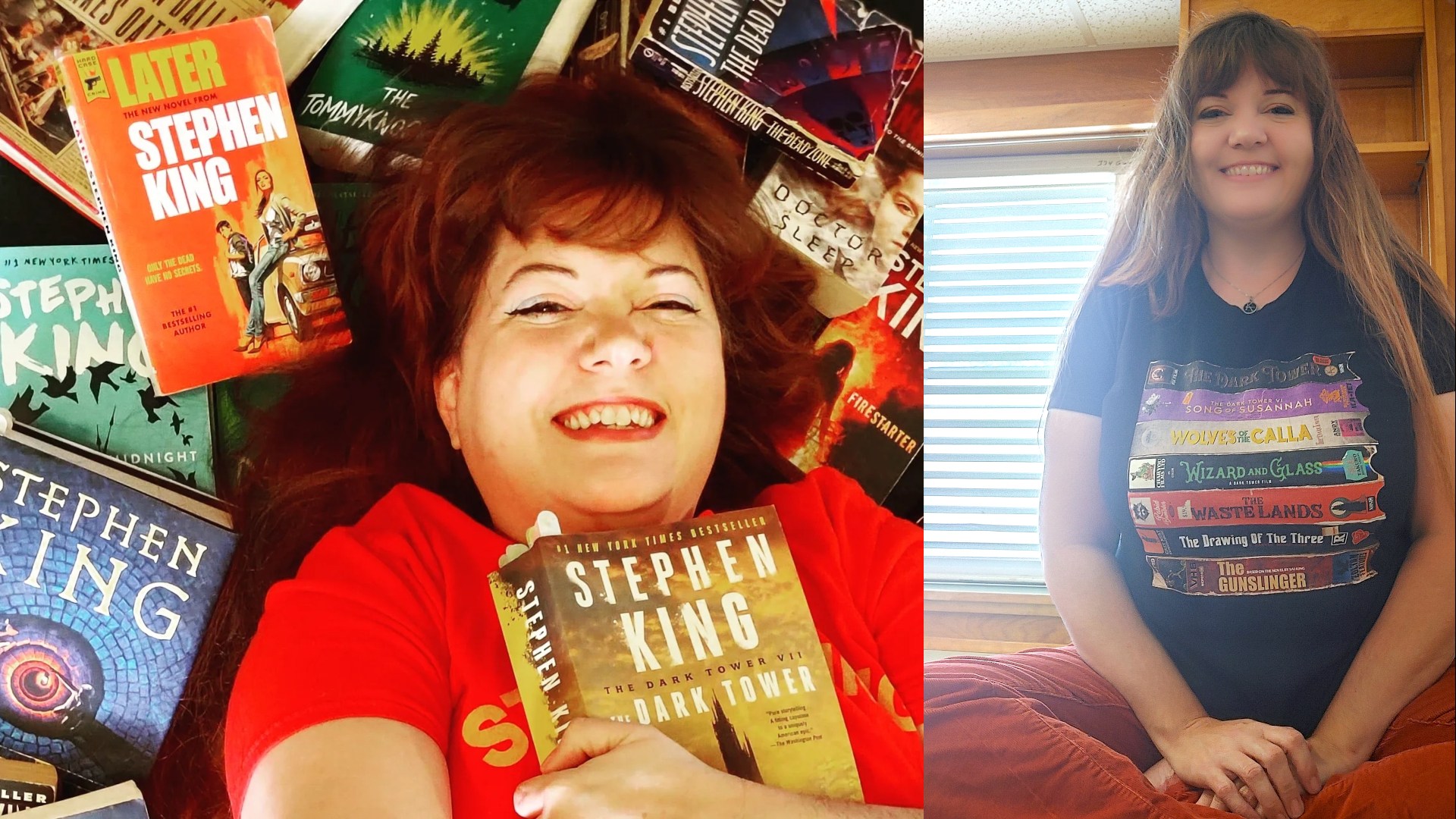
I have read all of the books Stephen King has written. Let’s break that down:
67 novels (spanning publication over 50 years)
12 short story collections
5 non-fiction publications
2 children’s books (!)
And that’s not including any of his screenplay work, or the incredible articles he has written over the years for various publications, and a thousand other things. To say he is prolific is an understatement.
The most incredible thing about his work is that, although he’s often dismissed as a “horror” writer, his books actually span an incredible number of time periods, genres, styles and a thousand ways to scare you before he even gets to the horror in his books. I can recommend works of his to you based on other books you love – fantasy, Western, sci-fi, survivalism, history and numerous other sub-genres.
You can dip into only the ones that sound interesting to you, or, if you’ll allow me, let me try to lure you down the Stephen King path that I have trod in reading everything and give you reasons why you should follow me into the most delicious literary puzzle I have ever encountered.
(I do recommend reading my first piece for Talkhouse here, to give you all the juicy details of my childhood obsession with Stephen King!)
Diving into Stephen King at 11, I chose to begin with Pet Sematary, It and Carrie. Three incredible novels, and a fantastic entryway to his work. These books show the variety of his characters, the astounding violence his works need to survive, and the depth of his fictional towns and his love of intertwining reality with fiction. Carrie White lives in the real-life town of Chamberlain, Maine, the Creeds move to the real-life town of Ludlow, and Louis works at the real-life University of Maine. But It takes place in the fictional town of Derry (which follows the geography, almost identically, of the real-life town of Bangor in Maine, including the canals, the barrens and even the Paul Bunyan statue).
Chamberlain. Ludlow. Derry. Castle Rock. Fictional or not, these towns create their own map.
You see, even though I’d been pretty hardcore reading Stephen King growing up, I realized one day that I’d never tackled what he calls his “masterwork” - the Dark Tower series, and I dove in with relish. But once I started to see just how interconnected his works are, especially in relation to the Dark Tower series, I stopped and decided to read everything connected to the Tower first, before continuing.
I thought it would be only a handful of books – I didn’t realize they’re almost all connected.
King really has done an incredible job of making sure that most of his works stand alone, but if you’re willing to take the time, it is honestly the most satisfying and titillating literary treasure hunt, with clues hidden along the way. I take such joy in highlighting each connection and putting a tab on the page, for easy access later.
Looking at all of his books as one giant piece of work actually makes sense if you’ve read The Dark Tower, and it genuinely was such a delight to finish the series – then turn right around and start it over again.
All of this has taught me to look at the bigger picture within an artist’s body of work. Some of my favorite authors, besides King, are Bret Easton Ellis and Jack Kerouac, also famous for having their characters crisscross throughout their works. With Jacqueline Susann, another of my faves, it also feels as if all of her characters live in the same universe. There don’t need to be official sequels to these authors’ works, their novels all play in the sandbox of their respective creator’s brains, all coming from the same well. Seeing a writer’s talent mature through their career is such a privilege and a joy.
And because Stephen King has been publishing novels for more than 50 years now, we also are able to watch him age and change as a writer. The Bachman Books are some of my personal favorites of mine, because I love how each one (The Long Walk, Rage, The Running Man and Roadwork) details the mental disintegration of the lead character, desperately trying to beat “The Man” and find a place inside their broken, violent worlds.
This version of King speaks to me, and I know that King has stated that he’s glad Rage is now out of print, but he is sad about losing a novel that tapped into a part of himself he can never regain. These stories were written when King himself was the blueprint for these the frustrated, poor and angry characters, but once he became successful, his access to this version of himself was gone, and yet lives on within these early stories of his. If you read his works chronologically, you can really chart his writing through his life – his early angry work, his coke-fueled insane ’80s period, getting sober, recovering from his terrible accident, moving to Florida – all of these events are easily reflected in his writing from these different periods, so it’s a fascinating dance of text and subtext.
I’ve delved deep into the brains of losers and bullies, dead men and creatures from the beyond, learned about monsters of every description, plus men and women who truly believed in the good in humanity (human and non-human alike), learned a lot about music and literature and pop culture, fallen in love with many characters and shrunk from others. King has no interest in superheroes, just human characters that are frail and confused, sometimes violent, sometimes refreshingly innocent. Always relatable.
I’ve also come across many books of his that I don’t like so well, too. I don’t want to present the idea that everything he writes speaks to me – a lot of them don’t. But that’s OK, right? I can loathe Dreamcatcher as a novel, while still loving it because it was the book he wrote when he was recovering from his accident, and I am so so happy he survived. I’ve only ever lived in a world where Stephen King exists – I try not to think about the time when he won’t. But it does mean that I cherish every new release from him and feel the warm rush of excitement us bookworms feel when the latest work by your favorite author is published.
His story “Life of Chuck” beautifully paints a portrait of the impact of a person’s death – when someone dies, you’re not just losing them, you’re also losing their brain, and everything in it. Every memory, every story, every character imagined is suddenly gone. I’ve spent decades of my life swimming in the stories of Stephen King and I feel so lucky to live in a time when new books from him are still to be anticipated. His imagination is so broad, so clever and heart-breaking and twisted, I don’t think there will ever be another author to achieve the nearly lifelong success that King has had.
Reading Stephen King has taught me about the evil possibly lurking just underneath the surface of men, to not stand too close to the street on a corner or near the subway platform. Taught me to be kind to those who others may not like. To stand up and fight against a system that wants to keep us all down. I’ve learned about aliens, werewolves, cannibals, killer clowns from outer space, devils and demons and cars that yearn for revenge. About gunslingers dedicated to a failing world, and the need for family, the need for love, and the need to stand and be true.
What will reading him teach you? I guess you’d better dive in and find out.
Happy Birthday, Mr. King.