
My childhood memories don’t exist digitally. Not really. Most evidence of my past is scattered in photographs and VHS tapes tucked away in my mom’s house in rural South Carolina. When I go home, I go scavenging for these memories and somehow always find something I’ve never seen before. On my last trip home, I found a photograph that resonates in a profound new way. And it’s fitting that I find this photograph now, right as my second feature film, Blood Shine, releases into the world.
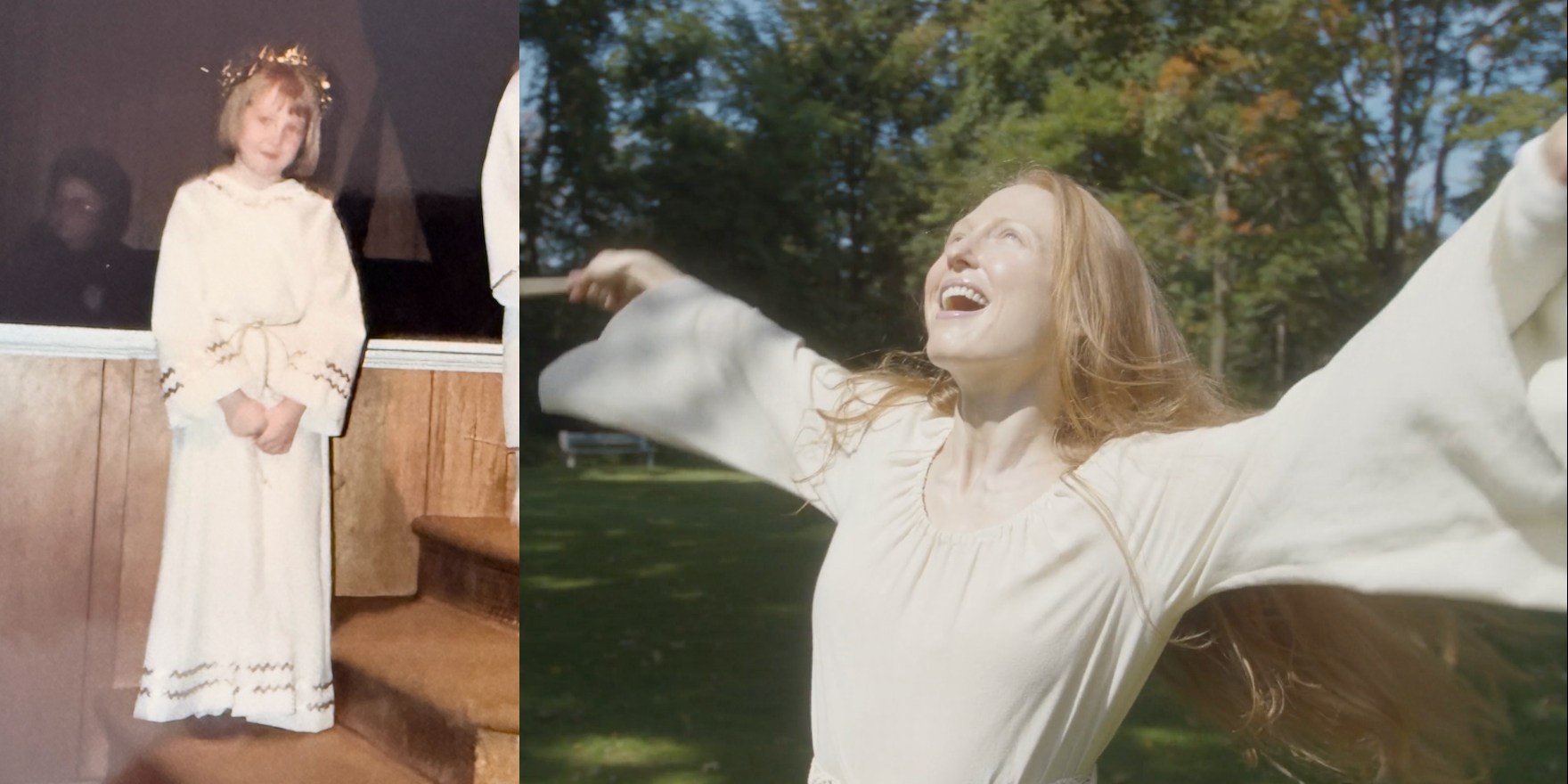
In the photograph, a tiny version of me is acting in a nativity play at the Methodist church where I grew up. I’m dressed in a white gown, a gold tinsel halo around my head and I have my hands clasped in front of me. This was my first role. An angel. My wide eyes and half-smile stare back at the camera. I look timid in the photo, but not scared. I look quietly electric, as if something big is about to happen and I’m unsure how to face it yet.
Looking at this photograph now, I see the beginning of a character who started growing inside me, long before I knew her name. That character is Clara, a role I co-wrote, directed and played in Blood Shine. For comparison, here’s an image of me as Clara, performing a very different act of worship. Same white dress. Same bell sleeves. Same faith-driven purpose behind the eyes. Clara is basically that little girl in church, all grown up, laden with years of heartbreak, tragedy and struggle, but with a tireless sense of purpose and a new kind of fervent belief.
When I compared these photographs, it struck me how my life has oddly come full circle. The little girl dressed as a faithful angel grew up to create her own drama about worship, but this time told through a transgressive lens of sensuality, dark love and violence.
Unlike the angel in the Christmas play, the character of Clara isn’t quite so easy to explain. She is pious, but vicious. Her savagery is ceaseless but sacred, and her faith is fulfilled by flaying men’s flesh. Clara worships the light of truth, yet crumbles in the darkness of her past. Clara is that little girl, raised in the confounding yet warm embrace of the Bible Belt. She is a woman striving for purity and grace, yet she’s thwarted by her own animal impulses and darker desires. She is my way of dramatizing and grappling with these inherent contradictions to an extreme degree.
Growing up in the American South meant growing up inside a paradox. It wasn’t all good or bad. It doesn’t make me feel entirely bitter or nostalgic. It’s complicated. The church gave me a story to belong to before I had one of my own. It gave me community, structure and a sense that good and evil were real, tangible parts of life. But it also taught me that my body was a problem to be managed, and that my emotions were annoyances to be ignored. I was raised to be devoted and small. Faithful and unphysical. I wasn’t allowed to be a spiritual person and also a sensual one. I had to pick, or at least pretend to. This inner struggle left a deep sense of shame in me that only got worse as puberty and womanhood took hold. As emotions and hormones swirled, I felt I was slipping further and further away from the ideal standards I held myself to. I couldn’t be the pure angel I longed to be. There was something wrong with me. I was broken and I tried to hide that feeling as best I could.
I didn’t understand how deeply broken I felt until I was a sophomore in high school. I found a Baptist church in Charleston and I loved attending because of the preacher there. He was a sharp, charismatic theologian and I looked up to him in the wonderfully uncomplicated way you look up to someone when you’re young. When I found myself in a frightening situation, I remember going to him after service and asking if I could talk to him about it. I was genuinely lost and struggling during a time that felt dangerous and scary. I still remember his face when I approached him. His typical charisma faded away entirely and he simply said, “I can’t help you with that.” He didn’t give me a referral to someone else in the clergy or even a piece of scripture. He just stared at me with cold eyes, turned and walked away.
That was the moment the church stopped being a place I could bring my whole self to. Not because my faith had failed me, but because a leader in the church who was supposed to represent its care for me seemed to decide I wasn’t worth helping or saving. It was the opposite of everything I’d been taught about the church. I was in a time of real crisis in my life, and that was when I realized the church couldn’t save me. I had to save myself.
That moment is exactly why Clara needed to be created. Because I finally stopped believing the church was infallible, I was able to grow as a person and as a woman. Clara, on the other hand, never had that opportunity. Clara is the result of deep, internalized shame and a vigilance guarding against her physical form and her secular needs. Unlike me, Clara never reconciled these two parts of herself and thus became a violent, beautiful but tragic character in Blood Shine. She is the extreme version of a woman unable to come to terms with her physical and spiritual forms. And by writing, directing and playing her, I was able to play this dynamic to its fullest and most tragic conclusion. I finally felt like the narrator of my own life instead of a character being shaped by someone else’s story. I played Clara, but I am not Clara. I love her. I’m grateful for the epiphanies she gave me. And I’m ready to leave her on film, in all of her bloody, shining glory.
Now, I’m grateful for my upbringing in the church. I’m grateful to that preacher who walked away from me. And I’m grateful for the new community I’ve found in my fellow artists, who tirelessly support me and each other as we craft dangerous, transgressive and transcendent films together.