The other morning, an electrifying song appeared on my TikTok feed. It was an old-school soul tune, urgent and intense. The video was in black and white; the singer was gorgeous and mysterious. She could have been 50ish or 20-something, Black or Latina or white.
I’m always on the lookout for talent to feature on my podcast, SongWriter, but I rarely interrupt my scrolling to locate an artist’s catalogue. This artist felt thrillingly different. Curiously, no artist account was named or tagged in the description. It wasn’t until I started reading the comments that I became suspicious. Half a dozen commenters asked who the artist was, but no one recognized her. The creator of the video responded to many of the comments, but ignored questions about the artist’s identity.
It was AI, of course.
I tossed my phone across the couch in disgust. Over the last year or so I have been fooled by any number of AI videos — who else momentarily thought the bunnies on the trampoline were real? — but this was the first time I had mistaken an AI for an artist. I felt ashamed and disgusted.
I wasn’t sure why, though. Was it embarrassment at having been fooled? One of the most important things we parse for in music is authenticity, the idea that the artist is who they say they are, and that their music is true to their experience.
But there may be something deeper as well. On an upcoming episode of SongWriter, Pulitzer Prize-winning journalist and author Jennifer Egan reads an excerpt from her tech-infused 2022 novel The Candy House. The book was written years before the public release of large language models, but the narrative explores ideas around shared consciousness that overlap with AI. In her own life, Egan avoids AI, and she particularly disdains the idea of using it for making art.
“The reason I’m not interested in it, at least certainly to create, [is] because I am trying to get away from group-think,” Egan said. “I think Chat-GPT may be useful for research, but I am not interested in its group-thinking inventions.”
Still, she considered whether her reaction to AI art may be skewed by a kind of generational tech-trauma. People her age (and mine) experienced the wonder of the social media revolution. The first chapter of The Candy House Jennifer wrote was serially published by the New Yorker on Twitter, then a new and intriguing medium. For many of us this excitement — along with the optimism around Tahrir Square — transformed over time into disappointment and disgust. Cambridge Analytica may have started the shift, but it was greatly accelerated by our dawning understanding of surveillance capitalism. Thus many people’s hopes for social media shifted to dour expectations of enshittification, deception, and exploitation.
And we expect the same from AI.
Dr. Christopher Barrie, a sociologist at NYU who specializes in AI, has his own theories. Dr. Barrie connects the “ick” in AI art to Masahiro Mori’s “Uncanny Valley.” This is the idea that when we see something (like an AI singer) that looks human but has markers that are not human, we get a feeling of revulsion. Dr. Barrie said that some academics believe that this reaction is evolutionary, a guardrail hardwired into our systems of self-preservation.
The environmental impact of the data centers powering AI may be part of our reactions as well. Medical innovation and scientific research may justify energy consumption, but gigatons of carbon pollution produced generating robot arias and pornographic deepfake videos seem like a poor tradeoff.
There’s another possibility as well. In the early days of hip hop, lots of rock and folk musicians asserted that rap was not “real” music. The argument was that because most hip hop artists used short samples of other people’s recordings to build the melodic structure of their songs, the genre was inauthentic and illegitimate. Today the dismissal of hip hop reads as bitterness (and thinly veiled racism), and the old going out with the new. Just as jazz aficionados scorned rock, and classical fans scorned jazz, olds may be making the same mistake with AI music now.
Will the next generation react to AI art differently? They might consider it a wonderfully inclusive representation of human experience — after all, any given output is built from millions of algorithmic refractions (or even “samples”) of human music.
I suspect not, though. Whatever its generational aspects and motivations, for many of us the ick is real. Social media companies would do well to take it seriously, and give their users tools to opt out of AI content. As MySpace, Friendster, and other defunct social companies attest, audiences can disappear overnight.
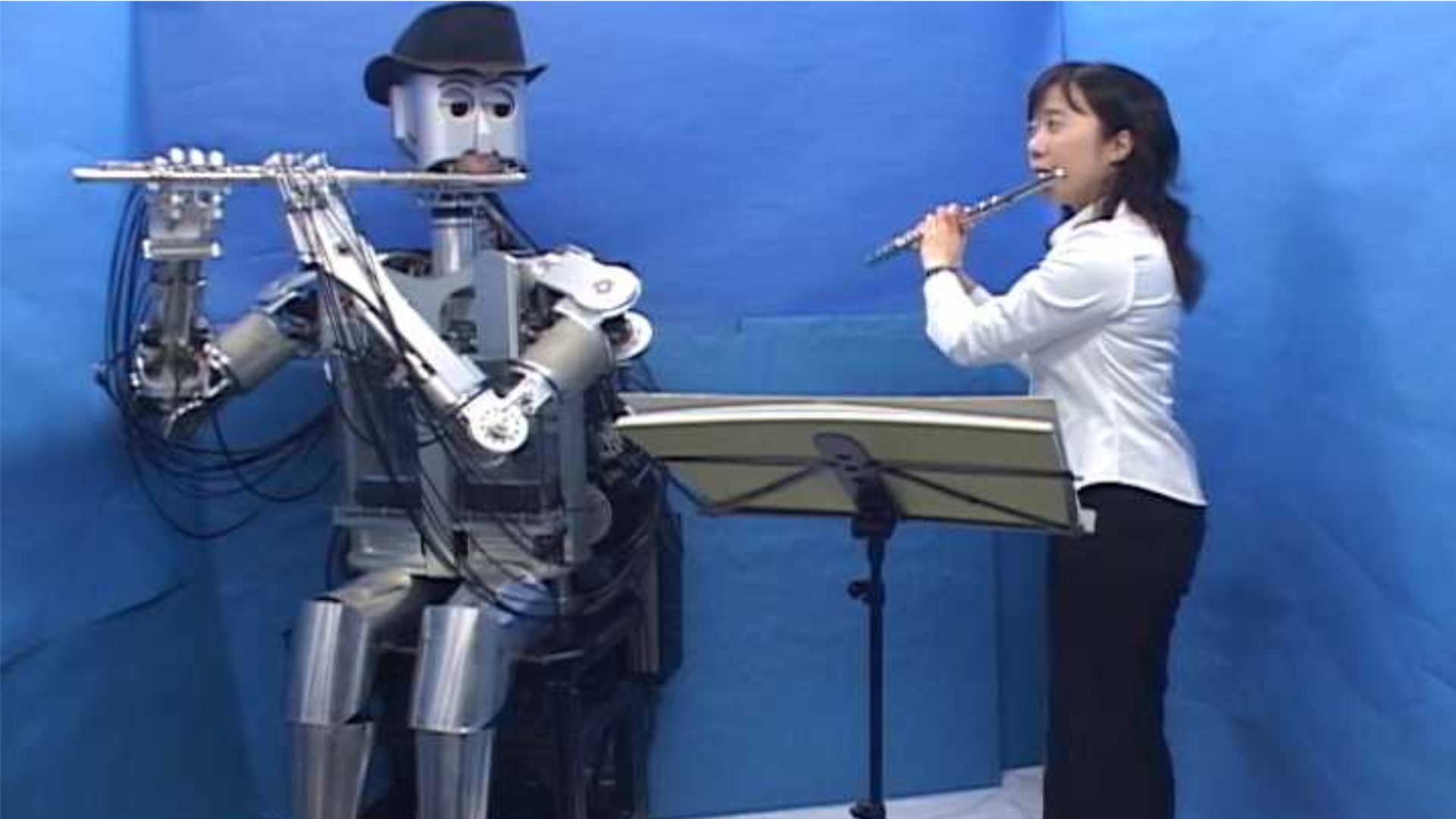
(Photo Credit: Waseda University)