My grandma always had a chair out at her powwow campground, ready for someone to come by and visit. She'd have a place to sit and coffee ready. I remember being a kid at powwows, playing with my cousins, my brothers, my sisters, running around the grounds, and then having to get ready for Grand Entry and go dance. Sometimes I wanted to, sometimes I didn't. I remember the sunsets at certain powwows, and playing at night, and watching my elders visiting, joking, laughing. These things are hard to put into words, but I have such vivid memories of them.
I've been thinking about Powwow People for a long time. When I first started making films, in 2011 or 2012, I remember thinking that powwows are such cinematic spaces. The film took shape over the last three or four years, from when we started pre-production, just after the pandemic, but it already existed in different forms in my head, and in treatments I'd written over the past 10 or 12 years. I wanted to make something of a love letter to powwows. Nothing too expository, nothing too didactic, just something focused on what I pay attention to, the things I think are interesting, the things I think are beautiful.
Working with the director of photography, Shaandiin Tome, helped with that. I had never worked with a D.P. before, but she is someone I respect and admire, and she knows these spaces as well. We shared the camera duties, and I got a glimpse of what she looks at, the way she moves a camera, the way a take can unfold in front of her. I want people who powwow to feel like they're at a powwow, or to be reminded of one. And for those who have never attended, who have no idea what these events are, I want them to get a small glimpse of the depths they contain, and of how a powwow is a place of active culture, not stagnant culture.
My more experimental work relies on abstraction to communicate things that are ineffable. With this film, I didn't feel like that was needed, and I didn't feel the pull to abstract. The challenge was to do something a bit more conventional in its form, in its shape as a documentary, and to let the dancers speak for themselves, and the drummers sing for themselves, and the people in it, the emcee Ruben Littlehead, the powwow coordinator Gina Bluebird, the singer and drummer Freddie Cozad, the dancer Jamie John, have their own voice in the stories they wanted to share and the places they wanted to take you.
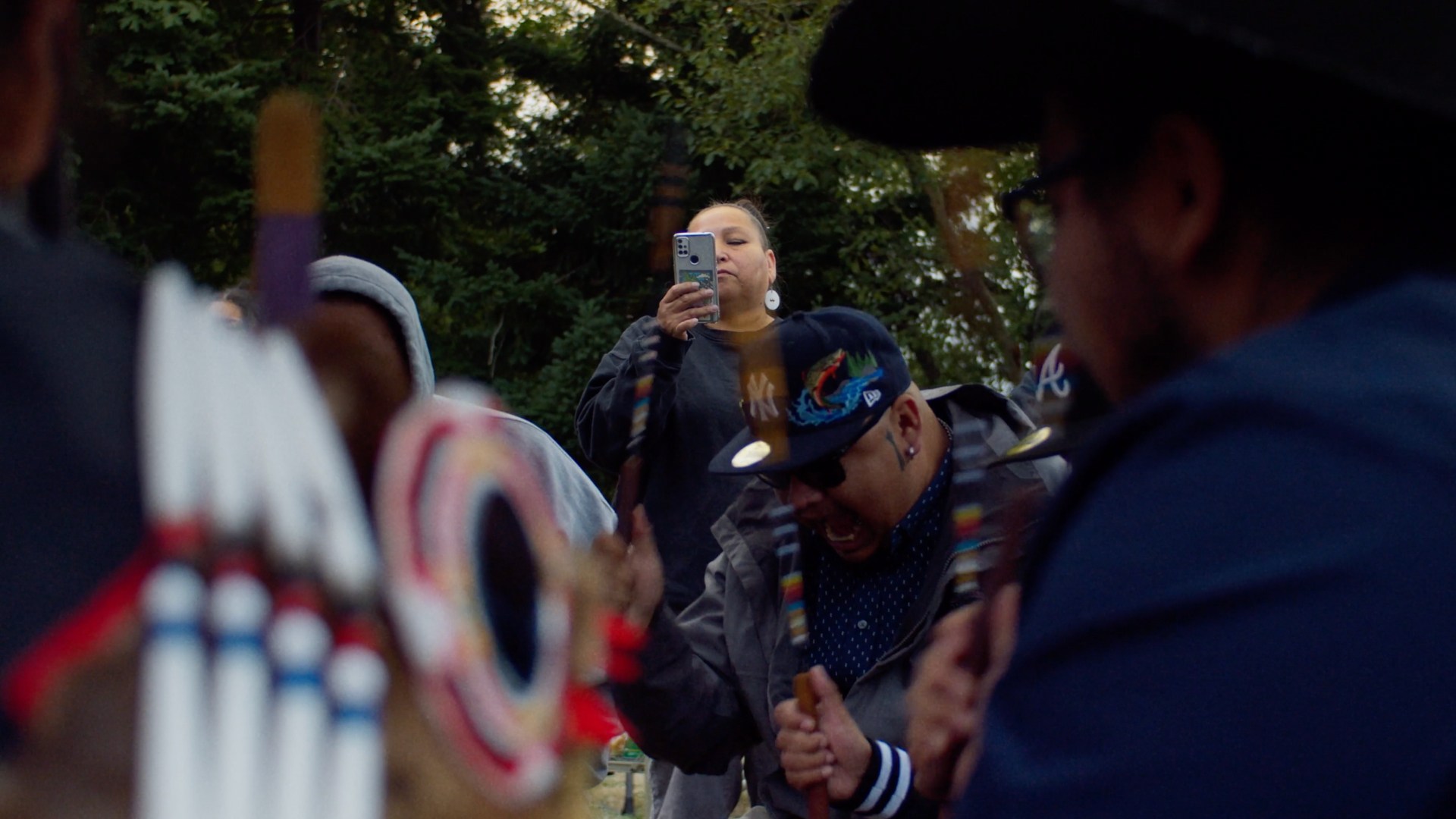
I think about this often, how the film isn't so much about powwows as about one specific powwow, the one we held over three days in August of 2023 at Daybreak Star Indian Cultural Center in Seattle, and the people we invited, and the memories we made, and the space we were in. We didn't want to invade someone else's powwow. We wanted to invite people to come and participate in our gathering and our film on their own terms.
I chose Daybreak Star because it was something of a middle ground. We weren't asking a tribe to host us. It stands on part of what was Fort Lawton, an Army base that Native people from many tribes occupied in 1970 to win land for a community center, and its grounds host a powwow I grew up going to. It's surrounded by trees, it overlooks the Puget Sound, and it has an important place in the local community.
There's something very consistent about powwows, and something very different about them each time. The structure is more or less the same, but protocol in one community might differ from another's, and that's OK. I think that speaks to the relationship Native people have with the pan-Indigenous identity that is sometimes thrust upon us, that sometimes we embrace and lean into, and that we also resist and push against. Powwows are sites where those conversations take place, where those actions unfold or get tested.
We held our powwow midweek so as not to compete with other powwows in the area. Aside from the usual factors that go into planning a powwow (bleachers, power, tables, chairs, lights, permits), the organizing was pretty smooth, thanks to Gina and her family. There were early mornings and late nights setting everything up, with Gina putting out any fires that popped up and making sure everyone had a good time. We didn't do any retakes. We didn't ask for anything to be staged. We just ran it like a powwow. For me, that was the truest way to film this thing.
I often say that out in the world, I carry a sense of stress or tension that sometimes I don't even realize I'm carrying. But when I go to a space like a powwow, where there are a lot of Natives, I feel an ease and a release of that tension. That hasn't changed over the years.
Even when you're sitting around the grounds in your camp chair watching the dancers, you're still visiting, talking with people. It's the small social interactions, the sense of connection, that I think is really beautiful. It's a place you want people to feel comfortable in, to feel relaxed in, to feel like themselves in, to find themselves in.
I grew up in these places, from a kid playing with my toys to a teen trying to be cool and really focusing on dancing. There was the Saturday night dance contest, or as Ruben likes to call it, Saturday Night Live. It's exciting whether you're dancing in it or just watching. You're a dancer there, but you're also with your family, with your friends. You're competing, and not just against the other dancers, but against yourself. Something your parents, your grandparents, whoever is teaching you will tell you is that you're not dancing for yourself. You're dancing for those that can't dance, you're dancing for those that are watching you, you're dancing for your family. So there are all these layers of performance and prayer. Powwows are not ceremonial places, but ceremony can happen there, and things that are sacred can happen there.
The 28-minute long take at the end of the film was my place to experiment. I'd never done one like that before, and I was excited by the challenge, and I wanted to share the experience of being a dancer in one of these five-song competitions. It began with a field of nearly 30 Men's Northern Traditional dancers, which is the style that I dance. After the first two songs, the judges chose a top eight, after two more, a final three, and after the last song, a winner. I held the camera on the dance floor amongst the dancers, from the beginning to the end. We only did it once, and I figured if I got it, I got it, and if I didn't, I didn't. Moving through the space felt natural and familiar. I thought about moving amongst the crowd as I would if I were dancing myself, but also as a dance judge, paying attention to who I'm looking at, surveying the dancers, finding the ones I like while making sure I'm checking in on everyone else. This film is also a way for me to begin asking what I want to make next around this culture and the community. I have a trilogy of films in mind, and this is only the first. The next two, I think, will stake out different ground formally, but my hope is that they'll all be in conversation with one another.
As soon as the powwow was over, I felt relief, immediately followed by a sense of the editing task ahead of me. I still had to drive home to New York. It's a long drive, but it gave me a lot of time to think about what had just happened, what the edit could look like, and what stories or memories or shots stood out. I found myself thinking of my grandmother, and wishing she had been there, but knowing, in spirit, she was. It's only appropriate to have hit the road right after, because that's how powwows are; as soon as one is done, you pack up and start making your way to the next one, in landscapes familiar and new, and with faces, familiar and new.