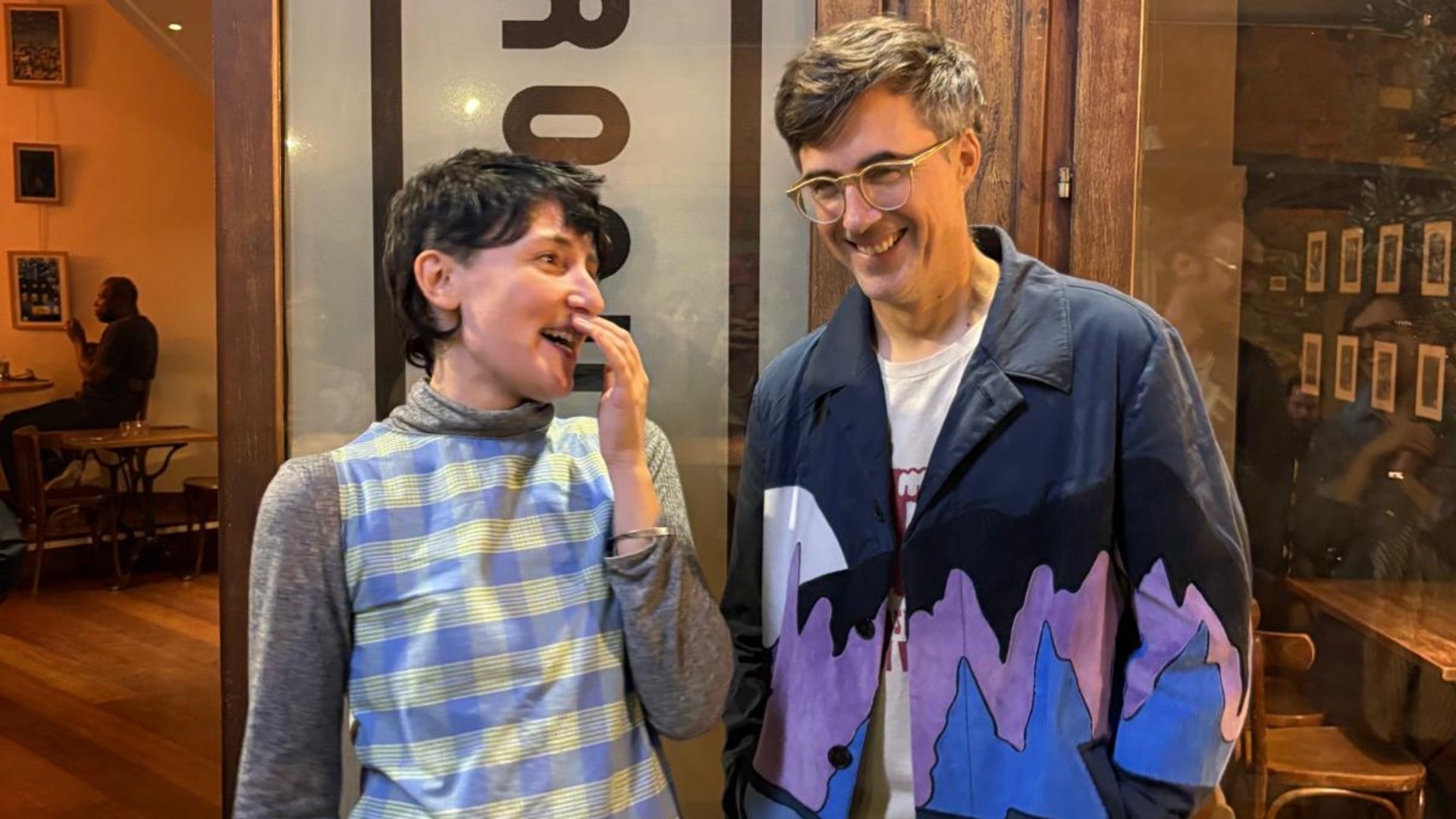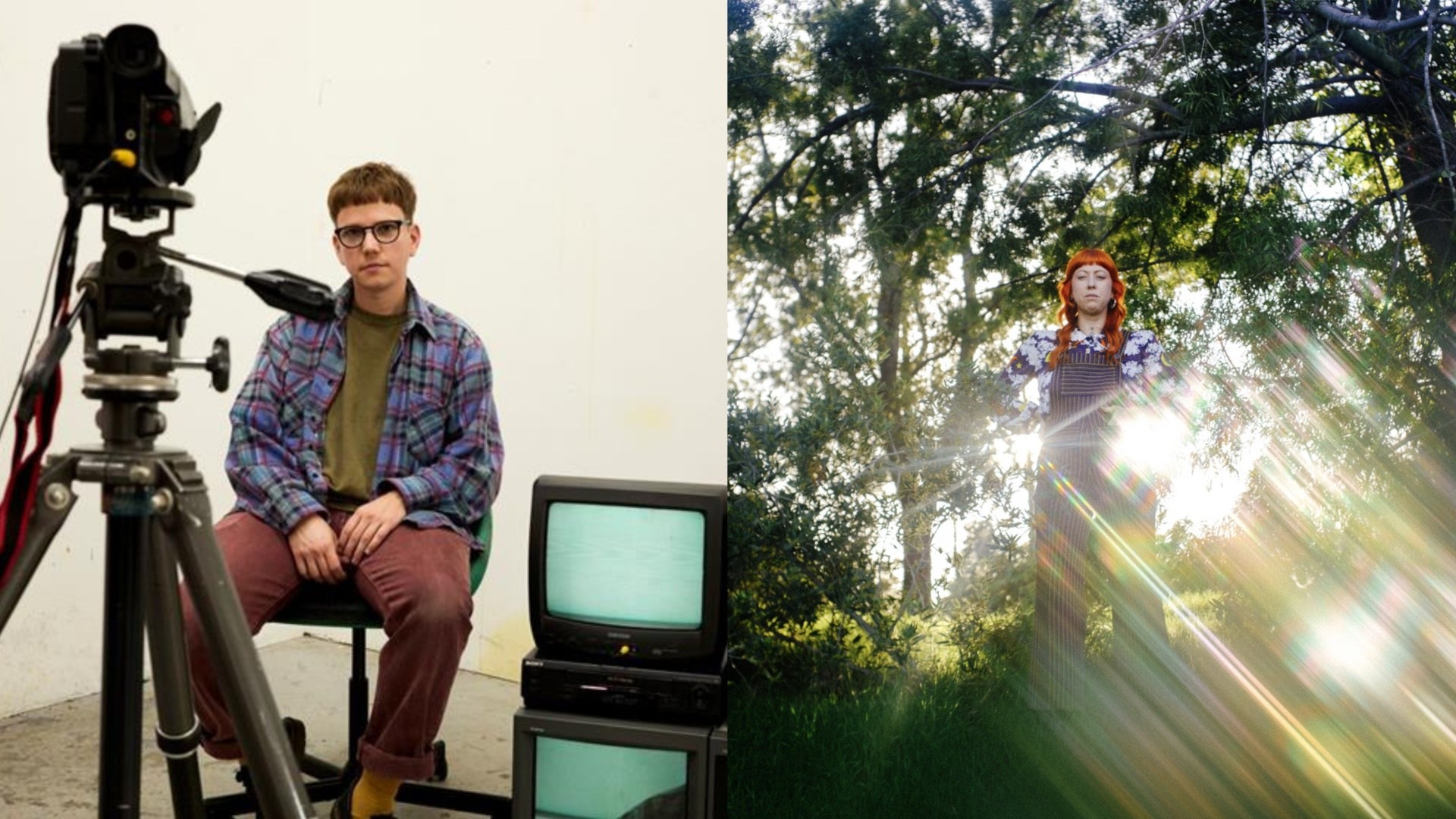
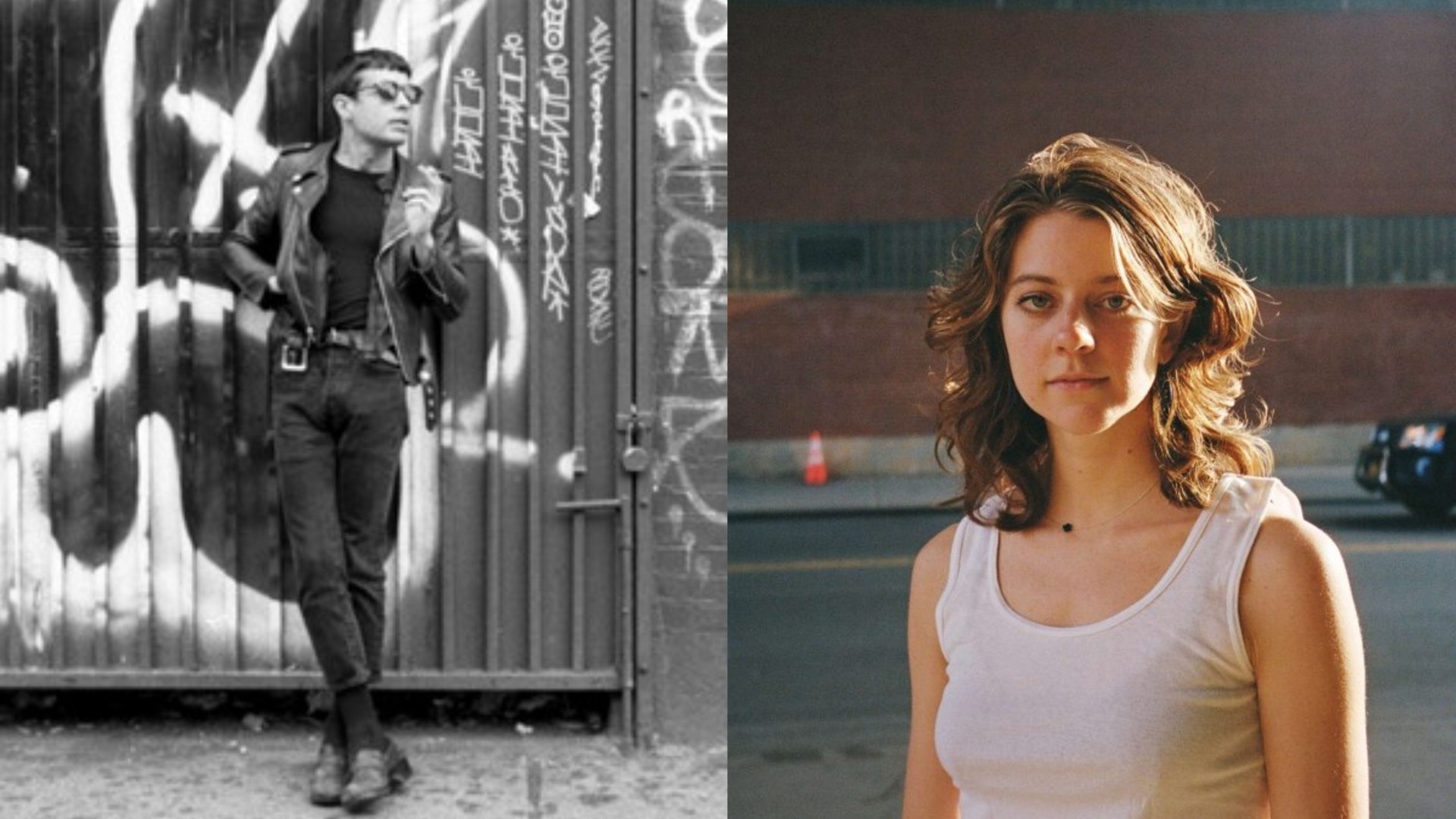
Told Slant is the project of Felix Walworth, a musician and photographer based in NYC who also plays in the bands Florist, h. pruz, and Sister; Allegra Krieger is a singer-songwriter, also based in NYC, whose latest record my heart is a gentle boxer came out this past spring. The new Told Slant record, What’s Up, just came out last month on Mtn Laurel Recording Co., and to celebrate it, the two friends got on Zoom to catch up.
— Annie Fell, Editor-in-chief, Talkhouse Music
Felix Walworth: What's up, Krieger? Where are you?
Allegra Krieger: I'm on my couch. I'm sort of in my pajamas.
Felix: I just got out of my pajamas. It's so nice to be a musician. You get to just stay in your pajamas until 3:30 on Wednesday.
Allegra: Oh, yeah. That's actually embarrassing for both of us.
Felix: It is. [Laughs.] But we work hard!
Allegra: We work really hard… But how are you? How is post-album feeling?
Felix: You know, sometimes amazing and sometimes horrible. Just as it goes. But I'm glad it's out.
Allegra: I'm loving it. I feel like it is that New York album for me right now. It's also good for easing into the fall walk season.
Felix: I feel like it would be good for walking around the city. I'm glad you like it.
Allegra: It's beautiful. My favorite is “Three Anchovies.” It’s so sweet.
Felix: Thanks. Yeah, it feels like it needed a little bit of peacefulness, a bit of a zoom in. I don't usually write as broadly as that. I feel like you're good at connecting those things, changing your focal length.
Allegra: From big to little. Or having the little symbolize a bigger thing. I love when that happens. I don't know if I can do it on purpose. [Laughs.]
Felix: Yeah, you start writing about things that are small and specific to your experience, and then you realize after several verses that you've just encapsulated something.
Allegra: Exactly. I was just talking to someone yesterday about that experience where, for me at least, typically when I'm writing, there's so much self-consciousness — or, I mean stream-of-consciousness — great Freudian slip. [Laughs.] There’s so much stream-of-consciousness that the shape and the meaning fall into place right at the very end. You realize after it's written what it's saying. Does that ever happen to you?
Felix: Basically always. And it's funny because I aspire to be that kind of writer who's like, “I'm setting out to write a song about this thing.” I admire people who are like, “I have this idea and here's how I'm going to piece it together with language.” But I'm usually just experiencing something, observing something, and then just recording it in a way. And then at the end, I'm like, Is this interesting or is it not interesting?
Allegra: It also can start out interesting, and then this line leads to another line, leads to another line, or whatever. And sometimes it works, and sometimes it just feels like, for me, this nonsensical noise.
Felix: Yeah. Do you ever find that you start writing a song and you're like, OK, first verse. This song is totally about… But then by the third verse, you're like, I'm actually really not that interested in that thing, but that verse is still important to the song. And then your song is about, like, five people, but you're still using the word “you.”
Allegra: Of course. I'm right now in the process of thinking about a record — you know when they have you make a track-by-track where you have to explain each song?
Felix: I just did one of those.
Allegra: They're ridiculous. First of all, crazy thing to do. This is like the David Lynch—
Felix: “Look at the donut, not the hole.”
Allegra: Yeah. It's like, why would I explain this thing that is supposed to be a mystery for all of us? But anyways, I was thinking about that, and yeah, you start off a song with maybe a certain person or element in mind, and then all of the characters merge and you're just telling the story that flows naturally. Because we all have it where you're connecting a current situation with a past situation, but they may be the same character in the song…
Leonard Cohen, I know, is a big artist for you.
Felix: Yeah.
Allegra: Like most people. But I was talking with a friend about songwriting this week, and we were talking about how all of Leonard Cohen's songs have this perfect metaphor, where it's such a complete poetic idea that feels so clear. And how, even though some of the songs are very simple, there's so much depth because of that full, complete picture. That's something I really admire, and that's so hard to do. You wonder, did he have the idea — like maybe “Hallelujah,” for example, he had the idea of the word “Hallelujah” and then was just like, “What does that word mean to me?”
Felix: I feel like he's a really good person to bring up for that kind of thinking about this kind of songwriting, because he's such a verse-chorus-verse guy. He really does generally follow this structure of, the chorus is the keystone of the song. It’s almost like an English garden or something, where there's a central [point] like a fountain. There's a path here and a path here, but they all come back to the fountain. I have to imagine that maybe he writes a single verse and he's like, “What's the fountain of this verse?” And then he's like,”OK, now I have the fountain. Now I have to write a bunch of verses that connect.”
Allegra: Yeah. And finding the fountain is the most important part. And also, for me, really hard.
Felix: I agree. When I listen to your music, it does feel a lot more like by the end of the song, you've accumulated enough information to understand. It's like the fountain is at the end.
Allegra: I feel that way when I write. Because it is like I arrive at the last verse and I'm like, “That's the name of the song.” And I have a hard time with choruses. I feel like this record, you have some very solid chorus moments. Did that come naturally or were you thinking of writing a chorus? I've been in my head about choruses these days.
Felix: I don't think I was thinking about it that much, but I had been listening to a lot of music that I wasn't listening to when I was making my previous records. I sort of re-entered a big Leonard Cohen, Bruce Springsteen [phase], sort of these storytellers…
Allegra: It's giving “Dirty Boulevard,” Lou Reed type era.
Felix: Totally. Incredible song.
Allegra: I love that song. I feel like that whole record, there's a mirroring effect to your record where every song kind of has its central theme. It's also not verbose, but there's a lot of beautiful language that circles back around to the central theme. Which is very hard to do sometimes.
Felix: It is. One of my favorite songs of yours, “Impasse,” does that. It's a rare kind of fountain-in-the-center moment, where I really do feel like you have this chorus that grounds… What you're grappling with in that song is broad, but it's also a specific kind of anger. So it feels like there's a refrain that reflects that, and the verses explore it a little bit.
Allegra: Yeah. You were writing this record over a period of time, right? It had been how many years since the last Told Slant record?
Felix: The last one came out in 2020. So six years between them.
Allegra: What was your process in writing this record?
Felix: Even though it took a long time between records, the writing process was a lot less… I feel like my older records, I would be writing them over the course of, like, four years. This one, the first song that I wrote for it, which is the last track on the record, was written in late 2023. So it wasn't an insane stretch. And there were some songs that I just finished even during the recording process. That was also unusual. It was a lot less planned out.
Allegra: I'm feeling a shift in how I'm writing versus how I used to write, and I was curious if that's something that you've noticed over the more-than-decade that you've been writing.
Felix: Yeah, it has shifted. I mean, at the beginning, you had your Freudian slip of self-consciousness versus stream-of-consciousness — I feel like they’re kind of the push and pull of the process of writing. Stream-of-consciousness writing is to me the most vulnerable, brave thing you can do with your writing, because you're just saying whatever's coming out is worth saying. And then the self conscious brain is like, OK, well, maybe at my core, I'm kind of a dumbass and I gotta put in the work.
Allegra: But it's also like, The world doesn't need to hear what my brain is just spewing out right now. The self consciousness is the editing brain, in it's best form. In its worst form, it just makes you feel shitty.
Felix: Well, that can also make you take years to make your song, because you're not confident in your voice and you've convinced yourself that you're not interesting.
Allegra: Yeah. Which I think it might be important to confront that, like that. I mean, it’s real — there's so much noise out there that sometimes it feels ridiculous to contribute to it.
Felix: Oh, yeah. I mean, god, I wish people would have that voice more and not put out their shitty ass records.
Allegra: [Laughs.] But then, honestly, how probably every great record got made is someone being like, “I don't fucking care and I'm just making this thing because I want to. Maybe not even because I like it but because I’m just doing something.” That kind of hands-off approach, I think, can either be just another something or it can be so magical.
Felix: It can either be this totally unrestrained, incredibly creative space, or this kind of lazy, hubristic space. But it's always nice when it's the first one. When I listened to gentle boxer, I was like, I know this is off the dome. I know this is just kind of coming out.
Allegra: That was some bullshit. You know what I mean? [Laughs.]
Felix: But amazing bullshit. If you had gone into that process being like, “Do we need six bars or eight bars of piano?” It would have not been good.
Allegra: The whole thing with that record was like, I have no idea what's happening at any time. It was just like, “A little bleep bleep here, a little bit here.” And there was even more bullshit that didn't end up on that album. And then I feel like the stuff that did make it on… You have to shed a self to move into the the next skin, and I feel like that was something that I was like, I'm just gonna get out of my body, put it on Bandcamp, call it a day.
Felix: Like a palate cleanse for your next project.
Allegra: Yeah. I'm sure subconsciously, there were some real… internal chaos that I was not confronting that I had to just put it into song.
Felix: Maybe there's even something about songs that can feel too restrictive sometimes, or capital-A “Albums,” where you're like, I'm making a statement and someone's going to ask me to do a track-by-track.
Allegra: Yeah. And even just feeling serious about anything kind of sucks sometimes. It's not so serious.
Felix: It's not so serious. But it’s also so serious.
Allegra: I always go back and forth with that. I had someone tell me, “Every album you put out, you should be OK with it being the last album you ever make.” That's interesting to keep in mind when you're making something because, at least in the span of your creativity, it's an important document of that time of your time on earth.
Felix: Right. There's so many interesting things about this in relation to your larger body of work, and the statement that that makes in the world. But I feel like there's all this murk in there about legacy and ambition, and these are things that I don't think are particularly useful to us. They feel very commercial to me.
Allegra: I feel like it's animalistic, kind of, making [something]. The fact that we want to procreate, it's almost the same mentality… Or maybe it's fear of death. People don't want to imagine that it ends with them. It's really hard to confront the reality that you're like a speck of dust that will be erased. So you try to leave these trails of your existence.
Felix: And even more maniacally, to try to control the way that they're left. There's so many artists who have periods of their catalog that are really joyful, but really kind of bad. And I love those albums — I love Death of a Ladies Man.
Allegra: I love that album.
Felix: Or just any artist who is committed to their craft and doing it because they love it could, I think, feel empowered to explore a little bit and not be so concerned with, as you're saying, “My next album is my last album and it's a lasting statement about me.” How stifling. You wonder, if you don't play in that sandbox, how are you going to write “I'm Your Man”?
Allegra: Yeah, exactly. In writing and making music, when I started, you're just doing it because it feels natural and exciting. You're playing in a sandbox. You're also learning and finding your voice and that's all very exciting. When you put pressure on yourself creatively… Pressure is different than discipline. Discipline, I think, is really good for creative work. But then it's easy for discipline to turn into pressure and wanting a result. I feel like if I'm disciplined in my writing — which I am fairly disciplined, just because I try to do it every day — but if I don't get a result that I like, then I'm like, It's not fun anymore.
Felix: Discipline is something that we need to have as writers or players. There's so much pressure from the world to not do any of these things. It's actually one of the easiest things in the world, to not express yourself. But the pressure can also be applied from the wrong direction. You've interfaced with music and commercialism sort of becoming attached — when you start feeling pressure from that direction, that feels really…
Allegra: It’s the worst thing. It's the worst thing that could happen to your music, probably. What a horrible thing to be thinking about. It's just the most useless thing to writing.
Felix: Useless, sometimes actively hostile… I feel like ideally, it's just one of those things where you have the discipline to continue your practice, and the pressure that you place upon yourself is just one to excite yourself. The pressure is just, I want to jot something down and then look at it and be like, “Oh, hell yeah.” I chase that when I'm writing.
Allegra: You know how nice it feels when you've completed something in a way that you feel proud of, or in a way that scratches whatever itch you were scratching at? And that's the thing: you just keep scratching.
Felix: Totally. And there's so many ways to get that in the world. Sometimes you can get it from other people's music, or you can get it from a really good conversation that you're having with someone. An intimate connection can sometimes feel like that kind of understanding is happening. And then for people that don't hang out with people really — like, I don't really hang out with people.
Allegra: I'm bad at it.
Felix: It feels social in a way. I'm curious if you feel this — when you're writing and you get to the end of an Allegra Krieger song and the fountain reveals itself, it's like you kind of taught yourself something.
Allegra: Yeah. It feels in some way you're like participating in something very human. So that is satisfying, especially if you're holed up in a depressive state. At least then you access to this sort of cultural consciousness of experience or emotion. And then you kind of are able to have a dialogue with yourself about something that maybe needed to be brought up. It's an interesting way to relate to the world around you. And I think for me, it's the way. Everything gets funneled through that process. And then additionally, I think for me — not to be so woo-woo, out there — it makes me feel like I have a place in the world. Whenever I'm writing, for a second, it's like, I live here. If that makes sense.
Felix: Yeah. Even on a level of nourishment, that is also such a rare thing to find in the world. Having a place that you feel comfortable.
Allegra: I feel like whenever I talk about this, it all circles back to what people forever have found in religion: You have that place, you have that foundation, the world makes sense through whatever religious perspective you adhere to. And I think that's something that a lot of musicians are able to find whenever they're doing their thing. Which is a really necessary human experience, I think.
Felix: It's just so relaxing, almost. I mean, it's many things beyond relaxing, but you know when you see people having a religious experience in community, hands to the sky or some kind of thing, there's this feeling of, I don't care how I look, I'm with everyone in this completely unjudgemental space, just emoting. Which I completely understand the desire to be in that state. Our world doesn't afford us that anywhere.
Allegra: Especially now.
Felix: We're under siege and surveillance in every direction and no one feels comfortable.
Allegra: I was walking through Washington Square Park and trying to just fully zone out, and I just noticed how many people were filming. It's out of your hands. And the amount that we are aware of ourselves — we're such a neurotic species already that it's like this extra emphasis on facing ourselves all the time and thinking about ourself and our relationship to everything around us. It's a very stifling way to live.
Felix: It's exhausting. I mean, I live off like the M and the L train and it's like a goddamn fashion runway, everyone on the subway looking at each other. And I'm just like, I don't want to think about this.
Allegra: Sometimes I’m at work trying to get in the flow, and then somebody comes up and just starts filming. I’m like, “Don’t...” But it happens all the time. It's so normal now. Don't love it.
This was the fastest 40 minutes ever. We should hang out.
Felix: Should we spend the last two minutes figuring out when we're going to hang out next? [Laughs.] What are you doing on Monday?
Allegra: I could probably do Monday
Felix: Alright. We'll text.
Allegra: Well, congrats on your album. I'm happy that it's out in the world and that everyone can listen to it now.
Felix: Thanks, Allegra! There's so much more I want to say, but maybe it's just one of those things where, at the end, we've reached the fountain.
Allegra: We got to the fountain!