The following is taken from How Do You Live?, the first English translation of the classic Japanese novel by Genzaburo Yoshino, a childhood favorite of anime master Hayao Miyazaki, the writer-director of Spirited Away, My Neighbor Totoro, and Howl’s Moving Castle. The book is out now through Workman Books, and includes the following foreword by author Neil Gaiman, who wrote the English-language screenplay for Miyazaki’s Princess Mononoke. This foreword is reprinted here by permission of Algonquin Books of Chapel Hill; all rights are reserved. – N.D.
This is such a strange book, and such a wise book. I wish I had been given it as a small boy, but I suspect I would have found it puzzling or even dull: a book-length essay about how we live our lives, interrupted by the story of a pre-war schoolboy in Japan dealing with friendship and bullying; or a story about growing up, bravery, cowardice, social class and finding out who you are, interrupted by essays about scientific thought and personal ethics. Sometimes the joy of books that seem to contain opposing elements is realising that without both things, you would have a lesser book. (There’s a book called Moby-Dick by Herman Melville that contains a story about a doomed hunt for a white whale and also contains essays about whales and whale hunting. Some people like one part of the story, and some like the other. For me, the joy is that the book contains both parts, pulling at each other, each informing the other side, and that if you removed either part you would have a less interesting book.)
I read How Do You Live? now, in this sparkling new translation, because Hayao Miyazaki is basing his next film on it. It’s a film he has said that he is making for his grandson, as a gift to the future.
The finest time I spent with Mr. Miyazaki was in the building he was making for the children of the neighborhood around Studio Ghibli, where he makes his cartoons. It was built of wood, and there was a bridge across it, inside, too small for adults to cross, but the perfect size for children to go exploring. It was a space for the whole person.
Miyazaki makes films for whole people and makes films about consequences. When I worked on the English-language script of his film Princess Mononoke, I was astonished when I finally realized that everything in the film was about consequences of acts and actions: seemingly unrelated events are actually the consequences of other events or actions, and everyone in the film is acting according to what they believe to be their best interests without realising that what they do affects everyone else.
In How Do You Live?, Copper, our hero, and his uncle are our guides in science, in ethics, in thinking. And on the way they take us, through a school story set in Japan in 1937, to the heart of the questions we need to ask ourselves about the way we live our lives. We will experience betrayal and learn about how to make tofu. We will examine fear, and how we cannot always live up to who we think we are, and we learn about shame, and how to deal with it. We will learn about gravity and about cities, and most of all, we will learn to think about things — to, as the writer Theodore Sturgeon put it, ask the next question.
Books like this are important. I’m so glad Mr. Miyazaki is making his film, not least because it means that, eighty-four years after it was written, Genzaburō Yoshino’s novel can be read in English, in Bruno Navasky’s gentle and winning translation, and that I got to read it.
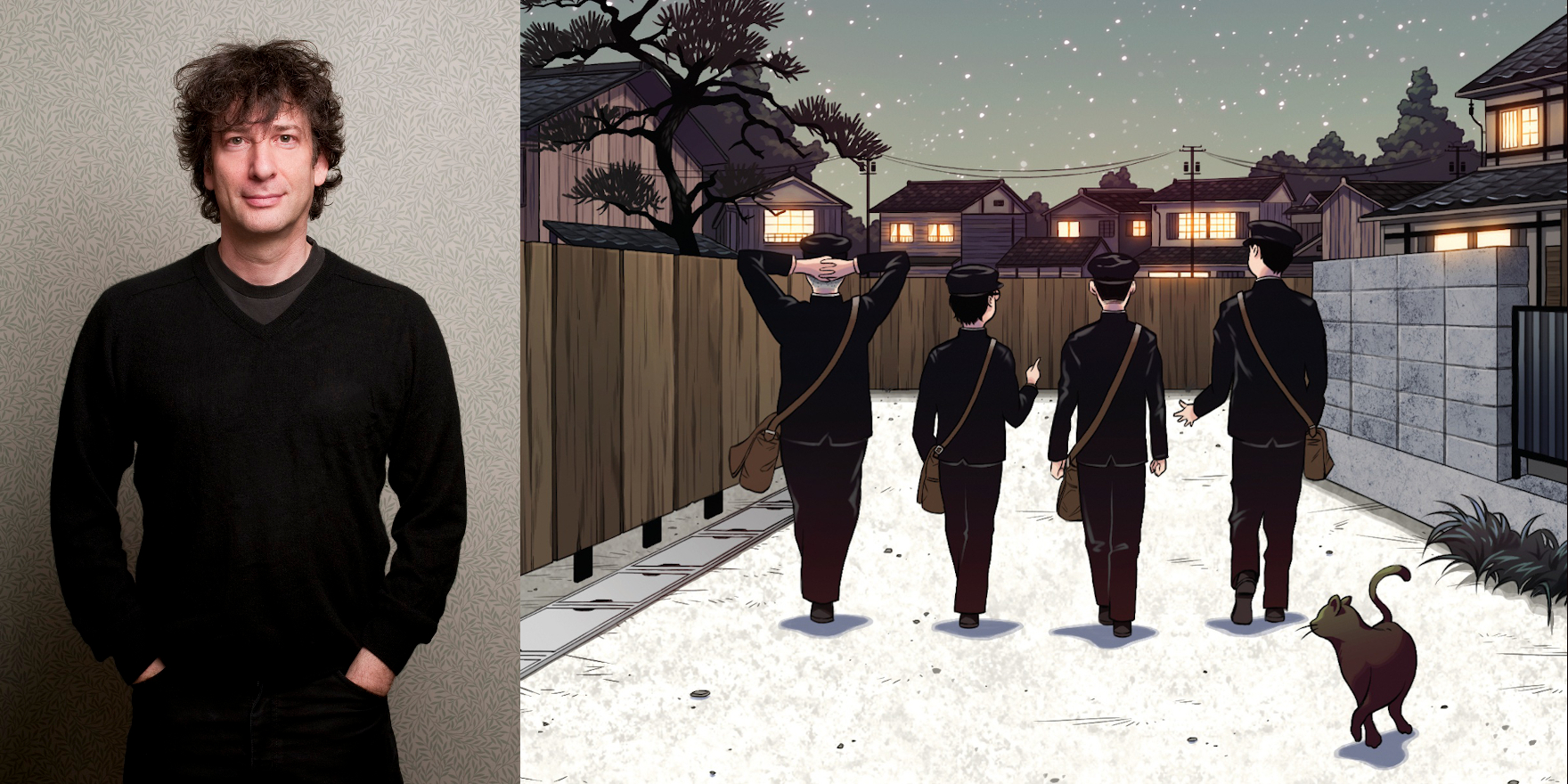
Featured image: Photo of Neil Gaiman by Kimberly Butler; artwork by Yuta Onoda is taken from the cover image for How Do You Live?