“EWWWWW,” sang a packed audience at the AMC theater in Indianapolis, Indiana, in near-perfect unison. The predominantly Black multi-generational crowd formed a chorus of disgust, a sound I wish I could unhear. The collective outburst was a knee-jerk reaction to seeing two women, Celie (played by Fantasia Barrino) and Shug Avery (played by Taraji P. Henson), share a mere peck on the lips; a peck that quickly faded to black.
There was no nudity, no erotica, and the intimacy shared between the two same-gender-loving characters was brief. Yet it immediately provoked that loud, long oppositional reaction.
In December 2023, the musical film adaptation of The Color Purple was released. My family flocked to the theater to see the film on Christmas Day. It had been nearly 40 years since the release of the classic Alice Walker novel and subsequent beloved Steven Spielberg film adaptation, and I had hope that the OG fans and their descendants were finally ready to witness an unapologetically lesbian story on the big screen. I, too, believed that people were ready to champion queer love as much as they champion women’s empowerment and sisterhood.
Perhaps it was foolish of me to have this hope. So when it came time to release the audio drama I created, wrote and directed, Red for Revolution – which centers intergenerational stories of Black women, queer love and liberation – I was petrified, instead of hopeful. I knew the celebratory occasion would be tainted by the opinions of those who would be disappointed to discover my work explores a lesbian love story. So I desperately wanted to go back in time to create something that my homophobic loved ones could be proud of. Truthfully, I carried anxiety, fear and paranoia throughout the making of the entire series.
I am often vocally disappointed by queer erasure in media, but I, too, have been guilty of said erasure. While pitching and creating Red for Revolution, depending on who I spoke to, or who was around me, I sometimes talked around the queer plot in pitch meetings, elevator chats and casual conversations at parties.
One of the most memorable instances was right before we started our music recordings in the Bay Area. My producer, Liz McBee, and I attended an event titled “Why We Aspire to the Beloved Community” at the Commonwealth Club in San Francisco. The event included a conversation with the iconic actor Mr. Danny Glover, who would later join our phenomenal cast, and the now late former mayor of Berkeley, California, Gus Newport, moderated by the late Rev. Dr. Dorsey Blake.
Over the course of the evening, I met many people and shared a great deal about Red for Revolution; one of those people was the late Rev. Dr. Dorsey Blake. Upon learning that Dr. Blake was a reverend, I panicked and quickly assumed he was homophobic. So while speaking with him, I purposely left out key details about the queer love story in our series.
Liz assured me that I did not need to worry; “We’re in San Francisco,” she said. Her optimistic presumption was based on our location, while my anxious assumptions were based on religion. To my surprise, during the panel, Dr. Blake began to speak about queer liberation, unprompted. He, along with Mr. Glover and Mr. Newport, spoke about the importance of being allies. My mouth dropped to the floor. Needless to say, I felt foolish for assuming the worst, and later confessed my apologies to Dr. Blake when Liz and I found ourselves at dinner with these legendary activists. I ended up being seated next to Dr. Blake, and throughout the night, he shared recommendations for queer documentaries and films that I should check out. This exchange was just what I needed. I wish I had more stories like this one. But the truth is, more often than not, my assumptions are confirmed, and my fears become reality.
During the making of Red for Revolution, I was frequently reminded of how pervasive homophobia remains and why I decided to create the series in the first place. I set out to make Red for Revolution alone in my closet, as an act of resistance. I often jokingly remark on how I wanted to rid the entire world of homophobia single-handedly, through a podcast. While this ambition was unrealistic and nonsensical, it was nonetheless very sincere. However, I didn’t realize that before I could rid the world of queerphobia, I had to rid myself of all the internalized shame and homophobia buried deep inside me.
I had a traditional religious upbringing where homophobia was regularly spewed, unprovoked, and that remains the case at birthdays, graduations and holidays. Every single occasion for a gathering involves unsolicited warnings (stay away from feminine men), unprovoked rants (gays are destroying the Black family), unwarranted surveillance (did you see what your cousin was wearing on Facebook?), unnecessary gossip (insert transphobic slurs about trans children of celebrities), and the occasional dogma (God will strike down [insert name of visible queer person]).
I learned so much from the church, from how to pray to how to be of service to my community. But I also learned how to carry shame and project judgment. I became an expert at it, which made telling the story of Red for Revolution with pride almost impossible.
Each homophobic or transphobic encounter felt like a test. To confidently stand against bigotry, or to accept anti-queer dogma as truth? I’m embarrassed to admit, it was not easy to choose resistance every single time.
Whenever a loved one condemned queer folks, or when Red for Revolution was rejected by a company that undervalued Black queer stories, or when a minister preached a homophobic sermon, or with each anti-trans or anti-queer bill passed, or with every report of a trans woman murdered, I thought to myself, Maybe, just maybe, those who hold anti-queer prejudice are right.
On June 1, 2023, I discovered that I had a lot of unlearning to do. It was our first session with the great actress Ms. Jennifer Beals, when we were recording episode five. At the time, I didn’t realize how heavy the episode was, nor did I think there were any triggers to be concerned about. So, of course, I was taken aback when I found myself crying uncontrollably. It was both very inconvenient and very embarrassing. Despite my best efforts to stop, all I could do was cry and cry. While witnessing the talent wrestle with the scene’s subject matter, I realized that, just like the characters in the story, I too was going through similar struggles.
Suzanne, the character voiced by Jennifer Beals, is a perpetual Gen-Xer and recovering homophobe who is cleansing her mind and body of internalized queerphobia. In episode five, Suzanne has a heated confrontation with her daughter, Jazmine. An excerpt from the scene is as follows:
We recorded this especially charged scene on the first day of Pride month. The L Word icon Jennifer Beals, aka Bette Porter, was acting right in front of me, and I had yet to get these nonsensical homophobic thoughts out of my head and heart. As I cried, I asked myself: Will I ever get to the other side of this? Will I stop fearing punishment or death? Will I ever confidently believe that queer folks are worthy of love, humanity, and goodness?
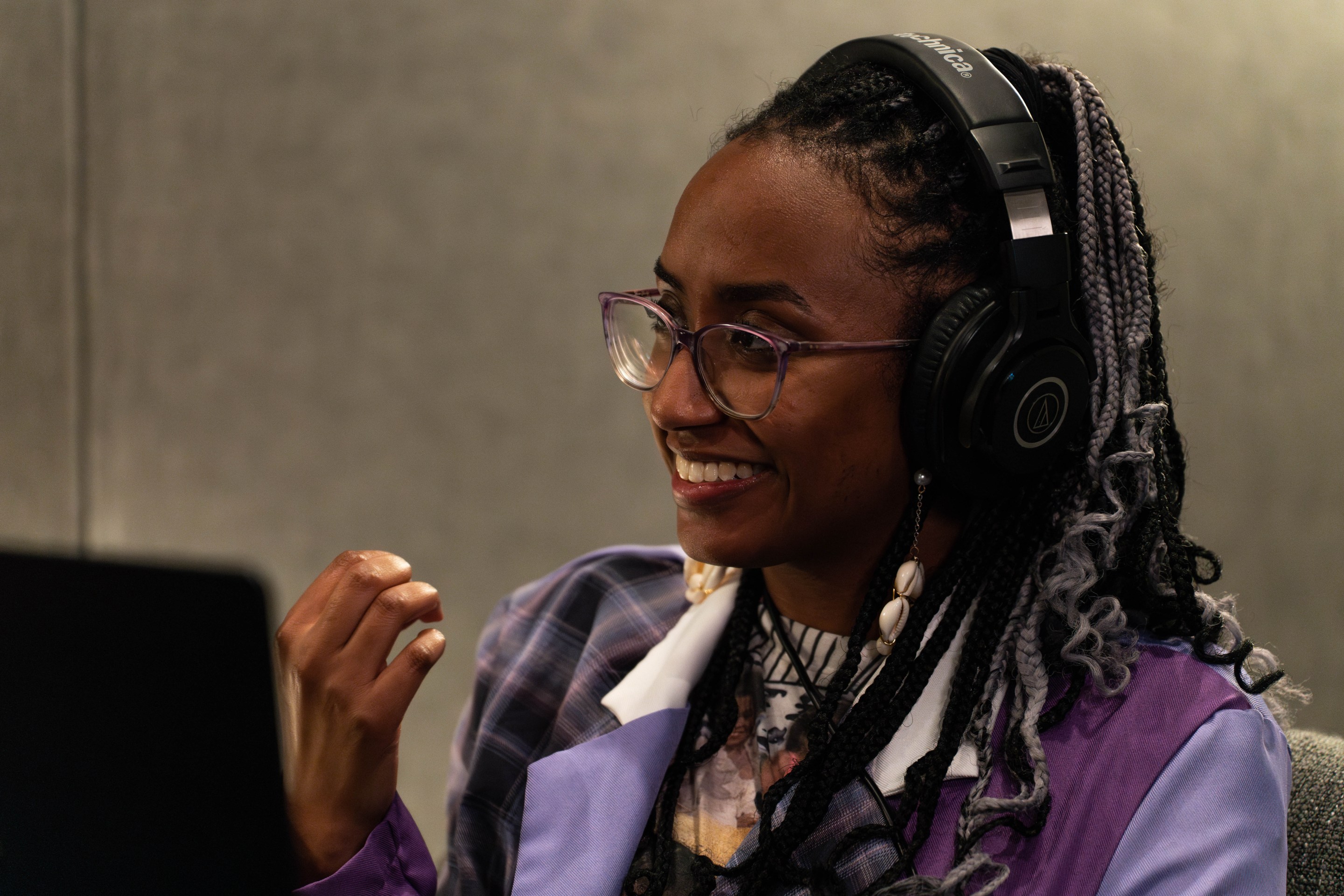
To make matters worse – or, in hindsight, incredibly funny – at this particular studio, every person was in the same room. Typically, I direct from the control room, while the actors are in a recording booth. I didn’t have privacy, so I kept my head down and tried to conceal my tears until a big glob of snot came running down my nose.
I desperately needed a tissue, but the box of Kleenex was on Jennifer’s sheet stand. I tiptoed over to her with my head down to subtly steal the Kleenex. Only my actions were far from subtle. I could not hide my crying and snot-filled nose for long.
Thankfully, all of the talent and the studio team were incredibly gracious, especially Ms. Beals, who, following the emotional recording, took us to a park and taught us how to lay our burdens down in the dirt and surrender to the trees. She also taught me about compassion.
I wasn’t too concerned with grace and compassion while writing the early drafts of Red for Revolution. I only cared about justice. I had not yet learned that grace and compassion can help facilitate justice.
As we neared the end of each session, I often told actors, “Let spirit move you,” in other words, improvise. One of the best takes was one where Jennifer Beals ad-libbed some dialogue. I had every intention of using that take, except for one of the improvised lines.
While editing the episode, I was very attached to what I had written. But then I edited together a pass with Jennifer’s improvised line.
The scene is an emotional confrontation between Suzanne (Jennifer Beals) and Ella Ali (S. Epatha Merkerson), where Ella insists she hasn't been a great parent to Suzanne. In the original script, Suzanne says, "Well, if that’s what you think, I’m not going to argue with you."
In the improvised version, Suzanne, after letting out an earned sigh, just-as-passionately insists, "It's not true."
The difference was subtle, but I wanted to see how her version sounded. Naturally, it gave me pause, and I felt conflicted. Which version should I go with?
I sent both versions without any context to trusted friends and asked their preference. They all chose Jennifer’s improvised version – because they believed listeners would benefit from experiencing the gift of compassion. Despite this unanimous feedback, for months, I stuck with my version … until I found myself in a real-life moment that challenged my allegiance to resentment. I finally understood what Ms. Beals was trying to communicate.
Red for Revolution premiered just two weeks after the inauguration and aired following the aftermath of the California fires, and throughout various anti-DEI firings, ICE raids, bombings and non-stop violence. Our team felt compelled to speak truth to power. Unfortunately, we failed to rid the entire world of racism, transphobia, homophobic violence, or anti-queer discrimination. But at the very least, we hope Red for Revolution encourages radical love. As listeners witness our characters struggle, thrive, fail, win and try again at love, we strive to remind audiences that radical love is a daily practice and an achievable discipline. And perhaps, one day, very soon, that audience will be expanded through a television adaptation of the story.
Throughout the making of Red for Revolution, I’ve come to learn that on the road to healing, you will likely encounter anger, grief, sadness, suffering, joy, grace, compassion and understanding. You need not avoid, suppress or deny yourself this experience. Liberation and healing are not binary. Both are, however, messy, sometimes embarrassing, and always very queer. It is OK for people to see you cry, and it is OK if it takes time to heal.
After all, Angela Davis told no lies when she said, “Freedom is a constant struggle.”