Ever since I was a kid, I’ve sought out storytellers. Not professionals, but people who, like great actors, don’t explain themselves; they reveal a humanity that speaks to something universal.
Wherever we would go as a family I would find these storytellers and often record them; I would ask my parents, my grandparents again and again to tell me tales about our ancestors. Stories were like evocations I would rewrite and reimagine.
My first published poems were creation myths, monologues written for different characters, which were also performed by actors. Writer Alastair MacLeod, a faculty member at the Banff School of Fine Arts, called my work “film poetry” given its visual, dreamlike imagery.
perfectly a strangeness
What can a story be? Does a story need a big dramatic arc? Can a story be a gesture, a moment in time, camera and sound bringing into being what photographer Robert Frank calls “the poetry behind the surfaces of things”?
How can we, like a child or a young animal, rediscover our world as “perfectly a strangeness”?
I began my film, as I always do, with questions and challenges.
I wanted to work with texture, movement, light, shadow, reflections, sound, rhythm – no text – creating cinema that you want to touch like an exquisite painting, or a poem that you want to experience again and again, offering the viewer a space to think and imagine for themselves?
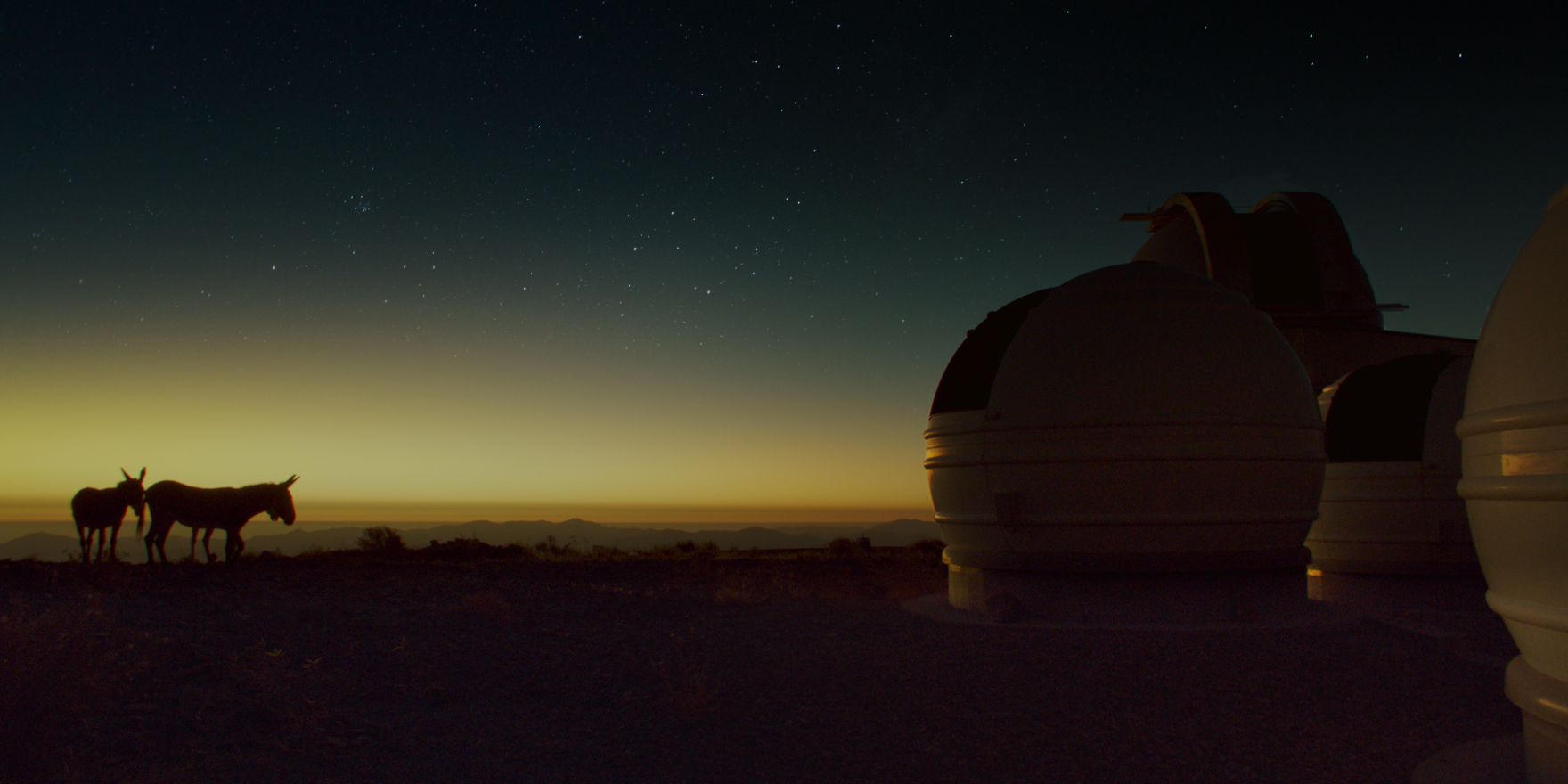
I wanted to find the authentic, uncontrived simplicity of the narrative in picture and sound, and express neither the well-known anthropomorphic view of animals, in particular donkeys, nor the familiar perception of astronomical observatories, but rather to immerse the viewer in a sensorial experience which feels animalic, fresh and unforgettable.
“Film as dream, film as music. No art passes our conscience in the way film does, and goes directly to our feelings, deep down into the dark rooms of the soul.” - Ingmar Bergman
I wrote a treatment in four movements.
- First light. We observe three donkeys in an unnamed desert. Desert animals are awakening. The donkeys climb a hill, spy astronomical domes, hear something unusual and decide to investigate.
- They enter the world of the observatory, play and explore. There is a peculiar strangeness to this new world. We sense that the observatory is watching and following the donkeys.
- Night falls; the observatory comes to life! The metal beasts awaken, open, turn, groan, sing during the night, chasing the stars. A sensorial, fantastic dance. We feel the interior worlds of the donkeys and the heart-soul of the observatory in conversation. Domes and telescopes churn and howl; we experience an ecstatic, tender beauty, a visual-sonic symphony we’ve never seen or heard before. There is more in the night than we can see …
- Epilogue: morning. The domes curl inward, sleep again. The donkeys leave the observatory.
“The project I have in mind is one which will shape itself as it proceeds and is essentially elastic.” – Robert Frank