Like most good stories, this one starts at Lowe’s. It’s 2018 and I’m acclimating to a new living arrangement – splitting time between Brooklyn and my hometown of Richmond, Virginia, where I’ve just bought a house. After 16 years of renting and roommates in New York City, I’m finally claiming a corner of the world as my own, for sanctuary and bra-less evenings.
Like any new homeowner, I’m convinced that repainting rooms counts as proper house maintenance. Then one day while picking out a slightly different green for my green kitchen, I’m paralyzed. For a fleeting second, I think I recognize my biological father, a man I hadn’t seen in 20 years. A man who, after a couple of brief interactions, ghosted me when I was six.
But it’s not him. I abandon the paint hunt and go home, now anxious and confused. There are some tears. Am I sad that it wasn’t him? Am I still mad at him? Am I mad at Lowe’s for failing to pre-screen their customers for potential genetic connections? Yes, to all of the above. In this instant, I realize that my new corner of the world, my Virginia eden, comes with steep collateral conditions: I have to be prepared to “run into” my father.
I expected some adjustments when coming back to Virginia. Learning to be chatty with strangers again. The thick, terrifying silence of a winter night. The pedestrian-driver relationship where both are perpetually flummoxed about who gets the right of way. But now there’s anxiety buzzing under my skin. Sharp, worried, electrical impulses assaulting my subconscious. I’m plagued with the rhetorical questions of a broken-hearted little girl: What did I do wrong? Why didn’t he want to be my dad?
I decide to take the most evolved, mature action I can muster: do nothing and adjust to my new more-anxious life. Of course, you can’t ignore a problem without significant consequences. Suddenly, I’m angry all the time. And it’s not my natural state, so I’m uncomfortable. All the circular thinking takes its toll on me and I begin to avoid the paint section at Lowe’s. I begin to avoid my house. I begin to avoid Virginia, and then I leave entirely.
Cue the movies.
Back in the safety of New York (specifically Red Hook, where I won’t run into anyone, much less my father), my body relaxes and I decide to do what I’ve always done. I write. About him, about my work-life and wanting more, about whether or not I should freeze my eggs, about my seemingly libertine approach to love and where the hell that comes from (spoiler alert: it’s painfully obvious).
This was the makings of the first draft of my new film, Bird in Hand. It was a feature screenplay about Bella, a thirtysomething who goes back to Virginia to find her dad and interview him live on her podcast about why he abandoned her. This all happens amidst Bella’s racially loaded wedding to a blue-blooded white Southern man. I send it around to some readers for perspective and the feedback is universal – it’s honest, but it has too many ideas. And it’s a little mean.
One of the readers is my producing partner, Craig Shilowich, who encourages me to make a short film version as a proof of concept. So I lift the last scene of the feature and restructure it as a standalone story. This evolves into a 10-minute film, White Wedding. It’s about a woman who’s reunited with her estranged dad on her wedding day, after she mistakenly hires his band. It ends with a father-daughter dance where Bella tells her dad to look at all the beauty around her and know that it has nothing to do with him. Bella’s venom fails to disguise her actual feelings – a desperation for him to love her. A shared grief. We shoot it in February 2020 and it’s invited to Sundance 2021. It’s this year that I get rid of my Red Hook apartment, and permanently move back into my house in Virginia.
It’s like a fever dream. Perhaps a fugue. Three years spent both entirely immersed in, and entirely avoiding, the pain of an absent father. Translating that into a piece of writing for other people to relate to, but dodging what it means for myself. It’s like trying to embrace a ghost.
Now the world is locked down for Covid. It’s just me, my fiancé and two dogs in a house. But the buzzing is back under my skin and now louder than ever. I’m staring at the walls, no production or film to distract me, desperately in need of a way to process this grief. Not for my character Bella. Not for the many fatherless women I’d met while sharing White Wedding. Just for me. Just for my mental health. For my upcoming marriage. For my liver.
And then I get a message from a user on 23andMe. It’s clear and brief. “This site says we’re 1st cousins. I know all my cousins. Who are YOU.” I’ll call the user Gloria. Gloria and I speak on the phone and I learn that, based on the timeline, my biological dad cheated on his wife with my mom, which resulted in me. He hid my existence from his whole family, including Gloria. And including his other daughter. Gloria said he’s divorced now, but he’s close with this daughter. Best friends. That’s likely why he hasn’t told her about me.
He hasn’t told her about me. I contemplate this. Slowly. His decision to “not be my dad” wasn’t just about leaving me behind, or avoiding raising a child. It was also about raising his other daughter. I saw that what he had done was protect her from pain (and, of course, to protect himself as well, and protect his marriage … I’m guessing), and suddenly this “bio dad” character I had created for my own life’s narrative had become more dimensional. Maybe he wasn’t an “absent Black dad” as the world had encouraged me to believe and as I had failed to question. Maybe he was a parent protecting his family, while making a huge, and very human, mistake.
So, once again, I decide to take the most evolved action I can muster: I start to blame my mother. Why hadn’t she told me about this? Why did she let me meet a dad who couldn’t stick around? Why didn’t she protect me? These conversations went the way they always had. Something along the lines of “I don’t know, but can you lay off of me?” She didn’t want to solve this crisis for me. No one did.
Repeating the pattern, my next step was to sit down and write, this time thinking about my mother. Thinking about whether or not blaming her would help me out of this mental cycle. Up until this time in my life, I’d been flailing. Reactionary. Impulsive. Untrusting. Those were my actions, not hers. Maybe I learned them from her. Maybe I didn’t. But all my anger, all my sadness, I couldn’t give that away. I couldn’t return it to my parents and say, “Try again.” This was life, despite their inadequacies.
The character of Bella changed into the character Bird. She’s reactionary. Impulsive. Manipulative. And she’s made a mess out of her life. All by herself. When I finished the draft, something inside of me untangled and the buzzing I’d grown so used to completely stopped.
Suffice it to say, this journey created what’s now Bird in Hand, a film that opens tomorrow at the Roxy and will continue on a wave of theatrical screenings before planting its digital flag. I’d like to think that this journey allowed me to make a film that’s kind. That has some grace. That can be buoyant in the face of adversity. And perhaps, most importantly, a film where the lead character writes her own story, regardless of how well she performs.
This film is the result of countless months in front of a computer, weeks locked inside, days in tears, moments of healing with my mother, dozens of jobs created, fear of failure, falling in and out of love, riverside walks with my dogs, and brutal honesty. Making this film is truly the most “Bird” thing I’ve done to date; I’ve rebuilt my narrative just the way it was meant to be. Now I can peacefully go back to the paint section at Lowe’s and run into my dad. Shake his hand. Say hello and maybe cry, but survive.
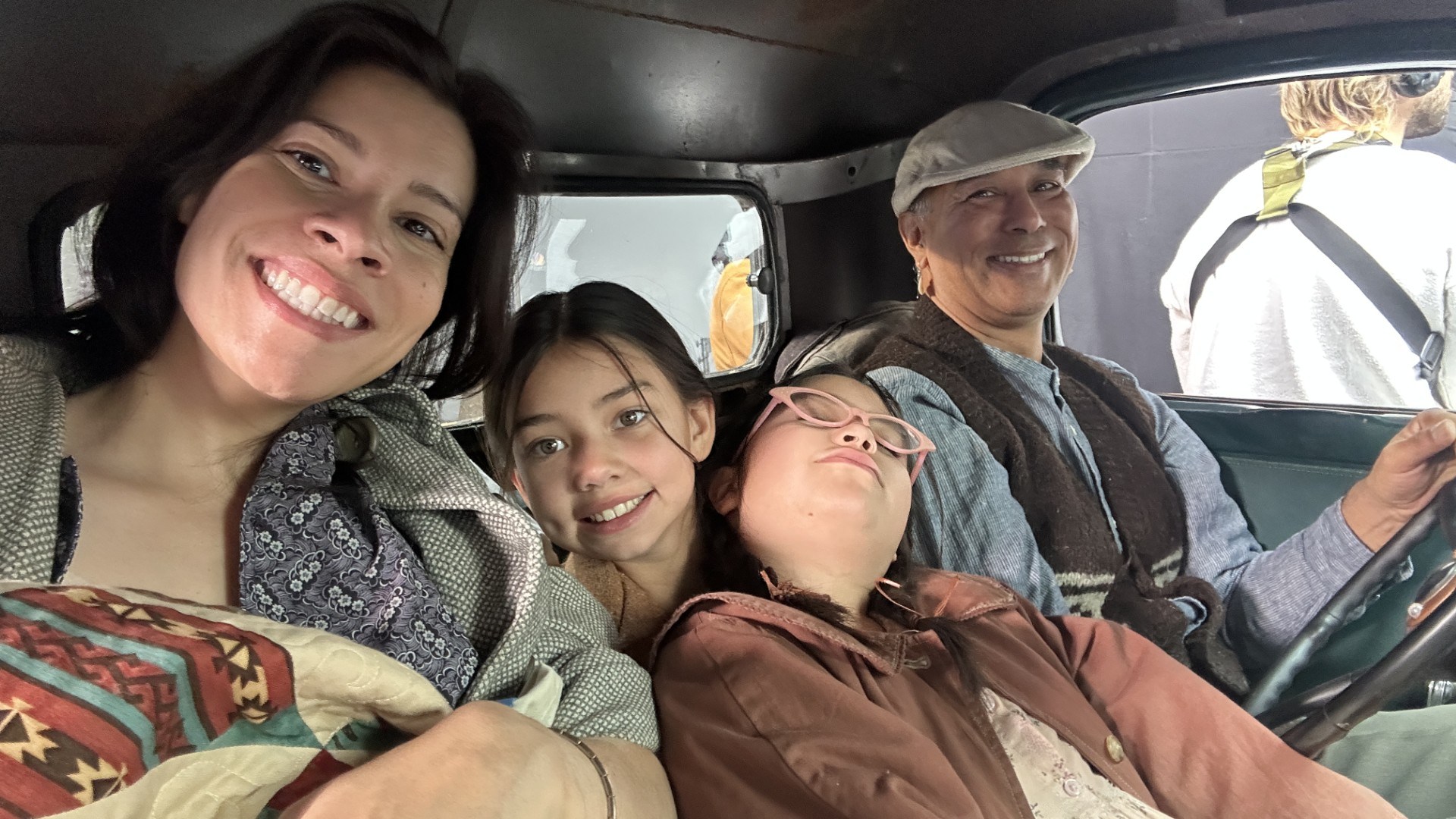
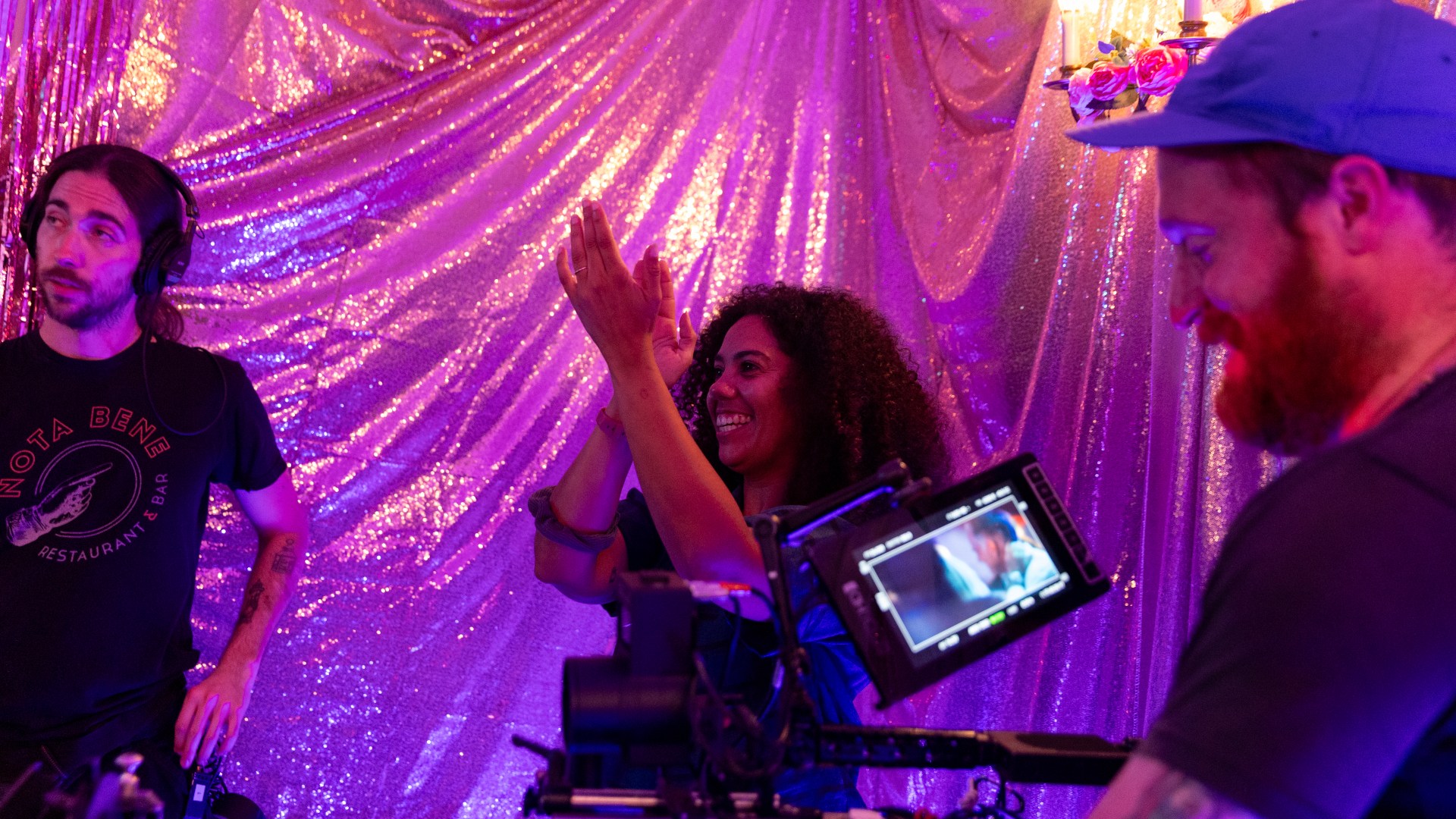
Featured image, showing Melody C. Roscher directing Bird in Hand, is by Julianne Tripp Hillian and courtesy Melody C. Roscher.