
You mean to tell me that 2026 is the 40th anniversary of Ferris Bueller’s Day Off AND Pretty in Pink?!
It’s true! Two of the most beloved films to have hatched within the genius of John Hughes’ brain were released within months of each other in 1986, and haven’t stopped influencing film lovers since.
Both of these films made tremendous impacts on me – seeing Ferris Bueller’s Day Off upon release, in the cinema, at seven years old was like a confetti cannon of teenage coolness exploding within my brain.
I immediately set a course to become the characters as quickly as possible. I needed to be Ferris for his effortless cool and outsized love of life. I needed to be Sloane for her spontaneity and willingness for surprise adventures, for saying what she means. And Cameron, for his courage and self-actualization.
If you’ve ever read Hughes’ original script for the film, not only do the Buellers have younger children as well as the teens, but Ferris is also meaner and nastier, looking down at adulthood with obvious disdain, and far more punk rock. Matthew Broderick (and really, no one else could have played the role) is necessary to smooth out Ferris and inject him with some much needed charm.
One of the (many!) things I love about cinema is the way that while a film stays static, you change around it and see it through new lenses as you age. And, of course, showing a beloved movie to others who haven’t seen it is always a true pleasure.
After initially watching Ferris Bueller’s Day Off, everyone I knew loved Ferris and wanted to be like him – his suaveness, control and goofiness are a hard combination to beat. Didn’t we all want the world to work completely in our favor, like his world does? I felt like I could have asked anyone I knew who they wanted to be after watching this film and everyone would have chosen Ferris.
Imagine my surprise the first time I showed this film to some British friends of mine who had never seen it – they didn’t want to be Ferris at all, they wanted to be Cameron! My mind was blown, but in the most delicious way – I saw the film in a whole new way through their eyes and completely shifted my feelings on the characters. Another friend who I showed it to recently loved it because it wasn’t a coming-of-age film for Ferris, but for Cameron, who definitely has the biggest and most satisfying character arc in the movie.
I’ve seen the argument that Ferris is trapped in a time loop and has lived this day many, many times before, which is why he times everything with such incredible precision. I can dig this theory – Ferris absolutely seems to be a thousand times ahead of everyone else, so why not?
I’ve always wondered – and maybe you have, too – about what the next day of school would be like for all involved. Ferris and Sloane would return as the absolute champions, but Cameron and Jeannie have both also had life-altering epiphanies – their change of attitude and self-confidence upon returning to school would be mind-blowing.
And then there’s Mr. Rooney. The end of the film sees him as a shattered man – muddy, bloody, suit shredded, car gone, keys gone, wallet gone, dignity gone. Is he a brave enough man to face the jeers, leers and absolute slaughter from the entire school upon his return? A part of me thinks that perhaps, after retrieving his car, Mr. Rooney simply drove home, gave his notice and went on to live a quiet life in another town. How could you face being the joke of that high school for the rest of your career?
I am glad, however, that no sequel exists. It’s fun to ponder where these characters might end up, but as a standalone film, it’s absolute perfection. I wouldn’t change a line, a character, a shot, nothing. It’s a joyous look at young freedom – and what it takes to be that free. Quite a deep message for such a seemingly surface-level film, but that’s what John Hughes did so well.
On the other hand, aren’t Ferris and his crew part of the “richies” crowd that Andie in Pretty in Pink detests so much? Ferris, with his big house and computer, gives no thought to how much it costs for his extravagant day out. And while these two films don’t take place at the same high school (although Ferris and The Breakfast Club do), it’s a fun experiment to see the characters through the lenses of Hughes’ different viewpoints of high school life.
And while John Hughes didn’t direct Pretty in Pink, as the film’s screenwriter and executive producer, his fingerprints are all over it. Molly Ringwald’s Andie is a confident teenager, dealing with an absent mom, a layabout dad, a fawning best friend and the knowledge that she’ll always be stuck with the wrong-side-of-the-track crowd. (Which, to me, looks like a more fun and way cooler crew, but this is 1986.)
And that’s the issue. Ten years later, in 1996, Andie and Duckie would have been indie-pop stylish thrift store gurus, but in 1986, it was all about labels and expensive brand names. Making your own clothes? Those stuck-up richies could never. But while we’re on the topic of fashion, let’s dive a little deeper into it.
Obviously, there’s the color palette – the poor kids wear darker or brighter colors while the richies live for pastels (and have you ever seen anything more luxuriously perfect than James Spader in a white linen suit?)
Then there’s the dress.
Andie, an experienced seamstress, manages to turn Iona’s prom dress and the dress her dad got for her (where did he get the money for that dress? Did he steal it?) into one of the most disappointing dress reveals in cinema. Ringwald is a lovely girl, but not even she can do anything with this monstrosity – baggy, shapeless, unflattering and incredibly amateurish.
The dress is supposed to be a pink fuck you to everyone in the school who has ever judged her and is supposed to show her off in a whole new light – as a fashion-forward mega babe – and I want it to be that, but it sure ain’t. I need to be a fly on the wall during the production meetings they had about this dress, because I am sure it was heavily discussed, and still we ended up with that? Missed the target by a mile.
I recently showed Pretty in Pink to a friend who hadn’t seen it, and she was totally in love with it, until the ending, with Andie choosing Blaine. It pissed her off – mightily. “What?” she screamed, “That’s how it ends?!” I explained to her that the original end was what she wanted – Andie and Duckie showing up together to annihilate those richie bastards, on a metaphorical moral high ground. But ’80s viewers balked – they wanted Andie and Blaine to wind up together, and so they reshot the ending.
But I am glad we have the near-punk roughness in this film of Andie’s nightclub hangout and, of course, her record store job. Her fashion and job alone should make her the coolest girl in school, and yet! Amazing to think how different the mindset is of a film when it was released, and how it ages as the years unwind.
Watched back to back, it’s a thrill to see the main characters of Ferris Bueller’s Day Off and Pretty in Pink be confident in their identities, and so truthful as well. They value friendship and love, and care more about being themselves than fitting in. But the fact that Ferris is a school hero for his behavior and Andie is an outcast for hers is a fascinating look at gender, society and especially high-school politics.
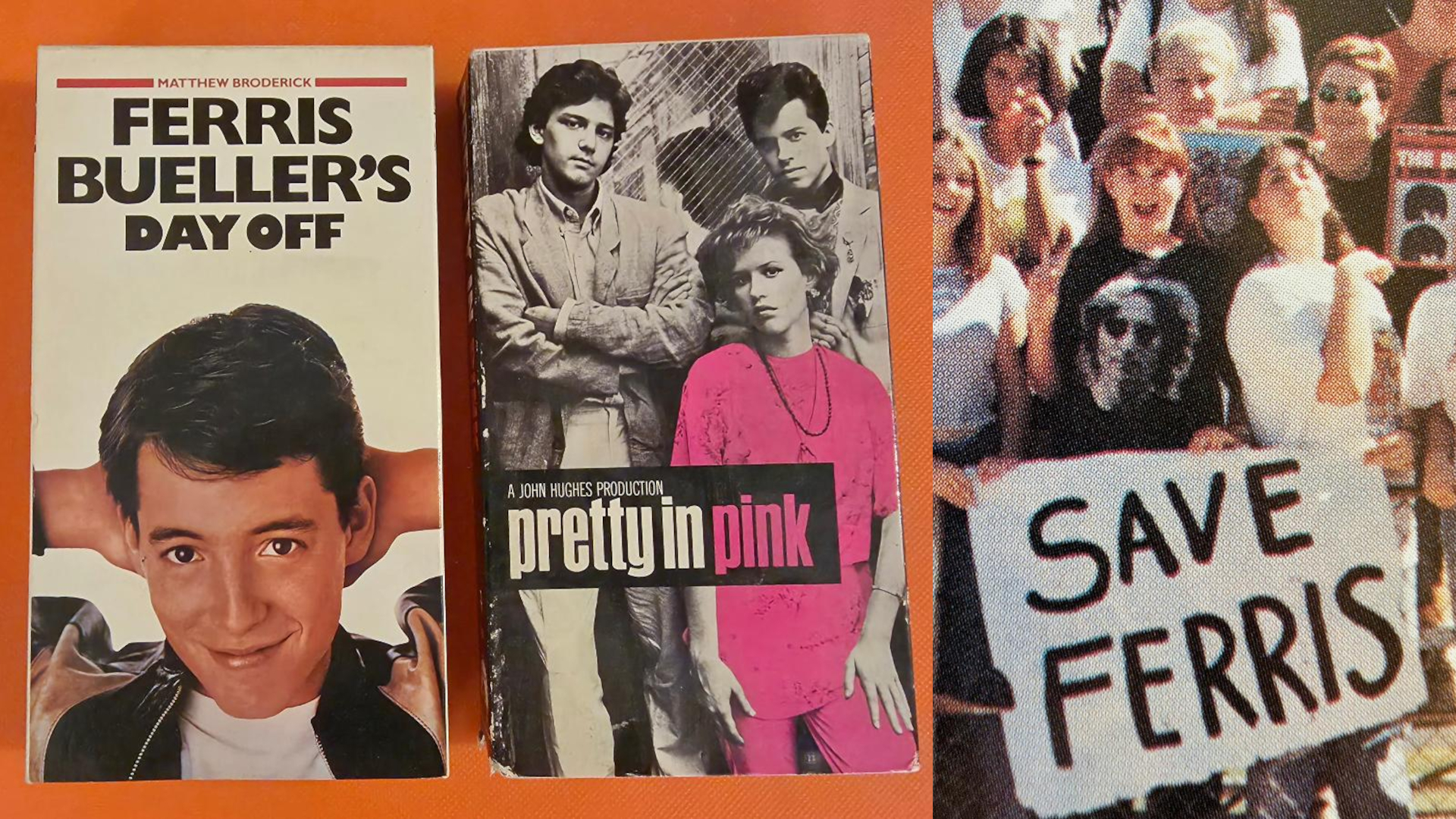
I’m so glad I was able to grow up with these films, to look forward to my teens in the hopes it would be like John Hughes’ films, luxuriating in these movies during my high school years (in the picture of my entire senior class, I'm holding a sign that says Save Ferris!), watching them on repeat, and then once I graduated school and moved on, seeing them through on a different lens. But I still love them both as much as I ever did.
They live in that special nostalgic nook in your heart where movies from your childhood burrow.
I highly recommend watching these two as a double feature, acknowledging the 40th anniversary while watching, but really paying attention to all the details – the production design, the fashion, the music, the performances. Really soak it all in. Hughes’ films still resonate because there are characters and moments in his films that we have all felt in our lives, whether we want to admit to it or not.
And whether you’re a richie or a rebel, life moves pretty fast. If you don’t watch the films at this age, you’ll never have quite the same perspective again.