In 2003, I was a film student at the University of Wisconsin Milwaukee Peck School of the Arts. One of my classmates and friends was an immigrant from Jordan named Abdel. As we moved through the program together, we worked on each other's films, often taking the same classes. One day, Abdel didn’t show up for class and our professor told me that he had been detained by Homeland Security, held in a jail downtown.
After a couple weeks passed and he still had not returned to class, I went to try to visit Abdel where he was being detained. Talking to him through the thick glass window, I could see his front teeth had been knocked loose, and they seemed to be wired back together. He told me this was from an accident that happened while he was playing basketball inside. He also told me it was all a big misunderstanding regarding his immigration paperwork and that it would be sorted out soon.
I remember Abdel being detained for most of the semester, and I spent a lot of time worrying about his situation. In December, the U.S. Department of State released a statement saying that he was being held as part of an FBI Milwaukee Joint Terrorism Task Force joint investigation called Operation Magic Carpet, which seemed like an absurd thing to name an investigation of my friend from Jordan. After being gone from school for months, Abdel finally returned, but he didn’t want to talk about what he’d been through. He explained to me that the case was messing up everyone’s life who became involved, and he did not want to mess up my life too.
The UW Milwaukee film school that we attended is an experimental film program, meaning we studied lots of avant-garde, unorthodox films and art – stuff most people would call weird. I recall once sitting in a theater for class, watching a film that was two hours long of just a solid blue screen, with no sound. Many students left partway through the screening, while others slept. Abdel stayed, front and center, enthusiastically absorbing this unconventional art work. He had chosen to come to our country and to this school for the creative education, and I saw his complete dedication. It was inspiring.
Knowing how committed Abdel was to his school and his art, it didn’t seem logical or fair to me that he was detained for as long as he was, in the manner he was. I wondered if he would have received the same treatment if he was white, from Australia or Norway, or had a common Western English name. This question stuck with me for years, and led me to start researching the war on terror, and how the U.S. government was treating our perceived enemies.
I discovered the story of Lt. Col. Yvonne Bradley while reading the book: The Guantanamo Lawyers: Inside a Prison Outside the Law, edited by Jonathan Hafetz and Mark P. Denbeaux. Her essay was one of more than 100 written by lawyers and compiled for the book. The Guantanamo Lawyers was fascinating because the backgrounds of its writers was so diverse, yet they were all painting the same picture: a massive disaster involving mismanagement, miscommunication, corruption, torture, indefinite detention, and even war crimes.
Bradley’s story stuck out to me as especially poignant. She was a JAG military attorney assigned to defend a terror suspect, Binyam Mohamed, being held in Guantanamo Bay. There was a lot of conflict that came through in her writing:
"I am not sure who was more apprehensive and nervous during the visit, Binyam or I. I … should not have been nervous or apprehensive, but I was. Here I was, a seasoned former death-row attorney who had sat face to face with dozens of convicted murderers and serial killers, nervous and afraid of Binyam Mohamed, not because he had been convicted of any wrongdoing but simply because he had been labeled a terrorist. I suddenly realized the ugly power of fear, labeling, and misinformation. I realized how propaganda could be used to keep people fearful and the truth hidden."
She was employed and assigned by the government to ensure that this person received a fair trial, but that same government had already stated publicly that all of the men held at Guantanamo were the worst of the worst and wanted to kill Americans:
"Imagine trying to litigate a major war crime case with schizophrenic rules and procedures. I also quickly learned that the only goal of the military commission system was to establish a rigged court that would guarantee convictions. The entire process was maddening. I often found myself questioning whether the people in charge cared about the Constitution, due process, and the rule of law."
Bradley was in the middle of an impossible situation, but she committed to the case even as the months turned into years – to fight for what she thought was right. For her, the entire ordeal was very personal: it radically altered her perspective on her country, her job, her relationships, her whole world. I wanted to learn more about Yvonne and hear more of her story, in hopes of sharing it with a wider audience. I optioned the book and began to work with Yvonne on making a feature documentary film.
While exploring the complexities of Yvonne’s story, I began to see connections between what her client Binyam Mohamed and my friend Abdel went through. The powers that be were detaining these men to demonstrate that we were fighting and winning the war on terror, and that our leaders were working fruitfully to keep Americans safe. The evidence and facts regarding the innocence or guilt of any of these individual men were secondary to maintaining the appearance of control. A dear mentor of mine, filmmaker Steve Wetzel, put it very eloquently: “This is a story about the callousness of state (the way it can and does render human life meaningless) and about power and what it needs to do in order to preserve its image.” The goal was to have Binyam and Abdel behind bars, with the newspapers printing quotes from the state about capturing the villains. The rest was someone else’s problem to sort out. In Binyam’s case, fortunately, that someone else was Lt. Col. Yvonne Bradley.
and Also the Truth LLC.)
In March 2022, Yvonne and I stood on the stage of the Alamo Drafthouse in Austin, Texas, as she received a standing ovation at the premiere of We Are Not Ghouls at the SXSW Film Festival. The film would go on to win the SXSW 2022 Documentary Spotlight Audience Award, beating out films about Mickey Mouse, Tony Hawk, the Kids in the Hall and Nolan Ryan (in Texas!).
Filmmaking is a wonderful tool for discovery and expression that has given me so much. I didn’t realize it fully at the time, but the filmmaking process on We Are Not Ghouls would become therapeutic for me in trying to better understand what had happened to my friend Abdel.
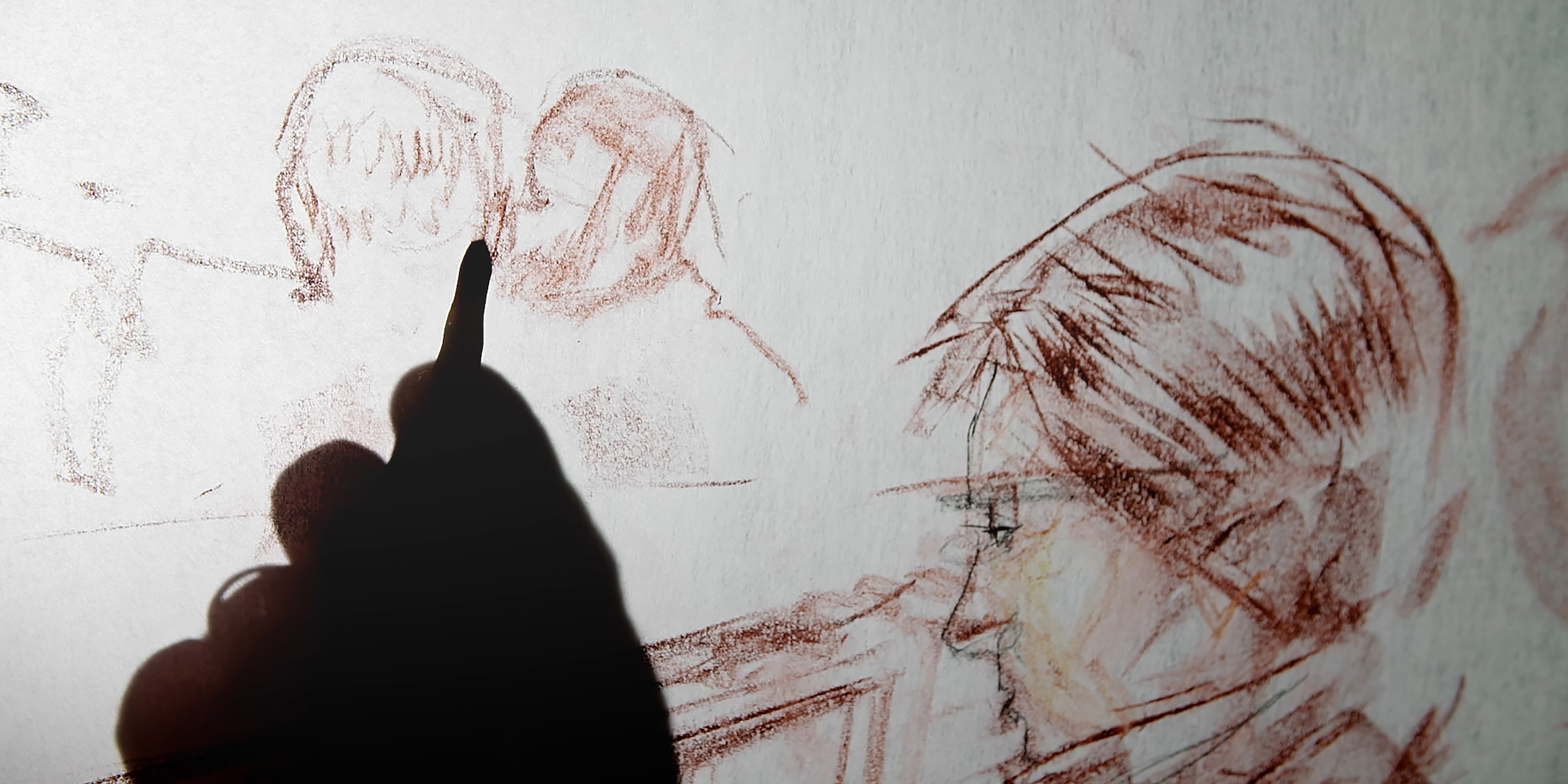
Featured image shows Guantanamo Bay court room illustrator Janet Hamlin sketching; photo by Erik Ljung / Humanity and Also the Truth LLC / illustration by Janet Hamlin. All images courtesy Chris James Thompson.