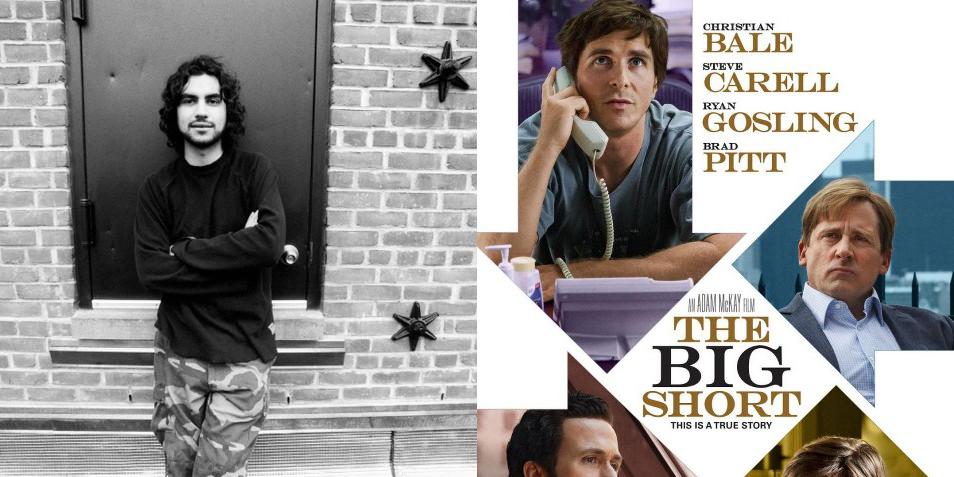
<i>The Big Short </i>is a heist film, only this time the gangsters are operating within the constraints of the law.
In the week leading up to the Academy Awards, we look back at Talkhouse Film contributors' takes on the major awards contenders.
Consider this: two of the best films of the past three years, The Wolf of Wall Street and The Big Short, have been about Wall Street. Is it any surprise? The Mafia movies of the ’70s, ’80s and ’90s have long fallen out of favor. The gangster flicks of 2015 are either about Mexican drug cartels or Wall Street. The goal in these films is the same – get money, by any means necessary. The cartels use assault rifles and grenades, the bankers need only smartphones or Bloomberg terminals. In both cases, the government makes it all too easy by turning a blind eye (this is putting it nicely; some would say it's completely complicit). The Big Short hammers this point home a number of times, airing out both the SEC and former Fed chairman Alan Greenspan, and rightfully so. It’s one of the few films of 2015 that made me laugh out loud numerous times in shock and awe at the utter absurdity on display, and it’s (almost) all a true story.
You know you’re in for a ride with The Big Short when within the first five minutes director Adam McKay breaks up the narrative with documentary-style archival photos, video and Funny or Die sketches. Characters talk to the camera, the first few sequences are brazenly color-corrected, the shooting style switches on a whim – hands-down, this movie has more energy and chutzpah than anything else I've seen in the past year. Despite its script being full of naked exposition and featuring some poorly written characters (Marisa Tomei does her best as a terribly clichéd wifey character), The Big Short also contains the best dialogue of the year, most of it spoken by Ryan Gosling. “Tell me the difference between stupid and illegal and I'll have my wife's brother arrested,” is just one of the great lines spoken by Gosling's Jared Vennett. The makeup artist should win the Oscar just for Gosling’s spray tan alone. Same with the hairstylist. I spent at least five minutes laughing when Steve Carell walked on screen. Carell's character, Mark Baum, is the dictionary definition of douchebag, the kind of fuck-stick that carries on a cellphone conversation with his wife while interrupting a speech to belittle the speaker. Carell should have gotten a supporting actor Oscar nod. Jeremy Strong, who plays financial analyst Vinnie Peters and chews two pieces of Trident in every single scene, also deserves recognition.
Adam McKay previously directed broad comedies such as Anchorman: The Legend of Ron Burgundy and Step Brothers, and The Big Short is at its best when it’s at its funniest. The film only slips up when it tries hard to make us sympathize with the characters or feel like they felt remorse about what they were doing. I don’t care if they regretted or questioned their decisions just like I didn’t care if Henry Hill regretted selling drugs in Goodfellas; Hill did what he needed to do to make money for him and his people, just like Christian Bale’s character in The Big Short. Can you really fault these guys for seeing a crack in the system and trying to take advantage of it? That’s capitalism, after all. And just like in classic crime flicks, you find yourself rooting for the gangsters to pull off their heist. And that gets to the essence of it: The Big Short is a heist film, only this time the gangsters are operating within the constraints of the law, because the system and government they work under is utterly corrupt. In the end, this irony is what makes The Big Short so special, so bitingly satiric and such an important film at this time in our history.
Watching The Big Short, I was also reminded of G. Edward Griffin’s legendary book The Creature from Jekyll Island. Some have called Creature the most important work on economics since Marx’s Das Kapital. In this compelling true-story yarn, Griffin explains how money is created out of nothing, worse even, out of less than nothing, out of debt. How do we perform this incredible magic trick? Well, it's thanks to the Federal Reserve System, aka the Fed, a cartel of private banks formed by the Rockefeller and Morgan families during a secret meeting with Senate Republican leader Nelson Aldrich on Jekyll Island off the coast of Georgia in 1913. Ever wonder how Bush and Obama were able to bail out the banks without raising taxes? Prepare to be pissed off. Griffin’s book shows how collecting taxes isn’t even really necessary when we are literally creating money out of thin air.
Griffin defines money in four ways: commodity money (silver coins or gold pieces), receipt money (paper money backed 100 percent by gold or silver reserves), fractional money (paper money partially backed by gold or silver reserves) and finally, and most importantly, fiat money (paper money not backed by precious metals, intrinsically valueless and used as money because of government decree). We are living in age of fiat money. The American dollar is no longer backed by gold or silver but by debt. It has no intrinsic value. Our dollars are created out of thin air by the Fed for Congress to spend as it wishes – mostly on war and interest on the national debt (nearly 50 percent). The Fed, contrary to popular belief, is not a government agency. It considers itself “an independent central bank because its monetary policy decisions do not have to be approved by the President or anyone else in the executive or legislative branches of the government.” Marinate on that for a second. If you think Congress, the President and the Supreme Court are in control of our country, think again. As Amschel Rothschild famously said, “Give me control of a nation's money supply, and I care not who makes its laws.”
The Creature from Jekyll Island, about the biggest scam in modern history, is told like a detective story, and a really scary one. It would make a great follow-up to The Big Short – a period piece set in 1913 as the richest men in America meet on an island to plan how to defraud American citizens (and soon the rest of the world, as the creature’s tentacles spread to the IMF and the World Bank) for centuries to come. Get on it, McKay!