My personal feeling is that as humanity becomes more and more obsessed with "progress," we are less and less able to determine our own personal reactions to the world around us. When we think about things in terms of "new" or "cutting edge," we inevitably put things into categories, we think in terms of form: "Have I seen this shape before?" "Have I heard this sound before?" etc. It becomes an endless world of abstraction, less about how it affects you viscerally and more of a mental exercise based on time: "This happened and then this happened, therefore this happening now must be based on what happened then." Because of this obsession with progress, aka time, we need to label everything, put it all in a nice, neat line so we can see the progression. Everything becomes about its context and, more and more, the truth that is embedded in reality is lost. If we're always thinking about the past and the future, we are never in the moment, so we're not really even seeing what's right in front of us. In other words, we are walking dead.
The irony of it is that we now allow things to exist in little boxes, perfectly preserved. That is the opposite of progress. It's as if we're in a panic and can't keep up with the information we are generating, and we need to keep order any way we can. And there is no better example of this than the business of music criticism.
If we dealt purely with reality, then we would probably talk about music in terms of how it affects our nervous systems — because, in reality, that's what it does. Harmony produces vibrations that resonate with our central nervous systems. We in the modern western world are dealing with a 12-note scale — far less evolved and complex than much older Eastern or ancient Greek microtonal scales, mind you. And yet there seems to be an almost endless number of combinations of those 12 notes, not to mention the subtle overtones created by the way the music is vibrating with its environment. The way that it is reactive is the way that it is alive. These patterns of notes enter our ears and produce a feeling in our bodies; there is something for everyone, depending on your taste and temperament. I probably sound like Mr. Rogers when I talk about the 12 notes and all that, but it's really come to this, folks: as some Native American grandfather once told his grandson, "The old stories are being forgotten."
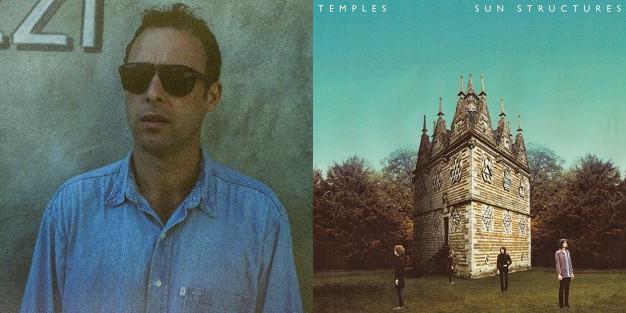
So, on to the topic at hand. Temples' new album Sun Structures is a record for those lost in the trap of time. It's very hard to listen to it without getting forced into places that have already been – in this case, the psychedelic '60s. It seems that the band was so obsessed with time that they overlooked the fact that, for example, having that much old school compression on the drums for the whole record will fatigue the listener. (I suppose they figured it worked for Tame Impala.) The fact is, there are some nice melodic movements here that aren't allowed to have their proper effect because of the obsessive preservationist approach. Every song ever written demands a certain treatment; if it is denied that treatment for the sake of continuity, then it will never have a chance of being heard, and therefore felt, by the listener.
To be honest, I listened to this record with half a heart. I honestly couldn't focus myself. I listened maybe three times and didn't have the heart to listen again. I picked it to write about because I saw Temples play at Union Pool in Brooklyn back in November and actually enjoyed the show. I liked them as characters, and the frontman pulls off that detached, self-satisfied-without-being-a-dick, androgynous thing pretty well. Of course, seeing a band live is to see something breathing, but this record just feels trapped and self-conscious. It's funny how pedestrian the genre of "psych rock" has become — there's almost zero exploration going on here, but then again, now that we have things in little boxes, "psych rock" is just "psych rock" — in other words, it's not actually trying to enhance the psychedelic experience. In fact, this record is the total opposite of psychedelic. It's more like "Best Buy rock."
Anyway, I'm probably going to get shit for this because we share the same European soundguy but, to be honest, I bet Temples wouldn't even care. They have their eye on the prize and they know what buttons to push to get the little lemmings jumping, so more power to them. Besides, the people who will buy this record probably aren't familiar with musical touchstones like the Pretty Things, Quicksilver Messenger Service, and maybe even the Byrds anyway, so Temples might get off scot-free.
Culturally we are at the beginning of devouring ourselves. At least we have all the madrigals and the Byzantine era to look forward to again.