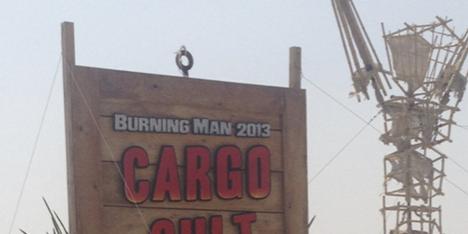
If you can’t enjoy yourself at Burning Man, I think that’s your problem. This was my fifth “Burn” since 2008. For the other 51 weeks of my year, Black Rock City, the instant metropolis erected for Burning Man on a dry lake bed in the Black Rock Desert in northwestern Nevada, is like an almost-forgotten chapter in Italo Calvino’s Invisible Cities, but for the one week its gates are open, it is both the most real and the most fictional place I’ve ever been to or even heard of. Like a Buddhist sand mandala, indifferently erected and erased in the Nevada desert, Black Rock City swells to over five square miles, making it the largest outdoor arts festival in North America. Unlike most household-name festivals held in the U.S., Burning Man wasn’t founded solely as a music festival, and will never really be about the music any more than it’s about creating an “anyone who dares” space that embraces musical expression in proportion to the rest of the art, performances or fashion that only occurs here.
If you ask any of the 60,000-plus attendees what it all means to them, why they follow this wooden statue back into the remotely terrestrial Black Rock Desert every year, you’re likely to get 60,000 unique and beautiful answers. Everyone's given a map, with directions to civic events like TEDx, A.A. meetings, law enforcement, and a post office where you can send snail-mail postmarked from a place that’s vanishing as you write. However, a map is never the territory, and nothing here is very static. Whatever your kink, like apps, there’s a camp for that at your fingertips.
Despite the impressions about me that my band may leave on audiences, I feel strangely at home here. I became a musician because I wanted to create music that had all the qualities I couldn’t find in what I heard around me in one place, and the same is true about why I go to Burning Man — to be the change you want to see in your community, or at least be there to support it. I don’t come because I feel like I would rather become a stereotypical burner, or because I feel like I’m hiding who I really am from the rest of the world. Most functioning stereotypes often seem to be exaggerations or overreactions to misunderstandings rather than a true reflection of the reality or current state of the subject matter. I attend because I want to help create new archetypes. I’m trying to challenge the stereotypes about burners and metal music makers simultaneously; from where I’m standing, I think there needs to be more cross-contamination between these two worlds.
Before I was convinced to attend my first Burning Man, I was naive and assumed all the wrong things, mostly gleaned from my experiences performing at some of the more commercial festivals. Although objectively they exhibit similar symptoms — Bonnaroo's stereotypical granola-ness, SXSW’s being hosted in a city, or Coachella’s desert camping — a burn these are not. At Burning Man there’s no main stage, no backstage, no headliners, no vendors, no merchandise, no wristbands, no printed schedules, no advertisements, no sponsors, no promoters, no contracts, no deposits, no curfew, no comp tickets or showcases, and in theory, no spectators. No trashcans and no trace — what you pack in, you pack out. No excuses. This is not a week for the weak. Because of the heat, most of the heightened activity happens when things cool down between sunset and sunrise. Getting a ticket, let alone getting yourself there with everything you need to survive for a week is a relatively expensive pain in the ass. Although it's become increasingly better since 2008, most people have no cell signal within miles of the event and finding free wi-fi from a nearby camp is the proverbial needle in a haystack – you’re essentially off the grid, and as a consequence no other festival is this “present.”
A week spent rubbing the dust out of your third eye also means having your third ear fucked open all day, every day by all the unsolicited man-made noise. It tends to leave your receptors numb, and like a lot of nameless things, everything simply blends until it just stops having any effect whatsoever: overheard snippets of bizarre conversations; obnoxious drunks manned with megaphones; idling generators; propane canons; generic bike rattles, spring-loaded porta-pottys slamming shut…Once your body and senses adjusts to the shock of it all; when you can start separating the signal from the noise, you begin to feel the music. Burning Man has more than its share of music. There’s a constant din of unrequested advice about performers I absolutely can’t miss. People I just met at a foam party are frothing over Damian Lazarus, telling me how if I liked Hieroglyphics, I have to see Opio at 5 AM. Later, friends are spreading rumors about the vehicle Behrouz was driving in getting pulled over on his way to the gates, but let off because the cop was looking forward to catching his set!? There’s even more chatter – before and after – about the double-double secret appearances by Diplo/Major Lazer. I’m still buzzing from Lee Burridge’s precariously perched sunrise set atop the Robot Heart art car – a massive mobile sound system roaming the Playa. In all cases, I loved what I heard and heard about, but I loved it more knowing what it took to make it happen there, and what everyone didn’t get for it, and how stoked they were to do it anyway.
Although I’m there to fully expose myself to all the exciting new music Burning Man has to offer, there’s just not enough brainwidth available. Admittedly the overwhelming amount of DJ/electronic music isn’t my usual fare, and I get more excited about jumping on the art cars that pump familiar-sounding funk, soul and r&b, and getting dropped off at Café Negro to cleanse my palette with black metal served with blacker coffee. There’s ways in which I wish it was more like those other festivals too, namely the noticeable imbalance of great DJs spinning electronic music vs. great musicians performing live music on the Playa. There’s some — I was blown away watching the Crossroads cover band literally get blown away by gusts of dusts, and still hit Stevie Wonder’s highest register – I just want more.
Burning Man isn’t just the biggest and best party in the world, it's literally thousands of the best parties in the world all writhing on top of each other like a well-lubed group orgy of LEDs, each light source a beacon, a galaxy of possibility capable of being intercepted and explored like Joseph Campbell bumper-boating through what most resembles the Creature Cantina from Star Wars. The Playa is an alternate universe, continuously unfolding itself as if to ask the eternal question – does art imitate life, or does life imitate 2Pac's “California Love” video?