There is an Afghan proverb, “Har kas ra watanash Kashmir ast,” which translates as, “Everyone’s homeland is Kashmir to them.” The idea is that Kashmir is so beautiful, and all people see their homelands as equally lovely as Kashmir.
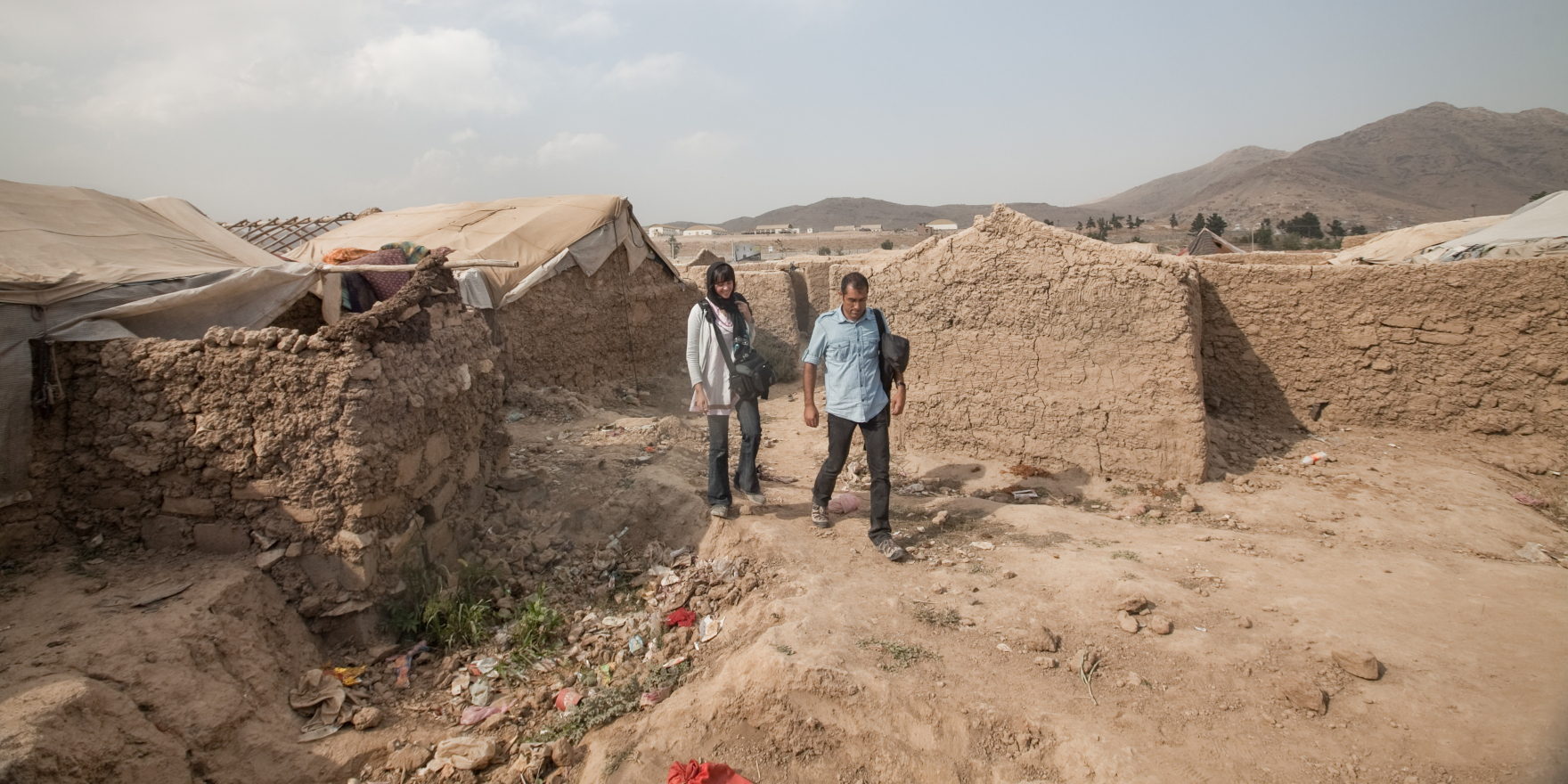
When we picked up a camera in 2013 to begin filming what would become our film Three Songs for Benazir, it was beauty we were drawn to. It was the beauty of a young couple full of hopes. It was this tenderness, this playfulness between them, that was enough to drown out the war. Even while the rushing whirr of American helicopters constantly droned over the camp, and as a giant foreign object floated in the sky monitoring everything below, what happened in the room between Shaista and Benazir was enough to eclipse all of that, even if just for a little while.
To live on the cusp of a war is to recognize, in a very acute way, the fragility and beauty of daily life. Moments that are easy to take for granted – the sound a pomegranate makes when you crack it open, the way a friend’s smile lights up the corners of their eyes, how the reflection of sequins on a scarf dance in a puddle of mud – become that much more pronounced. On the edge of war, one is ever aware of how quickly any of those things can be taken away. And therefore, it was the seemingly smallest of things, the love between two teenagers in a displacement camp with little in the world but each other, that became the most important to us.
Afghanistan is often framed in the media within the language of war and news. It’s a grammar that we have tried to render obsolete with Three Songs for Benazir. That is not to say that war is not hellish. For Gulistan, last year was the darkest year of his life when the Taliban took over Afghanistan again and his best friend, the greatly respected journalist Fahim Dashty, was killed in the Panjshir Valley. Afghanistan is now facing a terrible humanitarian crisis. We speak with family every week and do everything we can to support them. But war is never the whole story. If we close our eyes now, we can put ourselves back in Panjshir and hear the rustling of the mulberry trees in the spring wind.
Like Gulistan, whose father was killed by a Soviet landmine in Afghanistan in the mid 1980s, Shaista had many reasons to lose both his hope and faith. This time, it wasn’t the Soviets and the Mujahideen fighting, but NATO and the Taliban. In some ways, what difference does it ultimately make when the realities faced are the same? And yet, he still had that boyish smile. He still made Benazir, in all her quiet strength and stoicism, soften and melt into laughter when he serenaded her with one of the remarkably beautiful poems of the Pashto language. He still dreamed of carving out a path for himself, of risking everything in an unstable line of work, just to have stability. He wants what all of us want, probably what you reading this now want as well. There can be no more chasm between people once we realize our hearts are all connected and beating together.
There is a picture on the wall of Shaista’s mud-brick home in the displacement camp. In it, Shaista stands smiling and proud before an artificial backdrop of beautiful gardens. It reminded him, he said, of his home in Helmand. Helmand, a place that has widely been considered the “most dangerous” in Afghanistan. A place where the fighting got so bad that Shaista’s relatives were bombed out of their own home. A place where he could only get a third-grade education before the war tore him away from school. And yet, it is still Kashmir to him.
Love stories are universal. And Afghanistan is full of romance, just like anywhere else in the world, perhaps in some ways more so. Having ourselves fallen in love and gotten married in Kabul, we understand how love can blossom against the backdrop of violence and chaos, because it’s our own story. We understand that it takes courage to choose to step into romance, to choose to bring a child into this broken but beautiful world and build a family when there are so many uncertain things. Because love compels you to still choose to try to build something. And Shaista and Benazir are courageous in their ability to preserve love and intimacy and hope. The world can learn a lot from them.
Featured image shows Elizabeth Mirzaei and Gulistan Mirzaei during the shooting of Three Songs for Benazir. All images courtesy of Elizabeth Mirzaei and Gulistan Mirzaei.