I had just turned 42. I’d quit my corporate job, moved out of my house in Los Angeles and set out with a 20-kg suitcase to experience life in Vietnam. I told myself I would give it a year.
I had visited Vietnam briefly 20 years before on a trip with my parents and brothers, when the country was just opening up. Billed as a family vacation, it was really the return to the homeland my parents had thought they would never see again. Our holiday was heavy. Two decades later, I was going alone. I didn’t tell my parents or our relatives who lived in the north and south.
My parents are refugees who fled Vietnam at the end of the war. They came to the U.S. and eventually moved to Indiana, where I was born and raised. Growing up, the images I saw of Vietnam in movies and TV only showed the ravages of war and tragedy. It was a place I knew only sad stories about. I wanted to get to know the country on my own.
I decided to live in the city of Da Nang in central Vietnam. I was drawn there due to the beach, good medical care, the international airport and the fact that I didn’t know anyone there. This kind of travel was normal for many people I knew in their 20s, but not in their 40s. I had always assumed I would have done it before, but paying off university loans, career, marriage, life – surviving – swallowed up the decades. During all those years, in the back of my mind, Vietnam was whispering to me.
I likely would have kept going on that hamster wheel, but my body couldn’t take it anymore. I was burnt out and recovering from a prolonged illness. When I got stronger, I did what any sane person would do – I produced a low-budget feature that physically and mentally wrecked me. Then my marriage fell apart. I counted myself lucky that I could go back to a grueling corporate job, because of the health insurance and security. The whispers from Vietnam got louder. Lại đây. Come here.
I made another movie and it didn’t kill me. But it was clear that the only way to have a sustainable life was to leave the U.S. I was single, no kids, fairly healthy again, my parents weren’t ailing. A window had opened. If there was ever a good time, this was it. There was an urgency that if I didn’t go soon, the window would close and I would never have a chance to go. I couldn’t ignore the voice anymore. Đi đi! Go!
Many people thought I was crazy to eject myself out of a comfortable life and jump into the unknown. For others, the explanation was that I was doing an “eat, pray, love” experience, because I had gotten divorced a couple years before. That I needed to mend my broken heart with travel and introspection. This made me envy how men – seen as adventurers and explorers – are able to travel so freely, and don’t need their relationship status to justify wanting a change of scenery.
Most of my life, my schedule was dictated by others. In many ways, I let it be dictated by others. Now it was all up to me. If I was unhappy about it, I had only myself to blame. When people asked me what my goals were, I told them, “Sleep eight hours a day, exercise and eat three meals a day on a regular schedule.” I was not looking for some major revelation. Or to write a screenplay, like many assumed. I was hoping to feel rested, at peace, and to improve my Vietnamese.
I slept, exercised and ate three meals a day. I started to feel human again. I eventually moved to Hoi An, a small town by a beach 20 kilometers away. My life was simple. Instead of getting on freeways and sitting in traffic, I got around on a used bicycle that was so old and crappy,x I knew no one would steal it. My main stresses of the day were if there were waves in the morning, and could I surf before the morning market closed at 9 a.m.?
Although I wasn’t working 60 to 70 hours a week like before, my days were full. I did the things I previously never had time for: cooking, reading for fun, volunteering, writing without an assignment, even taking little remote freelance gigs that came my way. I was making inroads with the Vietnamese film industry. I found a community and carved out the life I wanted. I was happy. I finally told my parents a year later where I was and that I was staying.
One day, I received an email about a documentary shooting in Vietnam. It was about sustainability and an incredible woman named Trinh Thi Hong who had found a way to make cleaning fluids from organic waste. The dish soap I bought regularly at the refillable store was made this way. I was sure it was her product and that I was meant to help tell her story. It was.
It turned out the project was going to follow other inspiring grassroot innovators around the world. From a young man in Sierra Leone who built a solar car out of trash, to a woman fighting for inclusivity on the subways of Azerbaijan – this was a dream project for me. I pitched to direct the entire project and got it.
We filmed during the pandemic with local crews in more than nine countries while I directed via Zoom and WhatsApp on my laptop from Hoi An. It was a wild way to make a film, yet it’s also fitting for our world now: how we are all connected and can work together toward a common goal that benefits everyone. The film is called For Tomorrow. I’m really proud of it.
I often think about all the steps that led me to this place. I would have never gotten this project had I not been in Vietnam. Leaving the life I knew saved me in so many ways. The hardest part was making the decision to go. Once I made that choice, all these doors opened that I could not have imagined. Things presented themselves that made the transition to leaving quite easy, actually. But it was that first step to changing things up that was the hardest.
Why? There was a lot of fear and worry. I realized most of my life before was dominated by this. The things I feared could happen never actually did. The things that knocked me on my ass weren’t things I could have planned for. They came out of nowhere. I didn’t think about the good things that would happen. I wasted energy being cautious and too fearful to do anything.
It’s a strange feeling when you’re not used to things falling into place and they do. When things align almost magically. And you realize it was there all along. Listen to that whisper. Trust it. Đi đi! Go!
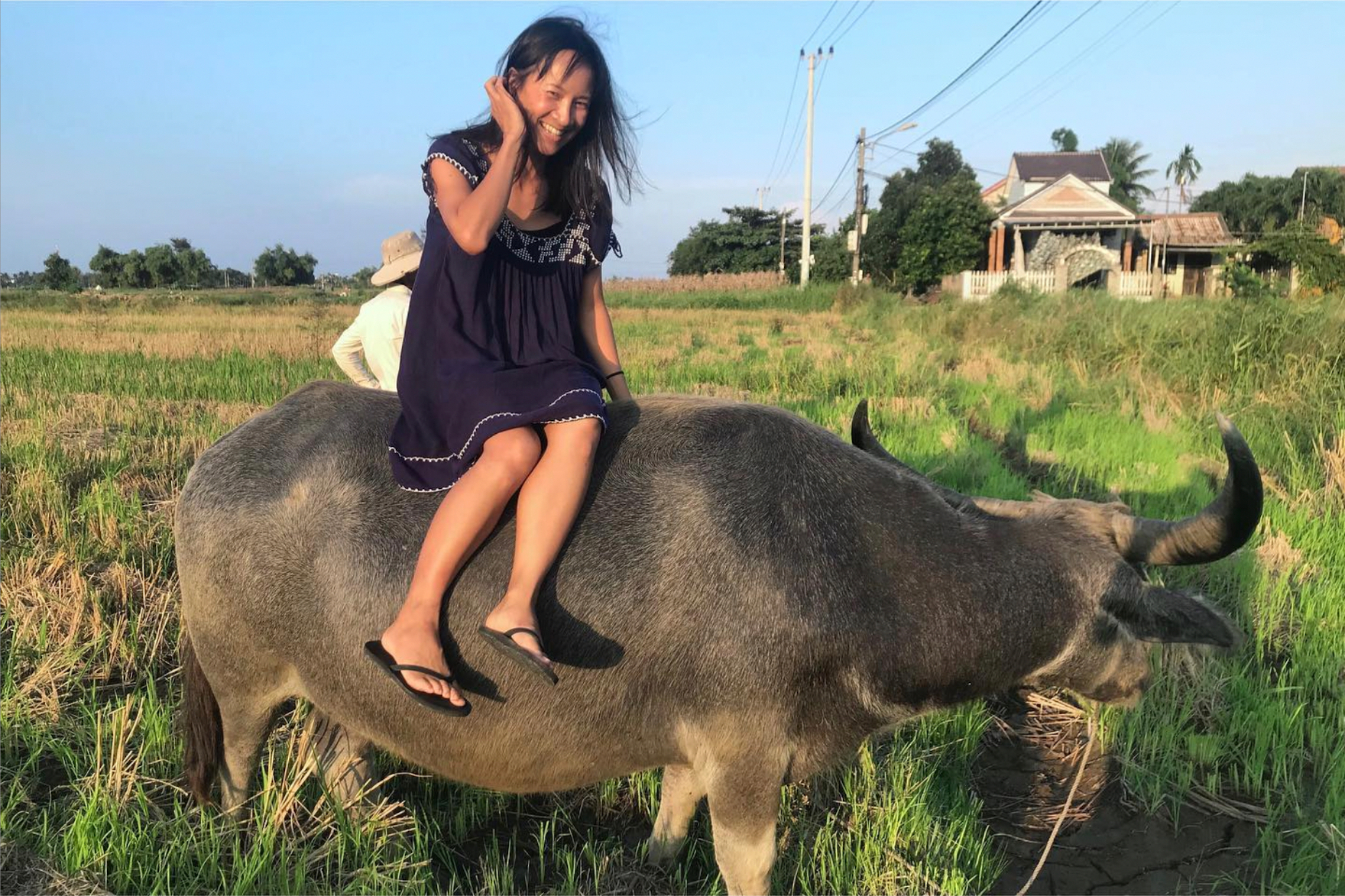
Featured image shows An Tran on a buffalo in the Vietnamese countryside. All images courtesy An Tran.