Sir Harrison Birtwistle has always dared to ask the hard questions, searching for the most extreme expression that angular modernism can find. In 2007 he managed to create a minor scandal in England with his ferocious Panic for alto saxophone and orchestra. Many of his other works seem as subtle as a team of rugby players throwing rocks at each other.
Don’t be put off by the surface noise. Birtwistle is one of the great composers, and his best works don’t just reflect the chaos of modern life; they are also connected to theatre, folklore and the primeval.
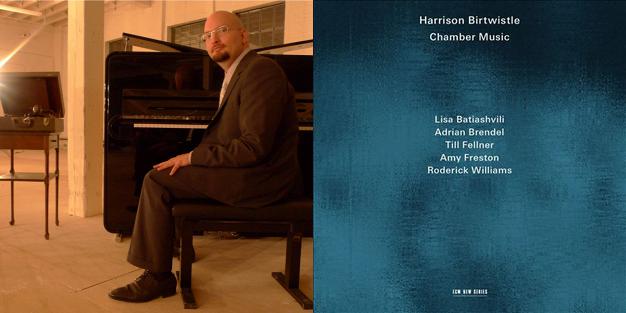
Birtwistle’s latest album Chamber Music is comparatively gentle next to orchestral assaults like Panic, Earth Dances (1986), or The Triumph of Time (1971-1972). Birtwistle turns 80 in July, so perhaps he is mellowing a bit, but another important factor in this album’s accessibility is the production by ECM Records founder Manfred Eicher.
Chamber Music comes to us via ECM, which might once have been typecast as an advocate for harmonious contemporary classical music artists like Arvo Pärt and Steve Reich, but in recent years more recondite voices like Alfred Schnittke, Giacinto Scelsi, Bernd Alois Zimmermann and György Kurtág have turned up on the label. ECM also has helped shine light on less-established composers like Valentin Silvestrov and Thomas Larcher.
For this current project, it seems like Eicher looked for the Birtwistle works that most suited the classic ECM sound: reverberant, thoughtful and intimate. The polished performers show secure understanding of both the composer and the producer, and the result highlights the profound subtleties of Birtwistle’s harmonic sensibility.
The disc is bookended by collections of short settings of the late American poet Lorine Niedecker, performed by soprano Amy Freston and cellist Adrian Brendel. Unlike some of his peers, Birtwistle writes for the voice, not against it, allowing Freston to deliver this concentrated expressionism with relative naturalness. The cello part is vibrant, with the thunking pizzicato that accompanies the arco in the first song (“Always North of Him”) being particularly striking.
In his excellent liner notes, English composer and music critic Bayan Northcott suggests that Sir Harrison has recently been listening to Ludvig van Beethoven, Felix Mendelssohn, and Richard Wagner. These relatively new interests for Birtwistle have borne fruit in conventionally scored and titled works like “Trio for Violin, violoncello, and piano.” However, to my ears, “Trio…” is the most recognizably Birtwistlian piece on the album. One of Birtwistle’s thumbprints is jagged ostinati, and several of them jangle away in pleasing fashion during the course of the the composition’s lone movement. At the climax, all three musicians — Brendel, pianist Till Fellner and violinist Lisa Batiashvili — must push their instruments to extremes in classic Birtwistlian fashion.
While “Trio…” is unusually transparent for Birtwistle, it undoubtedly remains rather “difficult” in the manner of much modernist atonal composition. One way to parse this sort of piece is to keep re-listening: put the “Trio…” movement on repeat in your iPod and go for a long walk. Eventually the phrases will cohere into sentences and paragraphs.
The longest piece on this recital is also the standout. The “Bogenstrich” cycle is comprised of five sections of six minutes apiece:
“Liebes-Lied 1” (song for baritone and piano)
“Lied ohne Worte” (cello and piano)
“Variationen” (cello and piano)
“Wie eine Fuge” (cello and piano)
“Liebes-Lied 2” (same song, different setting for baritone and cello)
Northcott’s notes helpfully explain the way “Bogenstrich” took shape: the initial commission of “Lied ohne Worte” became the starting point for an interconnected cycle of meditations on Rainer Maria Rilke’s famous poem “Liebes-Lied.” (“Bogenstrich” means “bow-stroke” and the word is featured in the poem.)
While “Bogenstrich” is not a work that gives up its secrets easily, it is impossible not to respond to Birtwistle’s heartfelt autumnal emotion. Once again, performers and production couldn’t be better; Brendel and Fellner are compelling advocates for this major work, and baritone Roderick Williams exhibits both passion and precise intonation. When Birtwistle’s 81st year begins next month, it will only make sense to blast his noisiest stuff in high celebration at high noon. But in the evening, “Bogenstrich” will be the perfect closer.