
There’s no real plot, but that is fundamental to the genre. Screen junkies don’t get caught up in mysteries or win the big game.
I was a child of the video-store cult section. All the dangerous material lived there. Over the Edge and Repo Man and Female Trouble. Liquid Sky and Pixote and Eraserhead. It’s also where I found Uli Edel’s Christiane F., the first movie about heroin addicts I ever saw. I was unprepared for such prodigious on-screen vomiting, but nevertheless was fascinated by the film’s gritty verisimilitude. Two decades on, I still am, though I’m not entirely certain why. Movies about the marginal, fucked up and disenfranchised have always been my bailiwick, but I’ve paid special attention to the junkie genre.
It’s a narrow one, really. Otto Preminger’s The Man with the Golden Arm is the corny urtext, with Frank Sinatra chewing the scenery in time to a jazzy beat. But it was the early ’70s that saw the material given its first scary close-up by a group of young, artistically inclined filmmakers. Barbet Schroeder’s More, Jerry Schatzberg’s The Panic in Needle Park and Floyd Mutrux’s Dusty and Sweets McGee collectively introduced the dirty realism that’s since become familiar — genuinely scummy locations, flinch-inducing close-ups of needles puncturing flesh, and performances so lived-in they’re scary. These movies were able to shock audiences by exposing a subculture that until then had rarely been explored with much honesty.
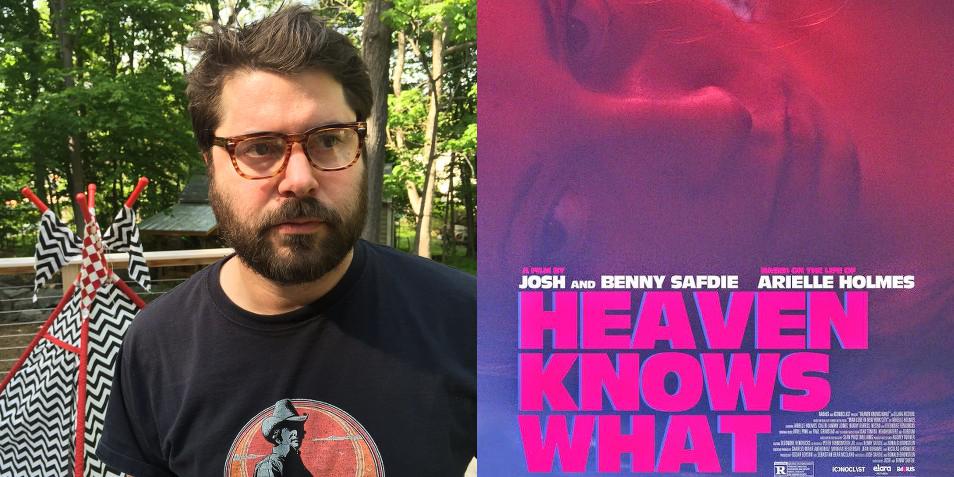
Contemporary audiences, of course, have seen it all, but the trend toward authenticity and squalor in the junkie genre hasn’t changed. A case in point is Josh and Benny Safdie’s new film Heaven Knows What. It’s heavily indebted to the aforementioned films, and seems self-consciously determined to out-gritty them all. You’ll find none of the black-leather glam of Permanent Midnight or the rock & roll gusto of Trainspotting here. This is a raw, unadorned production that focuses on the lowest of the low in the addict universe: homeless street punks. It’s all dirty fingernails and frayed nerves.
Like Christiane F., Heaven Knows What is based on the (as yet unpublished) memoir of an addict, and like Dusty & Sweets, it makes extensive use of non-traditional casting. What’s different is that the memoirist, Arielle Holmes, is also the film’s star, acting as the character Harley. This is a daring gambit that pays off in two ways. First, it authenticates the film’s bona fides from the start. This is legit. This girl lived this. How much more truthful can you get? Second, Holmes’ performance is amazing for an amateur. She’s adenoidal and perpetually bleary-eyed, and any New Yorker will have seen her type panhandling on a street corner somewhere.
We never get Harley’s origin story, but find her already a heavy user. There’s no real plot either, but then this is almost as fundamental to the genre as the scenes of shooting up. Screen junkies don’t get caught up in mysteries or win the big game. They’re serial fuck-ups. Harley makes a half-hearted suicide attempt, nurtures an attraction to a dangerous boy, and tries to get high without extending herself too much. She’s stuck in the familiar cycle — score, shoot, nod out, repeat — and shows little desire to give it up. The closest she gets to anything resembling transcendence is a motorcycle ride.
All this grimness is made grimmer by the filmmakers’ formal approach. The (video?) images are heavily desaturated, the interiors as hazy and bleak as the exteriors. Even the sunlight seems cold. Sean Price Williams’ camerawork has a spontaneous, documentary feel, but there’s sufficient coverage for some busy cutting, which underscores the overall mood of constant, b-grade agitation. I can’t help but assume that the overall mission statement here was to make the experience of the film parallel the experience of its luckless anti-heroes. It’s the same logic that informed Godard’s Les Carbiniers. A film about war, he reasoned, should perforce be a blunt, dreary, punishing affair to approximate such a hideous experience. Why not a junkie film too?
So does Heaven Knows What qualify as the grittiest of its kind? The most off-putting? The most street-level? It’s definitely in the running for all of these, and certainly has a place on that (now figurative) cult shelf. The question it raises for me is: where else might a junkie film go, other than doubling down on the 1970s precedent? Is there an alternative possibility that isn’t disingenuous or ethically thorny? I’m not sure, but I’m still attracted to the material. I’m just glad Heaven Knows What didn’t rely on barfing to make its case.