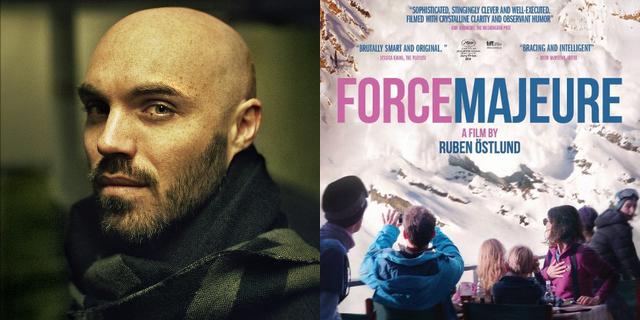
Ruben Östlund’s Force Majeure opens with a family posing for an offscreen photographer. They’re staggered in classical fashion — dad, mum, daughter and son — against the backdrop of the Alpine ski chalet where they’ve gone on vacation. Over the course of a single shot, a disembodied voice directs the family into a series of nuclear tableaux; it is just distended enough to do that wonderful thing that opening shots do sometimes, which is to function as an abstract of an entire film. Everything you need to know about this movie is laid out at once: theme, form, tone, principal cast — everything is there but Vivaldi.
Not to fear, however — the Italian composer comes on in full force moments later, as a montage of the French Alps unfurls to the climactic strains of his Concerto No. 2 in G Minor. As controlled avalanches cascade across the screen, the final movement of L’estate resounds in all its baroque glory. I spent some time thinking about this music after watching the film. The movement in question is intended to evoke a summer storm, and on its own terms it does just that. But is it the decades of cinematic appropriation that have left it fraught with irony? Those opening measures are as difficult to take seriously in a movie as they are to misuse: they lend themselves naturally to cinematic juxtaposition, and they also tell us exactly what to expect from the film at hand. Here, just as that opening shot did, they promise a comedy of social errors; they ensure the deconstruction of something rather grand.
But perhaps deconstruction isn’t exactly the right term. It connotes process, but this film is at its best when it’s not getting anywhere, when it’s studying and cataloguing and digging into effect. The cause is provided early on: soon after the opening shot, that same family is having lunch at an open-air restaurant amidst the peaks when they espy another controlled avalanche careening down a nearby slope. Everyone gathers to watch. The oohs and ahhs soon turn to cries of alarm as the tumult reveals itself to be very much out of control. In the snowy melee that follows, an act occurs which will have resounding consequences: the father runs, practically trampling his wife and children. Call it instinct, call it self-preservation, call it whatever you like; his friends and family will likewise run through every possible explanation, trying to figure out why a seemingly good, upstanding man might abandon his family in a moment of peril.
There are grounds here for probing drama; there is something of Haneke in Östlund’s formalism, although Östlund has no interest in the Austrian master’s ponderous sensitivity. As predicated by its musical overture, Force Majeure is a comedy; as suggested in that opening shot, its subject is masculinity. Family and class form a sub-stratum of targets, but the principal attack is on modern manhood, and it’s one that Östlund makes repeatedly, poking and prodding with an almost scientific scrutiny. This film is not an essay; there is no hypothesis stated, no conclusion drawn. Rather, Östlund establishes a controlled environment, introduces a catalyst and then, for 100 or so minutes, examines the results, while his bemusement rings as loud and clear as the Vivladi violin strains that predicate it.
I may sound critical; I am not. If my opinion seems dry, it is only because the film’s qualities have rubbed off on me. Force Majeure is tremendously entertaining, frequently hilarious, formally sound and remarkably assured. I am fascinated by the degree to which it is synecdoche. Every part is almost entirely representative of the whole. There are no dialectics in its construction; it offers no grand summation. Moment by moment, the film is a comedy; en totale, it is still a comedy, though one with faint underpinnings of tragedy that a less confident director might have leaned upon more heavily. There is a moment by a poolside involving two men and a miscommunication that is probably the most hilariously astute cinematic castration I’ve ever seen. There is imagery at the climax that hints at something mysterious and ancient and archetypal, but it would be a mistake to take it seriously. We know this because of that opening shot. And because of Vivaldi.