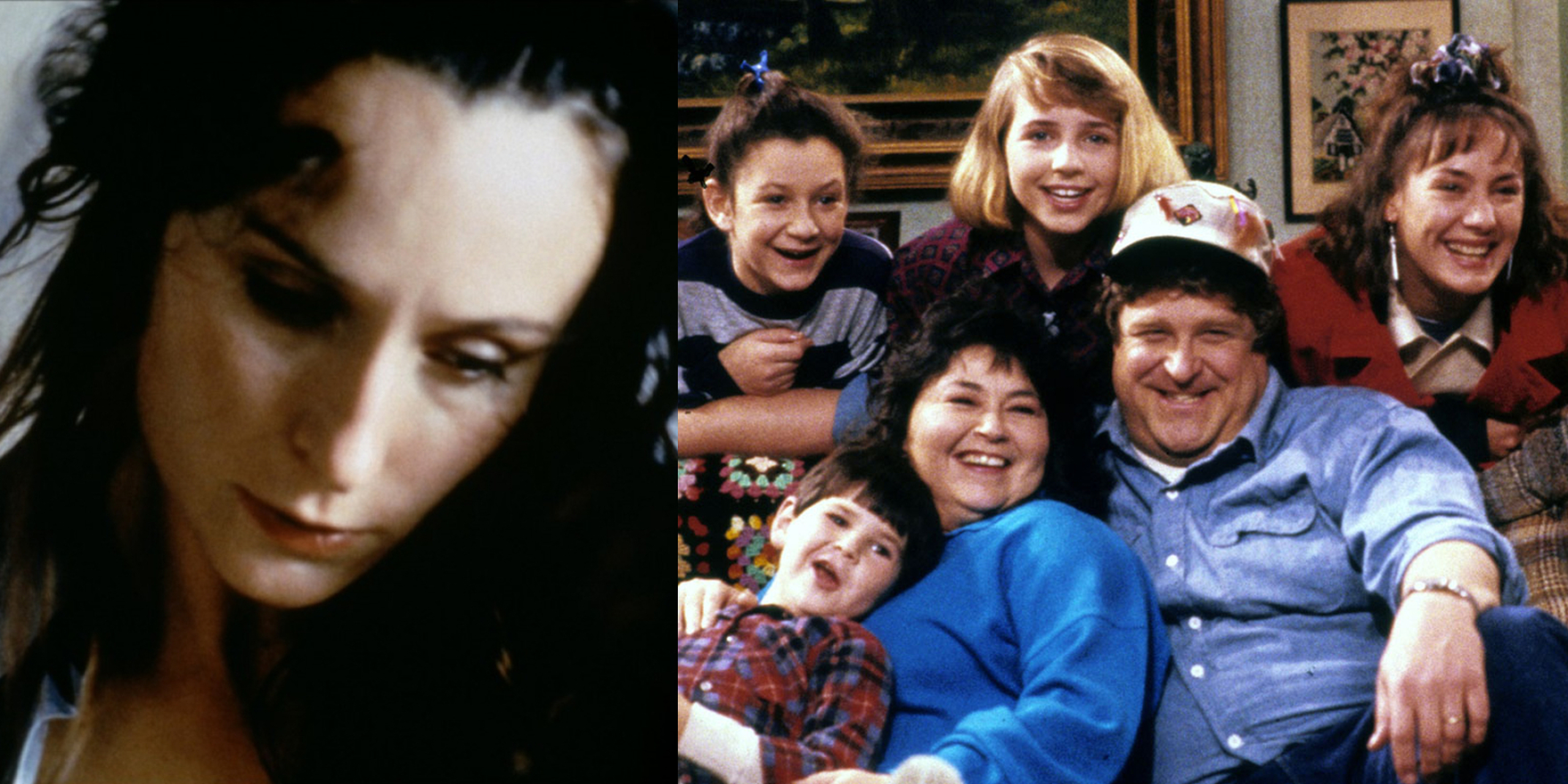
I move to New York City in August 2001. I barely have any facial hair and don't know a soul. The Sundance Channel plays Lodge Kerrigan's Claire Dolan in endless reruns. I watch it, and watch it again and again and again. On a different channel, there are reruns of Roseanne. Roseanne is never lonely. She's always surrounded by her family. Claire Dolan is always (even mid-coitus) by herself. I find my America sandwiched between the two. Down the street at the Chinese place, I'm a regular. I get plain white rice every single day. It costs 75 cents. I pour three packets of soy sauce on top. I persist with that diet until someone points out, months later, that this may lead to some health problems down the road.
Consuming goods in New York, I learn, helps soothe loneliness. But there’s a flip side: it makes the days in which you don’t consume goods feel bleaker. Roseanne sort of works the same way. I score a gig writing a column for a paper back home. I’m supposed to cover my life in New York. It’s a racket. I don’t have a life in New York. I have Roseanne and Claire Dolan and white rice. But I apply myself and go look for something to write about. In a Chelsea gallery, I come across Rodney Graham’s Phonokinetoscope. It’s a projection installation, a 16mm loop showing Graham riding his bike around Berlin’s Tiergarten, in an ode to Dr. Albert Hofmann’s LSD bicycle ride. I find it intensely beautiful and devastating in a way I’m not sure Graham intended. Maybe it’s just my mind. I spend three hours sitting in the gallery, watching the loop. Now I have something to write about.
9/11 happens and it feels remarkably familiar. Things exploded all the time where I grew up. So this – in the fucked-up way this world works – feels like home. People in suits walk up Seventh Avenue covered head to toe in white dust. The country goes to war and I make a mediocre political video piece and post it online. About 100 people see this video, but it’s enough for one of them to send me a xenophobic letter. In it, they offer to ship me back wherever I came from, all expenses paid. Thanks! I take a class with performance artist Karen Finley and tell her about the letter. In return, she gives me a book called Jew Boy, a memoir by Alan Kaufman that speaks of a racist America I didn’t even realize existed. Karen Finley also shows me Derek Jarman’s Blue. It is not a movie. It’s a crawlspace that requires a hardhat and a flashlight and it leads under Derek Jarman’s skin and into the sub-levels of his soul.
Somewhere near the U.N., I interview Oren Moverman. It’s years before he makes The Messenger, but he’s already a busy screenwriter. We talk for a few hours, way more than necessary for the measly 1200 words I owe the paper. He tells me about working on Louis Malle’s last film, about writing for Interview magazine, and about Jesus’ Son. This meeting will change everything down the line (years later, Moverman and Lawrence Inglee will produce my new film, The Ticket), but I still don’t know that. I forget this is an interview, enjoy myself way too much, kick back, and probably violate journalistic integrity.
There’s a bar on the West Side called Passerby with a Saturday Night Fever-type disco floor that’s really an installation by Piotr Uklański. I don’t know Piotr Uklański, but that floor sure makes dancing fun. They always play Corey Hart’s “Sunglasses at Night” and Laid Back’s “White Horse.” “If you want to ride / Don’t ride the white horse.” I don’t know what riding the white horse means, and for a little while conclude the song celebrates the Anglo-Saxon tradition of equestrianism.
The loneliness is still real, but it’s also an acquired taste, and after a while, you learn to enjoy it. You learn to deal. There’s a place on Houston where you can get a plate of rice topped with daal for $2. In an admirable show of transparency, the man behind the counter heats it in a microwave right in front of your eyes. It pretty much ticks the box for each and every food group. Problem solved.
Slowly, my relationship with Roseanne comes to an end. Instead, I date a girl whose family lives upstate. She brings me home and I find myself drinking Jim Beam out of eagle-emblemed shot glasses with her Marine Corps brother and her uncle who works for the county. Four or five rounds in (no, let’s be honest, maybe two rounds in), I feel sick and go lie down inside the house. I pass out and wake up an hour later. I can clearly hear them singing outside. They’re singing about me. They’re singing, “Ido is a spy, he’s a spy, he’s a Middle-Eastern spy … ” I don’t confront them. I go down to the basement where there’s a waterbed and sleep there.
Fifteen years later, someone introduces me to Lodge Kerrigan, but I don’t tell him how significant Claire Dolan was for me. And I still haven’t had the chance to meet Roseanne Barr. Probably never will. To quote another great sitcom, Roseanne, if you're reading this, thank you for being a friend.