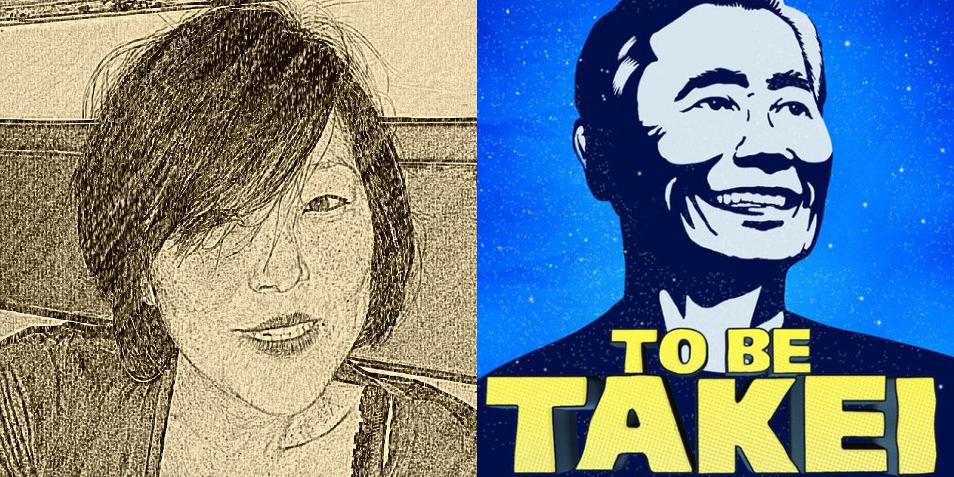
Because there are so few famous Asian-American celebrities in Hollywood, let alone Japanese-American ones, I feel an indescribable kinship when I see George Takei on the screen in Jennifer M. Kroot’s engaging documentary To Be Takei. He is the uncle I have been waiting for all my life. Uncle George might have easily turned up at our family’s Thanksgiving buffet, where there was a huge vat of white rice alongside the traditional turkey and stuffing. He’s the person that would have nurtured me in my creative infancy, encouraged me to be proud of my differences as a child, offered romantic advice when asked; he is the celebrity relative I would have bragged about to my friends in the drama department if I needed some street cred.
In Kroot’s film, we learn that George Takei really is pretty much what he seems on the surface: a gay, sage and witty orator with an impossible laugh. But it’s clear he has been many other things as well.
Takei has not been sitting around in his later years collecting residuals and playing croquet; he has found a way not only to capitalize on his past celebrity and political stances, but also to share his passionate take on current affairs. He ran for City Council of Los Angeles, has been “Loud and Proud” about his sexual orientation and gay rights, and is the co-creator of an epic Broadway-bound musical about a Japanese-American family interned during World War II. Did I mention his more than seven million Facebook followers?
With his typical Japanese “gaman,” he lived through the ordeal of internment (like my parents and relatives), spent years playing demoralizing Asian stereotypes opposite John Wayne and other movie legends in order to sustain any career at all, and masqueraded as a heterosexual to avoid further prejudice. (We in the family, of course, knew all along he was gay.) Since winning the prized role of Mr. Sulu on Star Trek, he has continued to work as an actor for five decades beyond the groundbreaking series. Furthermore, he has a perfectly manicured, almost storybook life with his adoring husband and business partner, Brad (Altman) Takei. What more could anyone want as an inspiration?
Still, like any documentary filmmaker, or nosy niece, I was particularly interested when Uncle George didn’t act like the storybook George. When he laughed fiendishly at Bill Shatner during a celebrity roast, deriding him as a “fat alcoholic,” my ears pricked up. When he told a brief story about disappointing his father, I wanted more. Behind that measured laugh, I’m sure there are more tales to tell.
Surely his life can’t only be achievement after achievement, speech after speech, arriving home with a well-stuffed fanny-pack of bills? Or can it?
When I spent time making a film about Elaine Stritch recently, I became convinced she wanted my life to be as difficult and tortured as her own. Watching To Be Takei, I found myself wondering what my life would have been like if I had had Kroot’s brilliant idea to make a film about George Takei instead. I bet George behaved himself, was a delight, and treated Jennifer responsibly and respectfully as a filmmaker. I can assume there were no 3 a.m. phone calls, no AA meetings, no tantrum outbursts at missed opportunities, nor trips to the hospital — over and over again. Did George personally opine on Kroot’s wardrobe, demand to meet boyfriends, and request midnight sleepovers at the Carlyle because he felt “off”? (Mental note: Make a cocktail date with Jennifer Kroot to confirm.)
Last year, I had the surreal pleasure of attending an event given by the Stella Adler Studio of Acting at which both Elaine Stritch and George Takei were honorees. I made several attempts to break away from the table to stand in line and meet my long-lost uncle, George Takei. I wanted to tell him how much his success had meant to me as a Fellow Yellow, and congratulate him on all his achievements. Every time I had an opportunity to disengage from the events, Uncle George was swamped with fans and photographers. Whenever he stood up, there was a crowd three deep around him, like a force-field. There were even Japanese dignitaries there, wanting, like me, to proclaim him as their very own. I became intimidated. Uncle George was simply too popular to approach. Our meeting would have been as forgetful and meaningless as the hundred other handshakes of the evening. I gave up. Instead, I chatted with Jim Gandolfini (who was curiously undisturbed by fans), who proudly showed me baby videos on his iPhone. (That “clink” was the sound of my heart breaking.)
So I’m terribly grateful Kroot’s To Be Takei exists, giving me a personal glimpse of the Uncle George I am so very proud of, and could not meet in person. But I’m sure, as with Stritch, I will always be longing for more.