I am, almost on principle, not interested in sequels. That wasn’t always the case, of course. When I was a teenager, I would dutifully go to the cinema and see just about anything Hollywood released. I was first in line for The Lost World: Jurassic Park on opening day with my best friend Phil and his girlfriend, and my mind was completely boggled by the fact that he missed the part where the dinosaur stepped on a guy because he was busy making out. Here was a guy who clearly did not have his priorities straight, I thought.
At the age of 22, with four years of film school behind me and a potential career as a storyteller ahead of me, my taste had changed. Hollywood had changed too. There were five sequels in the top 10 highest grossing films of that year (2004). Last year, there were eight. I know everyone likes to blame Hollywood for this creative bankruptcy, but the fact is and always was that film is a consumer-driven business, and I believe that my future depends on me taking that seriously. Every time I pay money to see a film, I am voting for more to be made just like it. So I am, almost on principle, not interested in sequels. But 22 Jump Street assumes this about me.
More specifically, 22 Jump Street assumes that I think most sequels are lazy, greedy retreads of a previously successful formula. (Their assumption is correct.) Directors Phil Lord and Christopher Miller, along with screenwriters Michael Bacall, Oren Uziel and Rodney Rothman, seem to think that the more they address that particular elephant in the room head on, the better. The result is the movie equivalent of that Macaulay Culkin/Ryan Gosling T-shirt war, which recently took the Internet by storm. It’s the type of humor widely embraced by the now-now-now mentality cultivated online, but not the type of humor that sustained my interest for 90 minutes in a dark theater.
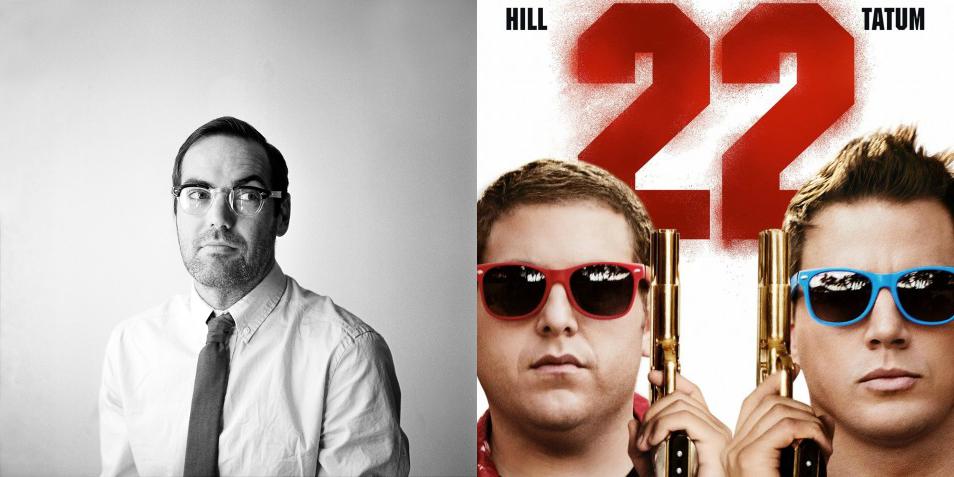
Let’s get a few things out of the way first. In 2012, something about the trailer for 21 Jump Street convinced me to see it, despite not usually being interested in big-budget, studio reboots of TV shows. I wound up loving it, due to three major factors. First and foremost was the wonderful chemistry between Jonah Hill and Channing Tatum, perhaps the best from a comedic standpoint since Vince Vaughn and Owen Wilson in Wedding Crashers. Second, I was pleasantly surprised by how much the female character was given to do, and how much more a spectacular Brie Larson did with it. Finally, I was quite taken by how the filmmakers managed to sneak in a lot of layered and insightful observations regarding the generational gap between thirtysomethings and millennials. Not to mention how generational gaps seem to be shrinking in general. Alas, only one of these aspects returns for the sequel and no other strong qualities are added to replace those that go missing.
First, let's focus on the good aspects of 22 Jump Street: Hill and Tatum are still a dynamite team. Tatum, in particular, is quickly becoming our most exciting and versatile young movie star. He completely steals the film, excelling at all of the physical tasks required of him, landing all the jokes, and managing to be impossibly endearing while doing so. Also, Ice Cube’s trademark cocked lip and furrowed brow are exploited to maximum effect and he more than earns supporting cast MVP honors. Unfortunately for poor Amber Stevens (the main female lead), she is given next to nothing to do but exist so that two of our male characters can be at odds with each other. Wyatt Russell also made a strong, positive impression on me and his early scenes with Tatum showed promise in depicting the way male friendships are formed, but it eventually and predictably devolved into gay jokes (dudes working out together sounds a lot like dudes having sex!). Other gags involving them obliviously making fisting gestures while talking about getting into the “anals of history” could maybe be written off as harmless but then a later scene, which comes out of absolutely nowhere and sees Tatum chastise a character for using the word “faggot,” seems completely self-aggrandizing, not to mention completely undeserved. It seems to exist purely as a license to get away with homophobic jokes elsewhere in much the same way jokes about sequels being lazy and reductive exist to excuse those very characteristics throughout.
Which is really the largest problem with the film. Nick Offerman’s Deputy Chief Hardy giving a speech about how nobody thought 21 Jump Street (the program) was worth rebooting in the first film can be considered a nice, self-deprecating wink to the audience. But here we see him give the same speech in the sequel, only about how nobody thinks a sequel is worthwhile, followed by a joke where they comment on how much more expensive everything looks, followed immediately by a joke where Jonah Hill comments that Ice Cube’s office looks “like a cube of ice” and at this point I’ve gone cross-eyed and am wondering if I’m even watching a movie anymore. Those are jokes that may cause a mild chuckle but they are also jokes that any blogger could have made in their write-up of the press release announcing that the film was going to happen (and probably did) so I can’t give the filmmakers too much credit for settling on them for the final product.
Occasionally, true moments of brilliance still pop up. A fight sequence between Jonah Hill and a villain that keeps stopping because of a unique, circumstantial tension is a wonderful, inspired scene and Jillian Bell manages to cram a handful of the film’s biggest laughs into the first 60 seconds of her introduction onscreen as Stevens’ roommate, but these moments of real originality and invention are few and far between. Which I suppose, one might argue, is the point. That’s fine, and you can still find much worse ways to pass the time in a movie theater this summer, but I expected more. Rather than spend the car ride home with my friend with whom I saw 22 Jump Street rehashing the best parts, we found ourselves quoting Ace Ventura: When Nature Calls back and forth instead and I secretly wished I was going to be writing about that masterpiece. Oh well, what do I know? My film isn’t funny at all. At least, not intentionally.