
Holmes is nearly a madman, not an abnormally smart guy with a morose disposition and a tendency towards deerstalker hats.
I grew up reading Sir Arthur Conan Doyle's Sherlock Holmes stories and, soon after, obsessively watching the BBC series with Jeremy Brett as Holmes and Edward Hardwicke as Dr. Watson. I would eagerly tear through the Oregon Public Broadcasting schedule, which my parents received every month, hoping for more episodes. At the time I had little interest in other portrayers of Holmes, feeling that Brett's performance was definitive and anyone else could only be a disappointment. I had also gotten the sense, later confirmed, that many other depictions of Holmes, especially Basil Rathbone's, were the domain of goofy B movies, featuring bumbling Watsons, moustache-twirling villains, and hammy exclamations of the game being afoot.
In the years since Brett passed away in 1995, I have expanded my universe of film and television versions of Holmes, exploring the straight adaptations, the melodramatic pastiches, and the revisionist contemplations. In almost every case I found that my original conviction, that Brett was definitive, held up. The only exception, much to my surprise, was Benedict Cumberbatch in BBC's Sherlock. When I first heard about the show, I was skeptical of its modernity and hyperactive aesthetic. After a couple years of avoiding it, my sister, an ardent fan, finally convinced me to watch an episode. Despite my objection to the stylistic excesses, I found that Cumberbatch as Holmes and Martin Freeman as Dr. Watson were, in my estimation, the only equals of Brett and Hardwicke that I had ever seen.
The thing is that Holmes is nearly a madman, not an abnormally smart guy with a morose disposition and a tendency towards deerstalker hats, which is how he's so often played. He's intensely focused, charismatic, playful, serious, imaginative, humorous, selfish, empathetic, depressive and tireless, sometimes all at the same time, while somehow maintaining the reassuring demeanor (with clients, at least) of a gentleman above reproach. Jeremy Brett's and Benedict Cumberbatch's performances both captured this about the character, perhaps because the actors themselves seemed to innately possess some of Holmes' traits.
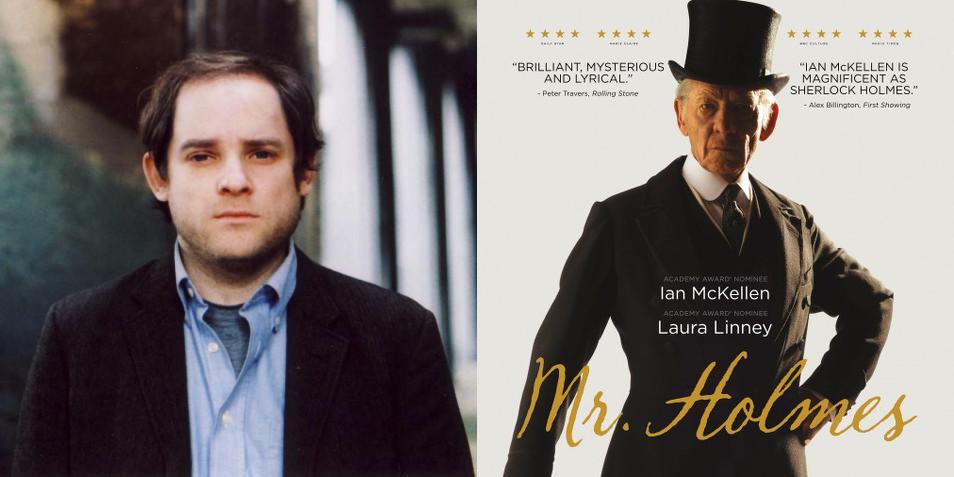
With the difficulty of playing Holmes in mind, but with great love and respect for Sir Ian McKellen, it was with immense interest that I anticipated his turn as the eponymous detective in Bill Condon's Mr. Holmes. The movie, which is based on Mitch Cullin's book A Slight Trick of the Mind, takes place in 1947. Holmes, now 93 and senile, has just returned from Japan, where he was searching for a plant with mentally restorative properties. For some time he has been retired and living on the Sussex coast, where he keeps bees and putters around in his study. Dr. Watson, Mrs. Hudson and his brother Mycroft have all died, leaving him with nobody in the world who really understands him. In their place there is only his housekeeper, Mrs. Munro (Laura Linney), and her 10-year-old son, Roger, played by Milo Parker. For reasons that never became clear to me, Mrs. Munro appears to harbor a deep resentment towards Holmes and his mild prickliness, despite that fact that he has taken a keen interest in young Roger. Though he can't remember why, Holmes is wracked with a sense of guilt surrounding his last case, in 1919, which he did not bring to a satisfactory conclusion. With Roger's encouragement, Holmes works though the story of that fateful case, eventually realizing that logic alone cannot be relied upon and that the unquantifiable intricacies of the heart ought not to be taken lightly.
Mr. Holmes proposes to explore the complexities of human emotion, more than the complexities of a mystery. The problem is that, though the film is beautifully shot and has an undeniable air of elegance, the emotions at play feel broad and are ultimately hard to connect with. When the details of the 1919 case finally come into focus, we flash back to a meeting between Holmes and the woman he let down, when by fixating on facts and reason he missed his chance to do the right thing. This should be the emotional climax of the movie, but everything is so perfectly engineered to be tragically ironic, and to symbolize the great detective's shortcomings, that it feels more like the will of the script being imposed on the characters than like a genuinely truthful moment.
There are a few other smaller mysteries in the film that attempt to capture in miniature the spirit of Conan Doyle, but they never quite added up for me. I got the feeling that each element only existed to comment on Holmes himself, which, though sometimes interesting, made the movie hard to accept as a real reflection on the human condition. I also started, about halfway through, to be troubled by a fundamental difference of opinion between myself and the film's makers on the essence of Holmes. During one of the 1919 flashbacks, Holmes declares that what he needs are facts, not imagination. This sentiment could not be further from Holmes as I see him. For me, his genius lies in combining his deductions from physical evidence and human behavior with a limitless imagination. He is able to imagine what people such as Inspector Lestrade and Dr. Watson, who rely too much on the obvious, cannot. It's not that I don't want to see a revisionist take on the character, it's that in Mr. Holmes I began to feel that I was watching a film about a different character altogether.
Though the writing often felt a little heavy-handed, McKellen's touch was always light. Holmes' relationship with Roger was touching, sincere, and my favorite thing about the movie. Grumpy old men befriending precocious kids can often stray into cloying territory, but both McKellen and Milo Parker kept it loose and natural. I wondered as I was watching if the presence of such a young actor necessitated a different approach on set that led to the script feeling less overbearing during scenes with Roger. Elsewhere McKellen is good, but restrained and without the freakish magnetism that makes Holmes so exciting as a character. I know this is an aged Holmes, a shadow of his former self, but there's something kindly and normal about McKellen that limited the performance's impact for me.
It's possible that I am too used to Jeremy Brett and Benedict Cumberbatch's interpretations of Holmes for me to appreciate other ways of playing the character. But then again, I used to feel that way about Brett alone until Cumberbatch forced his way in. And maybe that's the key. Holmes is an irresistible force of nature, and that's something I need to be made to believe before I can buy into a world where his ineffable spirit is fading away.