



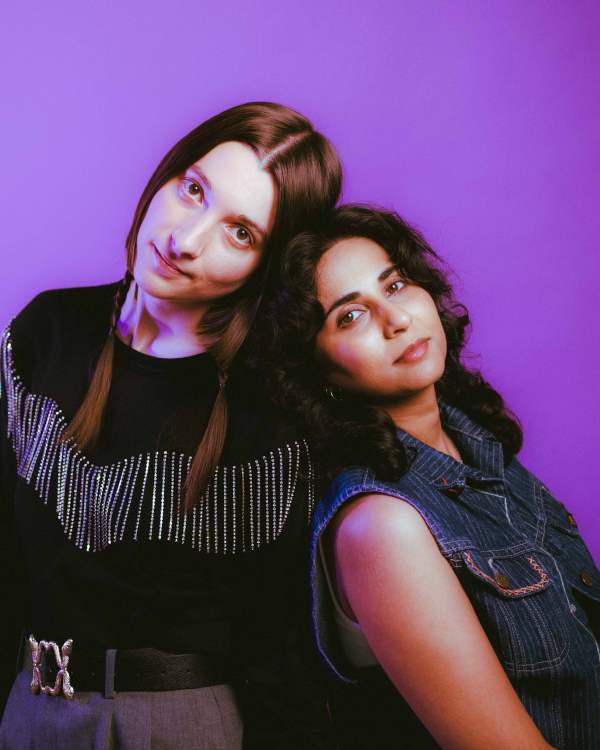
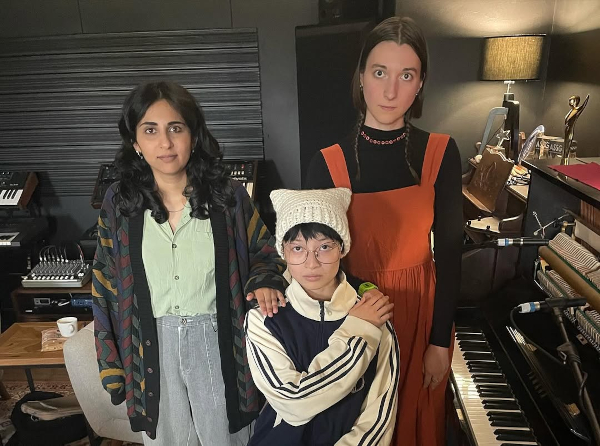
Leela Varghese (she/her) and Emma Hough Hobbs (she/they) are the writer-directors of the new animated film Lesbian Space Princess, which is in theaters from October 31. Leela is an award-winning Australian filmmaker whose short film I’m The Most Racist Person I Know was selected SXSW Austin 2025, having its world premiere in the narrative short competition. She is also known for her work as a musical comedian, television presenter and voice actor. Emma is a queer artist from Adelaide who is a filmmaker, animator and production designer. Their award winning short On Film was in competition at SXSW Sydney 2023. As a props master, they have worked on projects such as A24’s Talk to Me and Gold, starring Zac Efron. (Photo by Kyahm Ross.)
In case you haven’t heard, we (Emma and Leela) wrote and directed an animated queer space opera called Lesbian Space Princess. It was our first ever feature film and our first time working together. We are also a couple. We were one year into our relationship when we decided to embark on this creative endeavor together. Many lesbians get engaged or move in together after a year … but we opted to play life on “hard mode,” I guess.
The origin story of the film is that one time when Emma was having a shower, she had an epiphany via three magical words: “LESBIAN. SPACE. PRINCESS.” She ran out and immediately pitched the title to Leela as a creative project that would perfectly unite our interests/skills as queer filmmakers, one of whom is a musical comedian (Leela) and the other an animator (Emma).
Although Emma initially pictured the titular space princess as a cunt-y, dyke-y badass bitch bounty hunter – like a gay-as-fuck Cowboy Bebop – Leela calmly pointed out that if we were to collaborate, the story would need to have a healthy dose of heart and authenticity. And here lies the birth of Saira, princess of Clitopolis. The basic plot of the film is that anxious space princess Saira must leave the comforts of her home planet for the first time ever to rescue her bounty hunting ex-girlfriend Kiki, who has just been kidnapped and held ransom by the “Straight White Maliens.” The maliens are holding Kiki hostage in the hopes of exchanging her for Saira’s “Royal Labrys,” an elusive weapon that can only be summoned by the Clitopian Royal bloodline. The labrys represents the power of self-love and is actually a real-life lesbian symbol from the 1970s! Side quest: One of the Clitopian royals, Queen Leanne, is a trans woman who can summon her labrys, so none of that TERF-y nonsense applies to the labrys symbol here. We are reclaiming it! Anyways, the maliens, who are basically the future evolution of incels, want the labrys to power their chick magnet, so they can finally get hot women. The only problem with this whole set-up is that Saira has never been able to summon her labrys. So begins Saira’s quest of self-discovery to save Kiki and hopefully win her back in the process.
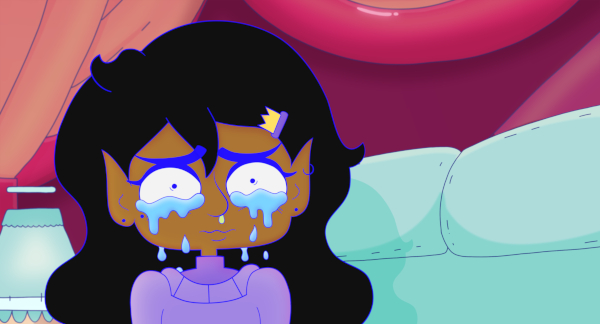
Whew, that was a mouthful! Sorry for the long synopsis, but it’s all-important context as we break down the influences from our lives that shaped Saira’s journey. Saira is not your typical hero: She has pretty intense anxiety, a penchant for saying “sorry” in all circumstances, and a complete lack of self-love. This is the kind of character who could be pretty annoying to watch in an adventure film; just take, for example, everyone’s combined dislike of Shinji Ikari from Neon Genesis Evangelion. However, as Shinji supporters and filmmakers, we firmly believe that today’s queer cinema landscape could do better to reflect real-life queer people and the kinds of day-to-day battles we face. Important to note as well, Saira isn’t just queer, she’s also a woman of color, written to combat some sorely needed queer femme POC representation in animation. Her identity does not define her struggles, though; Saira lives in a futuristic queer feminist utopia where the dynamics of the mainstream vs. the minorities of today are flipped upside down. This is to make room for all of our characters to live and breathe outside of the boxes we might put them in in today’s society.
It’s not like the two of us sit around all day thinking, Oh boy, it’s rough being a lesbian. Instead, we sit around agonizing over an unanswered text message, a potential job offer, whether we accidentally upset a friend by saying the wrong thing, etc. We have both always been in constant states of panic or anxiety and have found various ways of dealing with them. Emma has been seeing a therapist for about six years; she started cognitive behavioral therapy when she realized that being convinced your friends were all pretending to like you and secretly hated you behind your back was not normal thinking, and definitely not conducive to an enjoyable life. Leela’s been seeing a counsellor for four years to help manage her anxiety, starting when a good friend recommended them. She had the impetus to pursue therapy after a few big life events left her really struggling. Leela is one of those people who for a long time didn’t want to admit she needed help, but who now sees how important it is for her mental health to have the support of counselling.
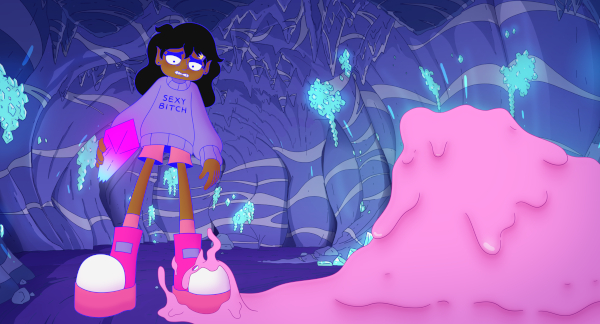
So when it comes to Saira’s character growth and her journey, we wrote the script to incorporate several important lessons she must learn. But obviously, unlike in the film, you can’t fix anxiety in 24 hours with an epic space quest! In one sequence, Saira gets trapped and targeted by pink sentient goo that feeds off bad vibes, and every time she says something negative it gains a stronger hold of her. After this point, we find that the overly apologetic Saira stops using her crutch word, “sorry,” as much as before, showing the way that the language we use can change and reframe our reality and what healthy self-dialogue can look like.
The part of Lesbian Space Princess that was most influenced by therapy and counseling is the “deep headspace” sequence where Saira travels deep into her subconscious and manually complete challenges to create a key (in the shape of the self-love symbol) that can be used to unlock her metaphysical labrys weapon. This scene was very personal to us and we re-wrote, re-storyboarded and even re-edited it many times to perfectly get our feelings across. The challenges Saira must face are things like coping with being excluded from social events, avoiding getting drawn into looping traumatic memories from the past and speaking up for herself. Saira’s all-purpose weapon in these situations? Focusing on her breathing. This is something that took Emma years to practice and understand, but the power of silencing these negative internal experiences through breathing is real and life-changing. When Saira is faced with these negative thought patterns in the rest of the movie, she remembers to breathe and it gives her more strength than the labrys ever will.
The point of Lesbian Space Princess is that Saira should not to vilify anyone, not even the straight white maliens, as pointed as their name might be … Their character arc and Saira’s are actually direct parallels of each other. Saira and the maliens have the same problems: they can’t get the hot chicks, they’re reclusive as a result of not feeling accepted by society, and they don’t have self-love. When Saira’s world is opened up, she is able to connect and empathize with the maliens as a peer, and doesn’t talk down to them. All this to say, at the end of the day, maybe lesbians and incels have more in common than we might imagine? And we hope anyone in the incel community curious enough to hate-watch the movie gives it a chance and learns a thing or two about self-love.
Finally, we just want to say that every part of making our first feature film has been scary and anxiety-inducing. When making a movie, you do it in a bubble, and you don’t know how people will react. Then once it’s out, you must hand it over to the audience and deal with feedback from reviewers and moviegoers. The press and film festival side of releasing Lesbian Space Princess has honestly been very overwhelming. But! Here we are, we’re doing it and we’re anxious about it … Even if it doesn’t look that way from the outside. We say this because, much like Saira, it’s OK to have anxiety and still be the hero of your own story.